Used-car retail giant CarMax is taking a haircut on gross profit per unit to help achieve lower retail prices, and therefore increase sales.
Keith Barr, the company’s new president and CEO, stressed three points about that short-term tactic in reporting CarMax results for the first quarter of fiscal year 2027, which ended May 31:
One, it’s off to a good start. Net revenues for the quarter rose 6.2% from a year ago, to $8.0 billion. Combined retail and wholesale unit sales increased 3.3%, to 392,357 for the quarter. Average gross profit per retail used vehicle was $2,177. That was down almost 10% versus a year ago, but the year-ago quarter was an all-time record, driven by tariff fears.
Two, thinner profits are a short-term tactic, not a long-term strategy. “Our focus is to self-fund more competitive vehicle prices through more efficient operations, rather than a combination of lower GPUs and efficiency gains, as we are doing this year,” Barr said in an earnings conference call June 17.
Three, Barr sketched out a medium- to long-term strategy for achieving efficiency and growth. The four “pillars” of the strategy are “great offering,” customer experience, added value and running lean, Barr said in the conference call. More on those points later.
CarMax CEO is a newcomer
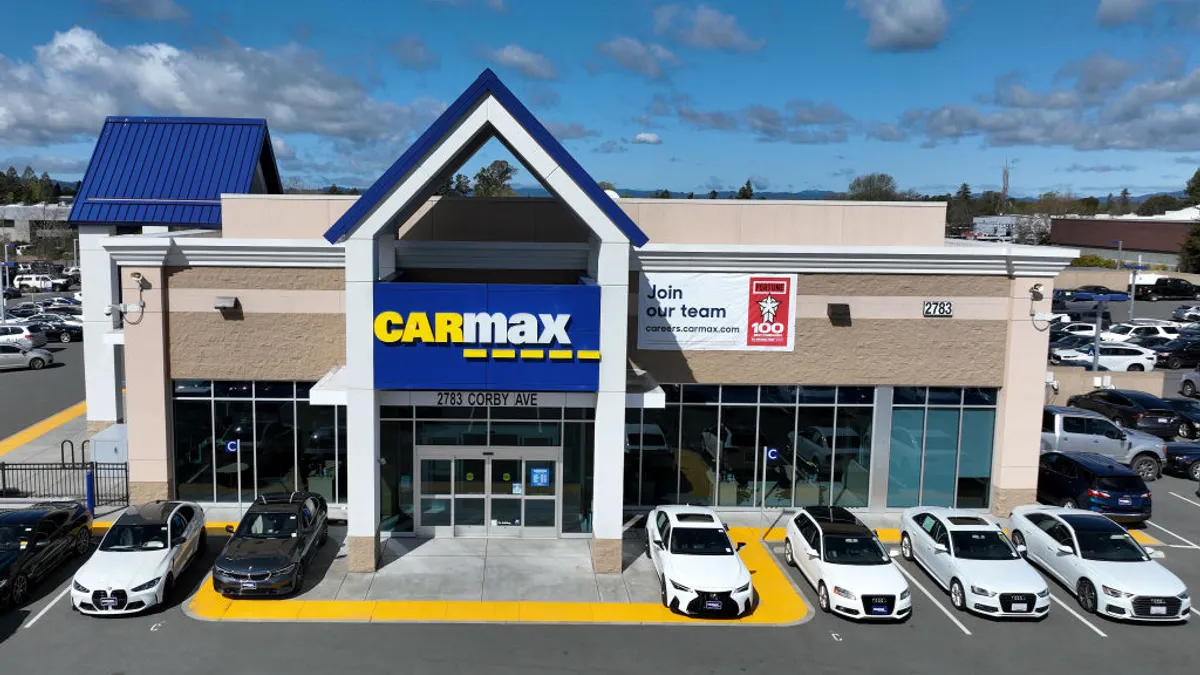
CarMax, based in Richmond, Virginia, has 256 locations in 42 states, the company said in its investor presentation.
The quarter just ended was Barr’s first as president and CEO. CarMax announced his appointment on Feb. 12, effective March 16. Barr was previously CEO of InterContinental Hotels Group, with a career of more than 25 years in the global hospitality industry.
Barr said in the conference call, and in a follow-up phone interview on June 18, that one of his takeaways so far about the auto retail industry is how interconnected all the different business segments are.
For example, Barr has CarMax working to reduce costs and gain efficiency in transporting vehicles. That’s no small matter; Barr said CarMax moves around 2 million cars a year. That includes transfers related to customer orders, and also for internal purposes, such as reconditioning.
Inefficient logistics also affect other business segments, Barr said. “By reducing our cost in logistics, it underpins our ability to then remain competitive in pricing. They’re all interconnected,” he said in the conference call.
Four “pillars”
Here’s a quick rundown of the four “pillars” of the CarMax growth strategy:
Great offering: “We will ensure our pricing remains competitive across demand cycles, while we both grow our saleable inventory and provide customers faster access to our vehicles,” Barr said.
Easy customer experience: Like other auto retailers, CarMax needs to better connect its digital sales channel with in-store customer experiences, Barr said. This should improve the rate at which CarMax converts shoppers to buyers, as well as customer satisfaction.
Added value: CarMax wants to grow long-term profitability in part by having its captive, CarMax Auto Finance, originate more loans. That includes the captive originating a greater share of loans to what CarMax defines as borrowers with Tier 2, or near-prime, credit, instead of referring those borrowers to third-party lenders. CarMax also wants to sell more extended-service contracts.
Run lean: Cost centers that could be run more efficiently include used-vehicle reconditioning and vehicle logistics, as noted earlier, which are accounted for as cost of goods sold. Under selling, general and administrative expenses, Barr said CarMax expects to hit an annual rate of $200 million in cost cuts in 2027, outperforming an earlier estimate of $150 million.
CarMax CFO Enrique Mayor-Mora said in the conference call results so far this fiscal year are encouraging. “You can see the results here in the first quarter because, again, we’re off to a really strong start for the year,” he said.