The players in the automotive industry, from automakers to dealers, often face one problem after another ranging from tariffs to parts shortages that hobble production.
Yet invariably, auto industry people figure it out, said megadealer Rita Case. Growing up in California, she worked at her parents’ Honda of Santa Rosa dealership. She married the late car dealer Rick Case 45 years ago.
Together they expanded the Ft. Lauderdale, Florida-based Rick Case Automotive Group with stores in Florida, Georgia and Ohio. A native of Ohio, Rick Case as a high school student, started selling used cars outside his family home.
Rita Case now heads the dealership group following her husband’s 2020 death of cancer at age 77.
As partners, she oversaw financial, parts and service operations, super-salesman Rick Case naturally had handled sales. It wasn’t uncommon for the duo to work 7-day weeks.
Today, Rick Case Automotive is billed as the largest female-owned and operated automotive dealer group in the U.S.
“The retail-auto industry runs through your blood,” CDK Global CEO Brian MacDonald told Rita Case during an online event highlighting the automotive software and information technology company’s product offerings.
“What makes you, you?” he asks her. She replied: “When you are passionate about the auto industry, this isn’t work. I’ve never ‘worked’ a day in my life.”
She’s a perennial optimist, like most auto dealers. For example, when U.S. auto deliveries dropped from nearly 17 million units to a frightening 10.6 million during the nadir of the 2007 financial crisis, auto dealers didn’t freak out. Their mantra was, “The sales will rise again.” They were right.
MacDonald noted today’s industry is facing its share of challenges. He cited tariffs, vehicle affordability and high interest rates.
Case’s take on it: “This is the way the car business is. I’m not worried at all about tariffs. I don’t think they are settled yet. I do think they are here to stay, probably leveling off at 12% to 15%.”
Right now, imported vehicle parts and content are more vulnerable to tariffs than the built vehicles themselves. That’s because most major international automakers run manufacturing plants in the U.S., avoiding import duties.
MacDonald predicted automakers will “do a bit of de-contenting” to make vehicles more affordable and tariffs less impactful.
“The thing I love about this business is that people in it figure it out,” he said. “Dealers in particular are so entrepreneurial. There will be change in the industry but it’s always changing anyway. We’ll be fine.”
To Case, the car business is doing well despite all that’s coming at it.
“Manufacturers are making great cars,” she said. “They are making a lot of money” as are most dealers. “They’ve just got to make some changes.”
Case noted affordability remains an issue. The average price of a new car was $37,000. Today, it hit $50,000 for the first time ever, according to Cox Automotive.
But, on the upside, Case foresees vehicle residual values increasing too, spurred on, ironically in part, by tariffs and higher prices.
She also noted automotive tariffs are nothing new. Case recalled that in the early 1980s, the U.S. put tariffs on Japanese imported cars because they were making inroads in the American market. Toyota, Honda and Subaru certainly survived that obstacle, she added.
Although, at first, many dealers initially feared the potential effects of the internet on their businesses, Case credited modern technology for taking auto retailing to greater efficiencies.
Those include inventory management, customer-relationship software systems to track customer car-shopping journeys and digital tools that let consumers feel in control of the buying process.
“Technology is the No.1 change in the industry in the last 35 to 50 years,” Case said. “It’s amazing.”
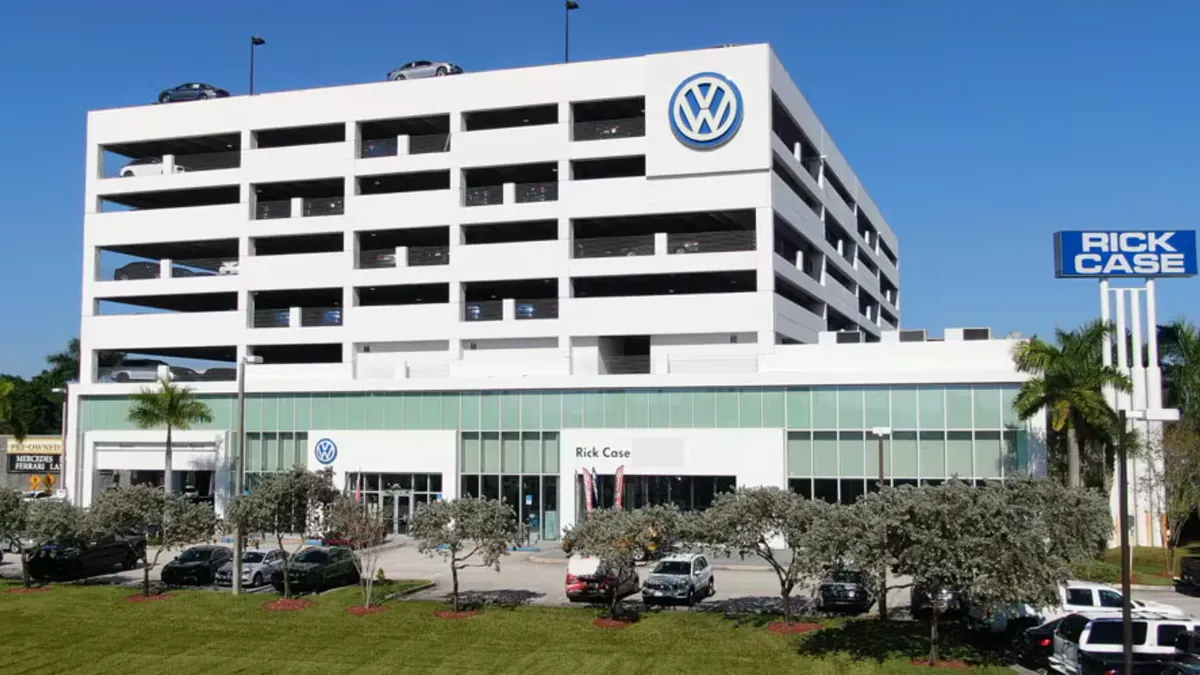
Rick Case Honda was named the nation’s top Honda dealer in 2024. The group’s Hyundai and Kia stores in Florida rank as No.1 in sales. Rick Case Volkswagen last year was named the largest-volume VW dealer in the U.S. for the seventh consecutive year.
How do they do it? “It’s pretty easy to sell cars,” Case said, “when you treat customers as friends, employees as family and community as home.”