Operations: Page
-

 Courtesy of WardsAuto
Like Riding on Air
The heavy duty truck market discovered in the late '80s what "air ride" could do for the comfort and controllability of all manner of trucks. "Air ride" of course, is a euphemism for air springs - replacing conventional coil and/or leaf springs with pneumatically operated "springs."Air spring installations penetrated deeply and quickly into the heavy-duty truck market, but Firestone Industrial Products
By Tim Keenan • Sept. 1, 1999 -
Courtesy of WardsAuto
Lightening Up for the 21st Century
As the century draws to a close, it's remarkable to ponder the advances and evolution in all aspects of society.Influenza, which once claimed as many lives as both world wars, is not the public health threat it once was. Smallpox is on the brink of eradication. American women and minorities won the right to vote. Einstein gave us the theory of relativity. A man walked on the moon.Yet in the face of
By Drew Winter, Tom Murphy • Sept. 1, 1999 -
 Explore the Trendline➔
Courtesy of Toyota
Trendline
Explore the Trendline➔
Courtesy of Toyota
TrendlineAutomotive Manufacturing
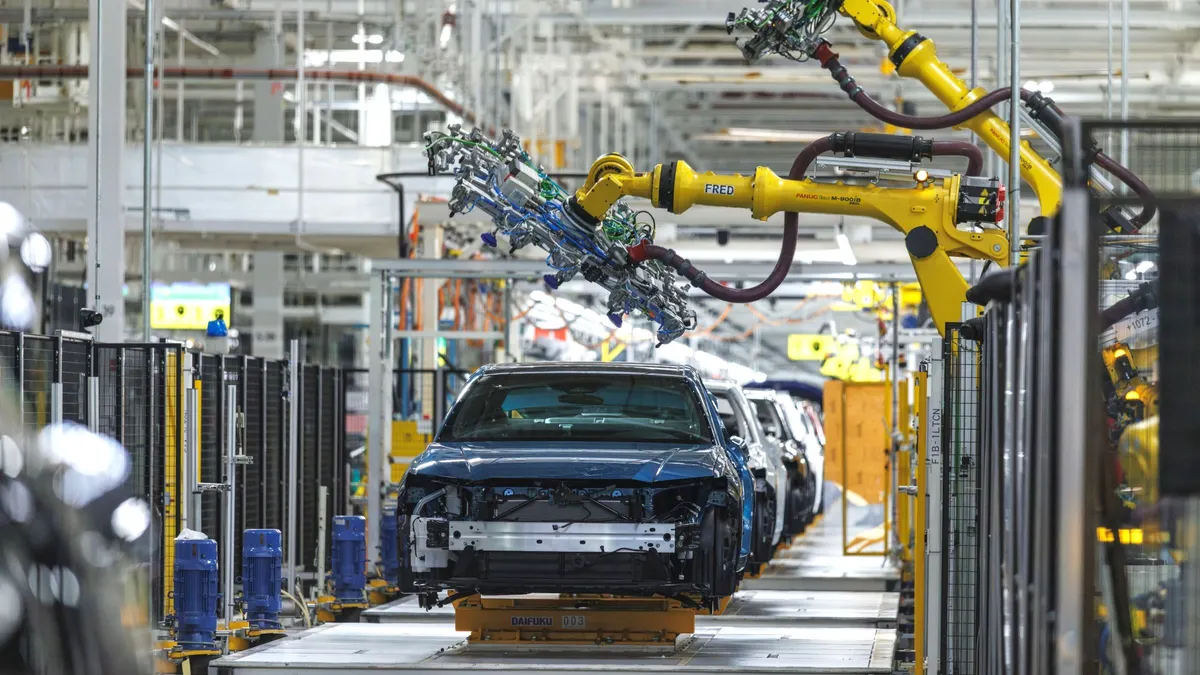
Production strategies are changing rapidly as tariffs and shifts in consumer buying patterns affect the industry.
By WardsAuto staff -
Courtesy of WardsAuto
HALF-TIME Report
Sonic Automotive just acquired stores in two of the fastest-growing markets - southwest Florida and Las Vegas, NV.The acquisitions add impetus to Sonic's new status as the third-largest publicly owned dealership consolidator.But other consolidators have been busy, too, both at making new acquisitions and at making money in the first half of the year.Sonic's gross revenues of $1.3 billion in the first
By Maynard M. Gordon • Sept. 1, 1999 -
Courtesy of WardsAuto
Europe Cools Off -- AC on 60% of new cars, a big jump
Not long ago, those who couldn't take the heat were advised to leave the kitchen. Today, the American response is to simply get air conditioning, in your car, home, office, even your tent, for swanky catered outdoor parties.While the U.S. generally takes some lifestyle cues from Europe, in the realm of air conditioning it's the Americans setting the pace. Some Europeans still resist the trend (and
By Tom Murphy • Sept. 1, 1999 -
Courtesy of WardsAuto
Microsoft CarPoint seminars offer instruction and advice
Want to save tens of thousands of dollars a year in service reminder mailings in this age of the Internet?Simply collect e-mail addresses from customers at every point of contact, says Robert Knight, a trainer for Microsoft's CarPoint customer referral system.He estimates that some stores can save more than $80,000 per year in service reminder mailings if they are done via e-mail.He also advises that
By Tim Keenan • Sept. 1, 1999 -
Courtesy of WardsAuto
Where the (Color) Rubber Meets the Road
There's a building in Greenville, SC, that doesn't have a name on it. How the mailman finds it is anyone's guess. The people who work there carry no business cards.What they do in this building is so secretive that in a prior life they must have been wartime spies willing to chomp arsenic pills in the event they were captured by the enemy.For now, the secret is safe. But its keeper, French tiremaker
By Tom Murphy • Sept. 1, 1999 -
Courtesy of WardsAuto
Push Shouldn’t Come to Shove
Opportunities are meant to be seized upon, but not even David Jac-obson, author of Non-Confrontational Power Selling, could have guessed his part-time DJ job would lead to a career in auto sales.In fact, he was actually apprehensive about moving into auto sales. He had interviewed at a dealership and the sales manager there had completely turned him off to selling cars."He told me how people get burnt
By Stacey Lewis • Sept. 1, 1999 -
Courtesy of WardsAuto
How to figure out what makes your sales people tick
To paraphrase the old saying, "a good salesperson is hard to find." That's why today's smart sales manager does everything he can to keep talented salespeople. But in what really works?The most important thing to realize is that all successful salespeople have one thing in common: they are all competitive, proactive, assertive, aggressive and play to win.They love the risk of commission and asking
By Mary Ruth Austin • Sept. 1, 1999 -
Courtesy of WardsAuto
HOW TO MAXIMIZE VALUE WHEN SELLING
In today's thriving economy, corporate mergers and acquisitions are making headlines.Technology companies, manufacturers and financial institutions are all consolidating, creating entities with critical mass - and the automotive industry is no exception to this trend.Automotive dealerships are rapidly changing hands as aggressive buyers swallow up smaller entities in an effort to dominate a region
By Paul Escobosa • Aug. 1, 1999 -
Courtesy of WardsAuto
NAFTA Success Story--Sanluis Rassini will quadruple its brake sales
Sometimes, large investments pay off handsomely.In the past few years, Mexican supplier Sanluis Rassini has poured $320 million into three new plants in Piedras Negras near the U.S. border and in Mexico City, as well as in a technical center in Plymouth, MI. The investments nearly matched the company's 1998 sales, which totaled $381 million.Part of the strategy was to cultivate Rassini's recent foray
By Tom Murphy • Aug. 1, 1999 -
Courtesy of WardsAuto
Customer satisfaction not all there is
While customer satisfaction is necessary to any success business, we are learning that satisfaction alone is not enough to build a loyal customer base.Since the 1980's customer satisfaction has been the watchword for business. Everyone was rushing around to find ways to make customers happy by meeting and exceeding their expectations.The theory was that if customers were satisfied, they would buy
By Steve Walker • Aug. 1, 1999 -
Courtesy of WardsAuto
Timken’s 100 Years:From buggies to Boxsters
Say "Timken" and you might just as well say "bearings." Henry Timken invented the tapered roller bearing, various examples of which can be found in virtually any and every vehicle. The Timken Co. celebrates its 100th anniversary this year.At 61, Mr. Timken came out of five years of retirement from making buggy springs to concentrate on the problem of friction. He often said, "The man who could devise
Aug. 1, 1999 -
Courtesy of WardsAuto
Proposed New York dealership training center is in the works
NEW YORK, NY - Nowhere is the need for a dealership training facility more acute than in the Northeast, say members of the Greater New York Automobile Dealers Association.Accordingly, the association wants to build a 90,000-sq.-ft. training and education center for prospective dealership employees and existing staff. Those include service technicians, sales people and office workers.The proposed center
By Steve Finlay • Aug. 1, 1999 -
Courtesy of WardsAuto
Are you Red, Blue, Green or Yellow?
Management By Strengths (MBS) is a program specifically designed to help companies increase productivity, improve customer satisfaction and employee morale, and create better communication through an improved understanding of how to work together more efficiently.The skills learned in the MBS program on ASTN enhance team building throughout an organization.MBS starts by analyzing surveys and creating
By Mike Postlewait • Aug. 1, 1999 -
Courtesy of WardsAuto
AUTONATION WANTS NEW CO-CEO WITH STRONG AUTO INDUSTRY BACKGROUND
Steven R. Berrard will step down as co-CEO of AutoNation Inc.Mr. Berrard, 44, says he'll devote full time to his New River Capital Partners venture-capital company. But he will remain an AutoNation director.The firm is looking for a successor, a leader with a strong auto-industry background. Mr. Berrard says he'll stay on until his replacement is named. The executive recruiting firm, Korn/Ferry International,
Aug. 1, 1999 -
Courtesy of WardsAuto
Saab Finds its Stride with Luxury Wagon
DEL MAR, CA - Saab Cars USA had hoped its 1999 9-5 wagon would be a hit among car buyers looking at the luxury station wagon segment, and apparently the company's hopes are ringing true.The new wagon, which went on sale in April, is expected to help Saab grab at least 6.3% of the 60,000-unit luxury wagon segment expected for the U.S. this year. In 1998, about 48,000 import luxury sport wagons were
By Andrea Wielgat • July 1, 1999 -
Courtesy of WardsAuto
Labs ‘Demystifying’ Ceramics Manufacturing
The Department of Energy's Sandia National Laboratories, five commercial ceramic manufacturers, and Los Alamos National Laboratory are studying methods to bring true "science" into ceramics production in an effort to create better products and slash costs."We are demystifying ceramics manufacturing," says Sandia scientist Kevin Ewsuk, who is spearheading the project. "In the past, new ceramic component
By Bill Visnic • June 1, 1999 -
Courtesy of WardsAuto
Emissions Rules Up in the Air EPA, automakers forge ahead despite court ruling
federal appeals court threw in a monkey wrench at the eleventh hour, but for now the Environmental Protection Agency and automa-kers appear to be proceeding according to plan in dealing with proposed new Tier 2 vehicle pollution standards. As they are written now, the new rules will force automakers to sharply cut tailpipe emissions and oil refiners to produce much cleaner fuels beginning in 2004.Under
By DREW WINTER and DAVE ZOIA • June 1, 1999 -
Courtesy of WardsAuto
The Velvet TouchMeat axe approach rarely works in mergers
It seems like everyday you pick up a newspaper you read about companies merging, one company buying out another, or selling or spinning off various parts of their business.I read somewhere that more than 60% of these mergers, buyouts, and such end up in failure. I'm sure that this figure is somewhat inflated because there are situations where one company buys out another company that's a "basket case"
By STEPHAN SHARF • March 1, 1999 -
Courtesy of WardsAuto
The Greatest Show on Earth Detroit extravaganza is the best I’ve seen
Many of you reading this slogged through the ice to the Detroit auto show and saw that amazing display of new and future models. I'm writing this as the show opens. It will be long closed when you read it.We've got short deadlines in this monthly magazine. But I want to write about this show, anyway. It's that important.This was the best auto show I've ever seen, and I've been from Frankfurt to Birmingham
By Jerry Flint • Feb. 1, 1999 -
Courtesy of WardsAuto
A Sardine Story There’s more to it than just buying and selling
There are industries such as computers, restaurants, gambling and maybe a couple of others where you can start with an idea and create an empire.But when it comes to manufacturing, it doesn't seem to happen anymore. Creating innovative products for consumers has been replaced with creative financial manipulation to increase stock prices.It's apparent that if you want to be a successful producer in
By STEPHAN SHARF • Feb. 1, 1999 -
Courtesy of WardsAuto
Connolly Leather Fights Back You don’t have to buy a Rolls anymore to get it
LONDON - Anthony Hussey is a funny guy. With his British accent and a gentleman's charm, he is always ready with a witty phrase. For instance: "We don't really have a family tree - it's more like a family bramble."When his family business, the renowned U.K.-based Connolly Leather, was struggling with the concept of JIT (just-in-time) delivery, he came up with the term "NQIT," for "not quite in time."Here's
By Tom Murphy • Feb. 1, 1999 -
Courtesy of WardsAuto
Wagons Ho! Young designers rediscover the station wagon
You were young once, remember? You were a little wild. You were going to live your own life, different from everyone else. You would travel the world, write the Great American Novel, date a movie star. Live fast. Die young. Leave a beautiful corpse.And you would never, ever drive a station wagon, the ultimate symbol of throwing away all the dreams of your youth to become a boring middle-class suburbanite
By DREW WINTER and BILL VISNIC • Feb. 1, 1999 -
Courtesy of WardsAuto
The Car Biz’s Real Y2K Problem
Thinking about the cars of the "new millennium" used to seem like an academic exercise - but now it's an immediate concern.In a few weeks the North American International Auto Show will open in Detroit and we'll be hip deep in . . . exactly what model year vehicles? How to "designate" 2000 models is the first question to be settled.When car-company personnel are pressed to guess what the cars of the
Dec. 1, 1998 -
Courtesy of WardsAuto
Mitsubishi: ‘Time of Real Change’Trouble at home drives U.S. reorganization
Mitsubishi Motors Corp., in a recently announced global restructuring, will cut 1,000 jobs, or 22% of its 5,400-person U.S. workforce over the next three years. Most cuts will come through attrition, company officials say, but layoffs will affect hourly workers and executives.Plans call for shrinking the 1,200-person sales division to 1,000, while 700 jobs will be eliminated at the company's Normal,
By Barbara McClellan • Dec. 1, 1998
 Previous