Editor’s note: This is a reported column, in which Steve Finlay periodically explores the relationship between automakers and dealers for WardsAuto.
Nine years ago, Bob Gritzinger drove a Chevrolet Bolt EV from his home outside Detroit to Traverse City, Michigan, about 230 miles away. It became an EV road-trip challenge. An ice cream shop saved the day.
His car’s battery range was short of his destination. So, he needed to recharge a bit somewhere. He used an app to learn where regional public chargers were. But the app didn’t say which ones worked.
Many didn’t, as Gritzinger, a former WardsAuto colleague of mine, discovered.
But he found a spot with a functioning Level 2 charger. Of all places, it was at a Dairy Queen in Grayling, Michigan.
“The cord was lying in the grass behind the building, but it worked,” said Gritzinger. “I had a hamburger and milk shake while waiting.”
That was then. Today the public charging network is much better, if not perfect, but there are a number of charging-station choices on the way to Traverse City.
Even though EV vehicle sales are in a slump (largely due to the end of federal tax credits last year), public EV charger installations are on a hitting streak. That’s because of an ambitious industry push to install more public chargers in the U.S.
As of August, according to the Alternative Fuels Data Center, the U.S. had more than 80,000 public EV charging station locations and over 250,000 individual charging ports. Thousands of new ports are being added each quarter.
It may seem counterintuitive to install more public chargers when EV deliveries are soft. But many in the industry say more chargers will yield more EV sales.
After all, car shoppers’ main reason for passing on buying an EV is charger availability, according to JD Power.
While many EV buyers install home chargers — typically a 240V Level 2 — apartment dwellers and others often lack on-premises charger access. Public charging is for them. It’s also a must for road trippers.
“We need to grow the public-charging infrastructure so consumers feel confident,” Brent Gruber, JD Power’s executive director of EV solutions, told me.
The type of charger matters too, as there are three types of chargers:
- Level 1 uses a standard 120V household outlet. That provides roughly 3 to 5 miles of range per hour. So, sit back, relax and maybe crack open a copy of “War and Peace” while waiting.
- Level 2 ups the voltage to 240V, the kind that powers home washers and dryers. It provides 25–40 miles of range per hour — or, perhaps, a full charge overnight.
- Level 3 direct current (DC) can do the job in less than an hour.
Building America’s public charging infrastructure remains a work in progress, but across the industry, coalitions to expand charging availability continue to be formed.
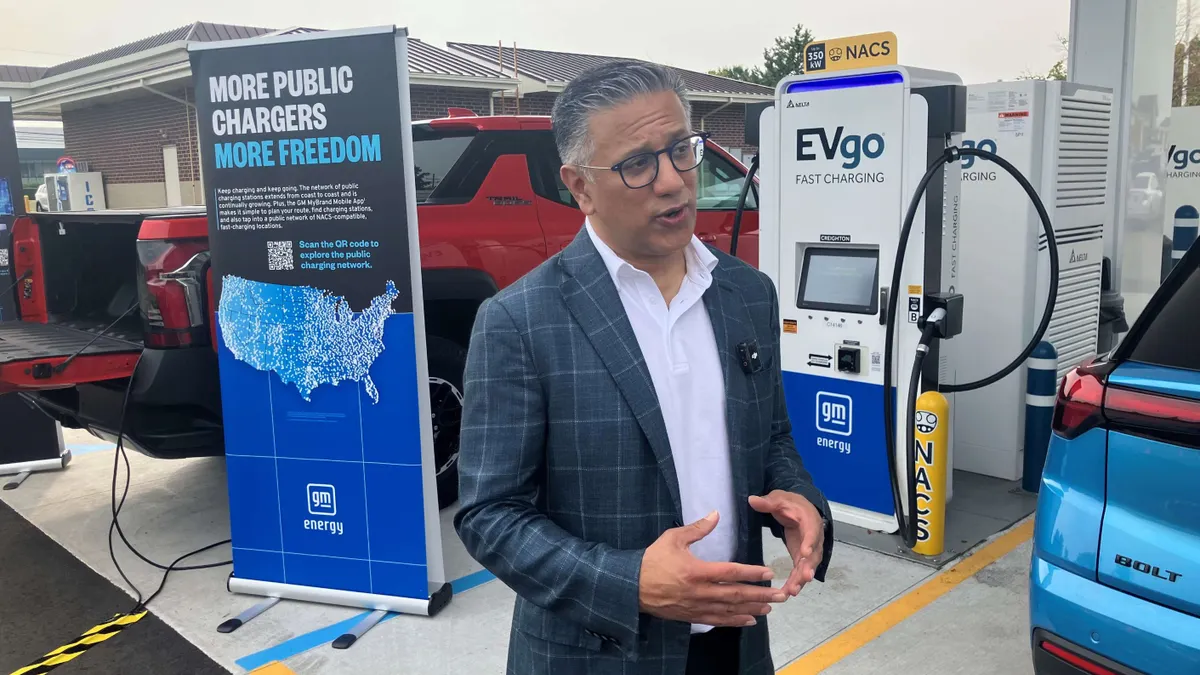
“The flywheel is in motion,” Will Hotchkiss, head of public charging at General Motors, told me at a charging station opening in Michigan in August, which coincided with an an Automotive Press Association event. But like any technology, Hotchkiss added, “there’s always a ramp curve.”
The event was to celebrate a new EVgo station opening at a Meijer, and built in partnership with GM. The charging station is considered a “flagship” location for EVgo because of its high-power chargers, size, and its access to amenities like shopping, dining and grocery while charging occurs.
Featured at one end of the Meijer parking lot were EVgo’s latest high-speed chargers, increasing the number of charging stalls there from five to 15.
More chargers will help — but vehicle cost needs to come down
EVgo CEO Badar Kahn said at the event his company plans to add thousands more stalls by 2030.
But will more public charging stations spur EV sales?
“Absolutely,” he responded. “Two top-of-mind considerations for people thinking about buying an EV are the price of the vehicle and where to charge it.”
While the charging part is important, most people who consider buying an EV but ultimately don’t, cite the sticker price as the No.1 reason, said Kevin Roberts, director of economic and market intelligence for CarGurus, an online automotive marketplace.
“Even if we had more EV chargers, consumers won’t flock to EVs at their current price points,” he told me. “Consumers are looking for more affordable options.”
Hybrid vehicles with combined gasoline-electric propulsion systems have become a popular alternative to all-electric.
“We’re starting to see the demand that everyone expected for non-internal combustion engines, but one of the biggest headwinds facing EVs now is that consumers really seem to like hybrids,” Roberts said.
User satisfaction has rated highest for DC chargers at hotels, gas stations/convenience stores and restaurants, while car dealerships score significantly lower, according to JD Power polling.
Andrew DiFeo, general manager of Hyundai of St. Augustine in Florida said his dealership has onsite Level 2 and 3 chargers. But people aren’t lined up to use them.
“It’s pretty much a convenience for customers, however our charging station isn’t something I think about daily.”
Yet is a well-functioning, widespread fast-charging network necessary for an EV breakout?
“I would say yes,” said DiFeo. “The charging infrastructure has to be there for mass adoption of EVs, whatever percentage that will be,”
Right now, it’s tough for automakers to try to figure out how many EVs to build — and when — as that market fluctuates, he noted. “I don’t envy manufacturers who must go back and forth with production to meet where demand is. It’s tricky, pricey and time-consuming.”