


Dive Brief:
- The California-based EV maker Lucid Group, in a second-quarter financial update with investors, outlined an “operating reset” focused around cutting costs for a $1.4 billion cash flow improvement and an accelerated path to profitability. Lucid ended the quarter with $3.0 billion in total liquidity and said it has “sufficient liquidity runway well into 2027.”
- Lucid confirmed the delay of the Cosmos, its first model on a new midsize platform, which was originally set to be revealed this summer and launch before the end of 2026. The company indicated production will now scale up in the second half of 2027.
- A “sportier” version of the Gravity SUV is due to be revealed at Monterey Car Week in August, the automaker also confirmed.
Dive Insight:
What would have been a Q2 earnings update on Tuesday instead took on the form of confessional, as the California EV maker owned up to what it sees as some realities: It hasn’t executed consistently, it’s been underinvested in service, the ownership experience has come up short and it’s responded too slowly to quality issues.
So Lucid is getting back to the basics with a foundational change, in the form of an operational reset, and by freeing up $1.4 billion by year end on what it calls a “cash flow improvement plan” that aims to carry a lower level of working capital by reeling in inventory, cutting about $500 million in capital expenditures and reducing operating expenses by about $200 million.
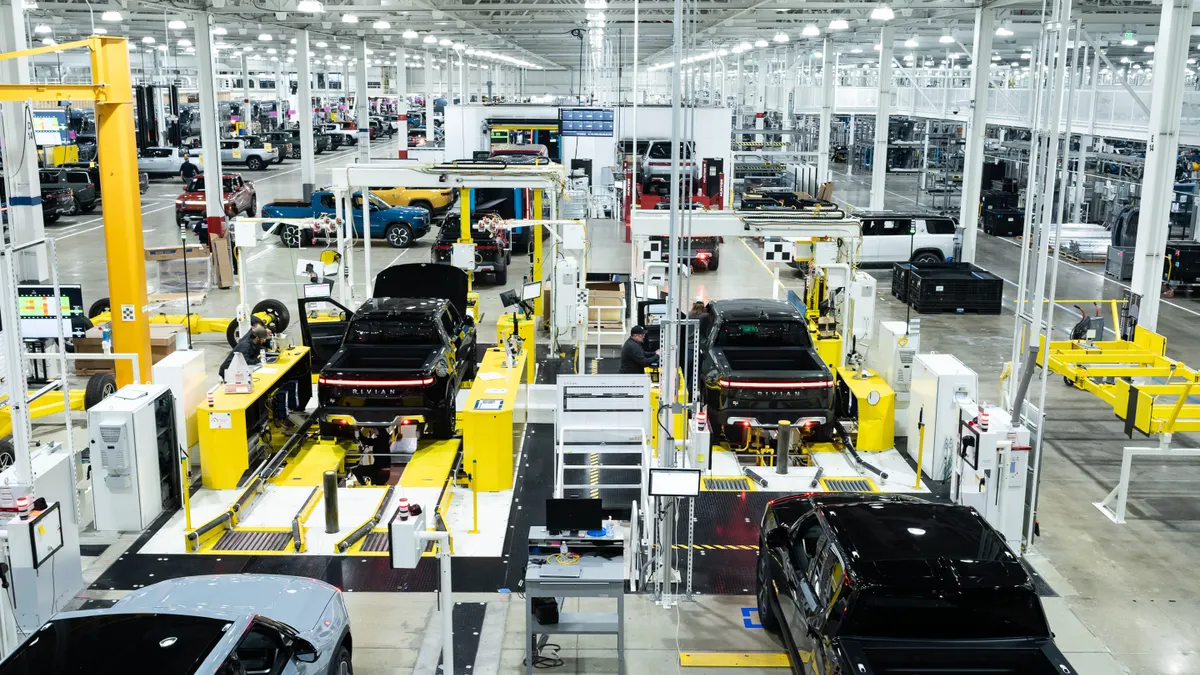
Among the initial changes related to the plan: It’s eliminated a second shift at its Arizona AMP-1 plant in Casa Grande, Arizona, that builds the Air sedan and Gravity SUV.
In Q2, Lucid produced just 4,774 vehicles at the factory, which currently has a capacity of 90,000 vehicles per year, and it delivered just 3,953. Those numbers are up 24% and 19%, respectively, versus Q2 2025, when Lucid was starting to pick up the pace of Gravity deliveries. It expects production numbers to go down through the year as deliveries rise, in this push for what CFO Taoufiq Boussaid described as a “normalized inventory level.”
Lucid emphasized that it deliberately lowered production during Q2 to better match the market, stabilize the business and accelerate the path to profitability.
Lucid has also made some significant workforce reductions. Initially it made a 12% reduction in February, then announced in June that it was laying off 18% of its hourly and salaried employees. The second round, related to the cost-cutting plan, frees up $158 million in annualized savings, according to Lucid.
The update represents the initial actions of a new executive team. On July 2, Lucid confirmed sweeping leadership changes — essentially a replacement of its entire C-suite — as sales continued to falter.
Amid these changes, Lucid has no full-year guidance for 2026, although it said it will provide it for 2027 in its 2026 year-end results.
“Our responsibility now is to build a disciplined operating model that converts those strengths into consistent performance,” said CEO Silvio Napoli. “We expect to be judged by the results.”
Napoli also indicated that the company has some messaging work to do as part of what he termed a “brand audit.”
“Today, our brand is very strong, but I think it is fair to say that the approach, the understanding of the brand, is not consistent across every sector, every market, and I'm going to say even internally within the company in the sense of how people see it,” said Napoli.
Lucid noted that its Robotaxi program has started deliveries of Gravity Production-Validation vehicles. Those are being tested by Uber and Nuro in the San Francisco Bay Area and in Houston. That project, which now involves a commitment to purchase at least 35,000 vehicles, will start ramping in January.
Napoli also revealed that a “sportier” version of the Gravity SUV will make its debut at Monterey Car Week. At present, the performance flagship of the Lucid lineup is the 1,234-hp Lucid Air Sapphire.
Lucid is still planning for production of its midsize models to start first at its Saudi Arabia facility, termed AMP-2. Meanwhile, the company reports that prototypes of its midsize models and their corresponding Atlas drive units are being built on a pilot line and “progressing through validation and production readiness activities” at its facility in Coolidge, Arizona, formerly occupied by trucking startup Nikola Corp.
“Our objective is clear,” said Napoli, addressing the delay of these models, to be led by the Lucid Cosmos, which is now in advanced crash, cold-weather and durability testing. “Midsize will launch only when every process and quality requirement has been met.
“We will not repeat the mistakes of the past by bringing a product to market before it is ready,” he added.