PLYMOUTH, MI — Semiconductor-specialist NXP’s CoreRide computing platform, aimed at dodging some of the complexities automakers face in designing their next-generation software-defined vehicle architectures, will see its first production application in 2028, executives revealed here at a wide-ranging backgrounder for media and analysts.
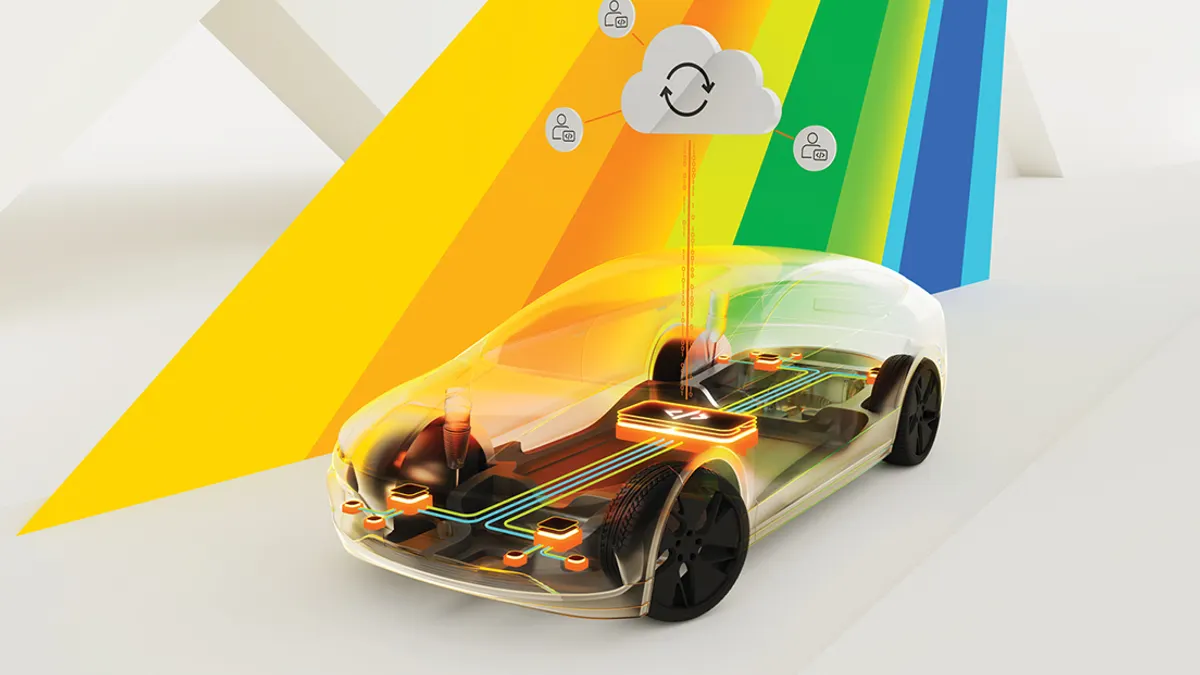
CoreRide was introduced last year and continues to evolve. Formulated around NXP’s S32 processor family (MCUs & MPUs), the platform is designed to serve as a plug-and-play computer-network core automakers can build upon as they develop and seek to differentiate their vehicles in the market.
The platform serves as a ready-to-go vehicle-chassis nerve center in which automakers, with or without the help of Tier 1 suppliers, can layer in their choice of software-driven features and other performance applications, potentially speeding product-development time and cutting costs.
Since its introduction, NXP has been moving to add even more flexibility to CoreRide, unleashing a Gen 2 design, powered by NXP’s S32K5 processor, that accommodates the recent industry movement away from domain-based architectures.
Currently, computers and controllers are dedicated to a handful of core functions such as ADAS and infotainment. The new trend is for zonal architectures that place more multifaceted computing and controls around various sections of the vehicle.
A third generation of CoreRide, based on an S32N processor, is also expected and will feature high-powered centralized computing. It is targeted for availability in 2027-2028.
Seemingly seconding the semiconductor maker’s view of where the industry is headed, General Motors announced in late October it was working on a new centralized computing platform planned for rollout on its Cadillac Escalade IQ battery-electric vehicle in 2028, calling the new architecture a “foundational piece” of its plan to boost the capabilities of its vehicles, according to a CNBC report.
NXP does not say which automaker will be first with CoreRide on a production vehicle or detail the targeted vehicle’s specific SDV architecture. But Paul Lee, senior director-Systems Solutions and Ecosystems Management, said the product is drawing global interest as automakers begin to sort through the complexities of SDVs and determine what’s best to engineer in-house and what can be purchased off the shelf.
Lee said Chinese automakers are leading the industry with new-vehicle development times of 12-18 months, leaving legacy OEMs scrambling to compete. This is a market dynamic NXP executives see as ripe for success with systems such as CoreRide that would ease some of that engineering burden.
“If (an OEM) does all (its own) software and hardware, the complexity gets higher,” Lee noted. “Automakers are realizing they have to simplify.”
Although well underway, NXP executives admit the movement to SDVs has been slowed by unexpected complications and shifting strategies.
“There is a wide range of approaches (to SDV architectures),” said Jan-Philipp Gehrmann, vice president-Automotive Systems Engineering and Marketing, “and some are better than others. The (SDV’s) core platform needs to have connectivity and alignment across all (vehicle) domains. That’s where the complexity is for OEMs.
“What do OEMs need?” he added. “One modular platform that they can scale and that’s what NXP is working on.”
As automakers have dithered with their SDV strategies, suppliers have been squeezed in the process and semiconductor providers, facing long lead times in chip R&D and manufacturing, have had to place bets on which direction the industry might be headed. CoreRide’s ability to fit into any architectural design is NXP’s answer to the dilemma.
“We need to anticipate the carmakers’ needs faster,” Gehrmann said. “That’s the challenge we see.”
Opting for the CoreRide platform can improve an automaker’s engineering efficiency 25%-30%, NXP claimed, potentially cutting new-vehicle development time to two years. And because it is an open platform, CoreRide can provide a pathway to a much larger ecosystem of applications providers, the supplier contended, meaning automakers will have more opportunity to surprise and delight their customers with emerging new features.
Moving to an SDV architecture requires OEMs to either “build up their (engineering) competence or look for players that have the competence,” Gehrmann concluded. NXP is counting heavily on the latter.