

A British thermal management specialist is claiming a breakthrough in automotive battery-pack cooling and heating by slashing fast-charging times for electric vehicles, typically from 30 minutes to just 10 minutes.
The system is also claimed to offer significant improvements in battery range, life and safety.
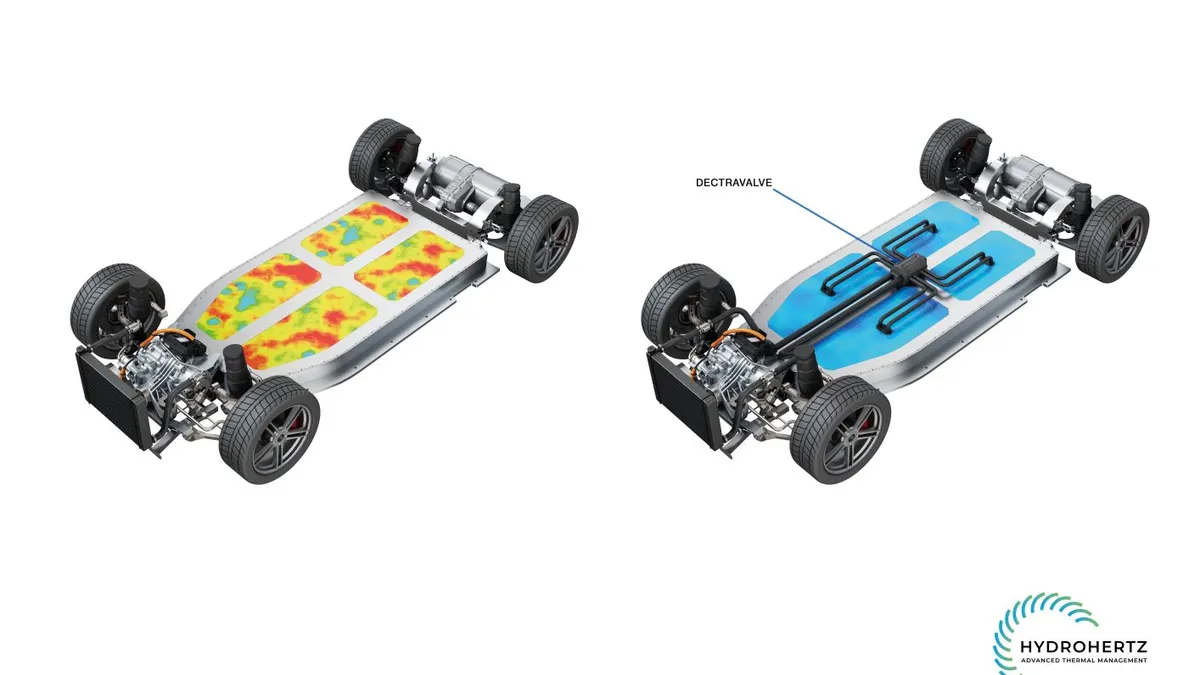
The company, Hydrohertz, has patented its Dectravalve system that claims to provide a compact, intelligent, multi-zone valve cooling solution boasting precise heating, cooling and energy recovery for an EV battery.
“Optimizing the operating temperature of an EV battery is crucial to both its short- and long-term performance,” said Hydrohertz CTO Martyn Talbot and founder in a company release emailed to WardsAuto. “Unlike traditional systems which treat the entire pack uniformly, the Dectravalve allows for targeted heating or cooling of individual modules within the battery. This means it can keep every part of the battery pack at a consistent, optimum temperature, maximizing the performance of the cells across the entire pack.”
The company claims its system has been put through its ultra-fast charging paces by leading independent battery experts Warwick Manufacturing Group (WMG).
In tests a 100kWh lithium iron phosphate EV battery equipped with Dectravalve kept its hottest cell at under 44.5°C, maintaining a temperature difference of only 2.6°C across the whole pack.
This compares to typical fast-charging conditions in today’s EVs, where peak cell temperatures regularly rise to as much as 56°C and the temperature difference across the pack can exceed 12°C.
According to the company, once cells go beyond 50°C, charging power must be throttled to avoiding internal damage to battery cells, known as lithium plating, and long-term damage to the pack, causing charging rates to be reduced and increasing the overall charging time.
In tests, Dectravalve cut charging times by up to 68% when using a 350kW fast charger, putting EV charging on a par with an internal combustion engine vehicle’s refueling time.
Hydrohertz also claimed the system’s overall management performance also increases vehicle range by up to 10% and reduces the risk of battery overheating and fires.
“What makes this genuinely breakthrough technology is the precision it delivers,” said Talbot. “We've essentially created a thermal management system which thinks and responds as quickly as possible – and one that is completely agnostic to cell chemistry too.”