Dive Brief:
- Ford Motor Co. has unveiled a new in-house-built computer that will serve as the “brain” of its future software-defined vehicles, the company announced in a Jan. 7 blog post.
- The high-performance module bundles the management of vehicle infotainment, advanced driver assistance systems, audio and network processing into a single, compact housing that costs 10% to 15% less per unit to produce.
- The company says the goal of developing a custom-built processor is to "democratize" advanced vehicle technology that’s typically offered in luxury and high-end models and make it accessible to more Ford customers.
Dive Insight:
Many OEMs source hardware and semiconductors from electronics suppliers such as Nvidia, NXP Semiconductors, Bosch, Continental and others due to their complexity and specialized manufacturing requirements. But Ford is taking a strategic vertical integration approach to ensure that it controls the entire vehicle’s hardware and software stack in the future, which will eventually expand to the automaker’s entire portfolio, per the release.
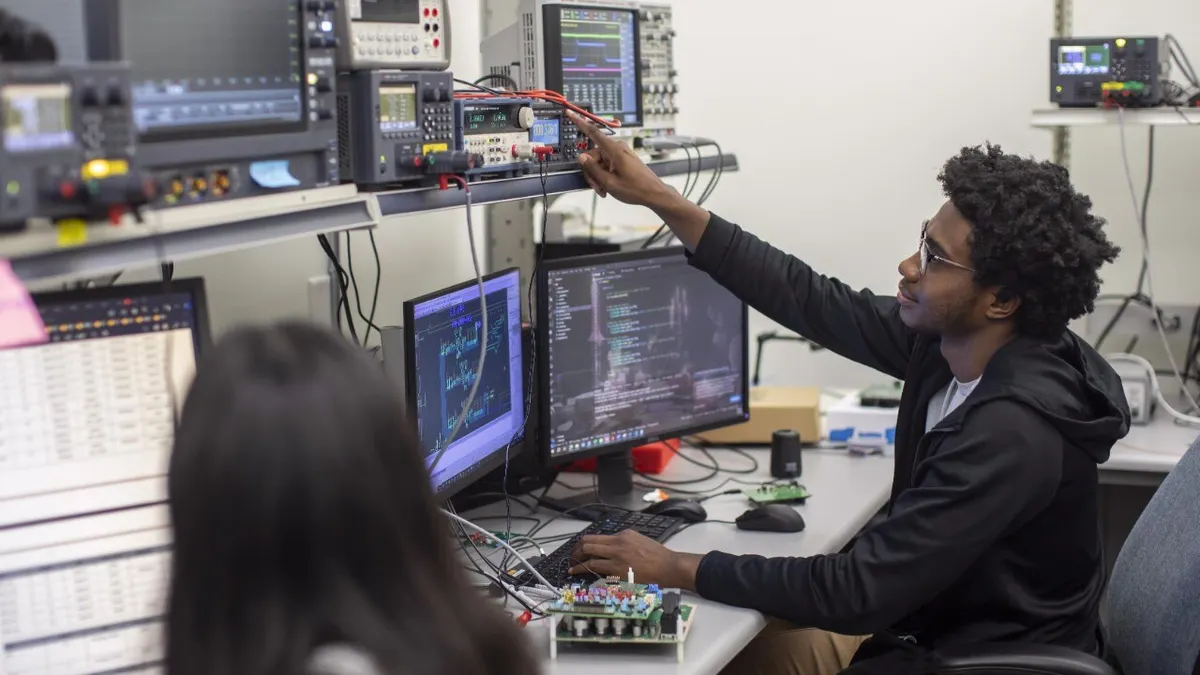
Ford’s new vehicle computer, which is around half the size of its current processors, was developed by a team that included engineers from the mobile phone industry.
By bundling the control of various vehicle systems via a single processor, Ford said it was able to significantly reduce complexity and boost flexibility for adding new software-based features to vehicles, including automated driving capabilities.
The computer will underpin Ford’s new Universal Electric Vehicle architecture, which provides Ford engineers with five times more control over the critical semiconductors, per the release. The automaker’s new EV platform also uses 20% fewer parts than a typical vehicle, including 25% fewer fasteners that results in 15% faster assembly time, according to the company,
Ford said its in-house electronics team is helping to drive exceptional hardware performance that delivers superior reliability and a high level of functional safety. The team has already produced 35 million modules for the automaker that outperform engineering standards, per the release.
Along with Ford, General Motors announced last year plans to adopt a new centralized computing platform and software-based vehicle architecture beginning in 2028. Similar to Ford's approach, GM’s new architecture will bundle all of a vehicle’s core systems, including powertrain, steering, infotainment and safety, using a single, high-speed processor.