

Dive Brief:
- Toyota is developing a next-generation hybrid powertrain combining a new family of 1.5-liter 4-cylinder engines with lighter and more compact electric motors, power control units and inverters — and targeting a 15% improvement in fuel economy — according to a release from Toyota Motor Europe.
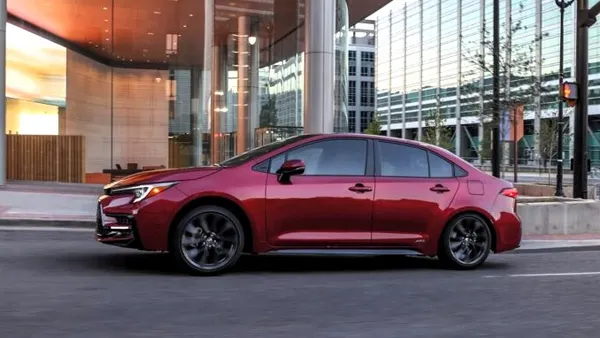
- The next generation hybrid powertrain will potentially cover cars the size of the Corolla, Prius and others. It’s being conceived for Toyota’s common Multi-Pathway architecture that will allow the company’s manufacturing operations to fine-tune the product mix depending on demand and market needs.
- “While knowledge and resources are shared across Toyota globally, we are unable to confirm whether, or when, this next-generation system would be available in the U.S.,” said a Toyota Motor North America spokesperson to WardsAuto, via email.
Dive Insight:
The new modular engines, set to be used with the hybrid system in naturally aspirated or turbocharged form, “were designed for electrification from the start,” according to Toyota, and are themselves downsized, and notably lower, permitting lower hoodlines. The non-turbo version will cover future versions of hybrids currently using the 1.8-liter engine — which in the U.S. includes the Corolla and the Prius.
The fuel economy gains are the result of lower mechanical friction, improved thermal management and reduced electrical losses, along with the lower aerodynamic drag enabled by the lower profile, Toyota explained in the release.
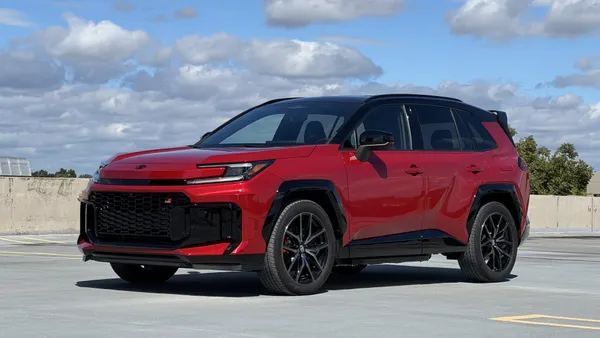
While current and previous Toyota models — like the 2026 RAV4 lineup — do have slightly less cargo space and cabin versatility than their hybrid counterparts, Toyota suggests that this new-generation hybrid system may enable packaging to be the same.
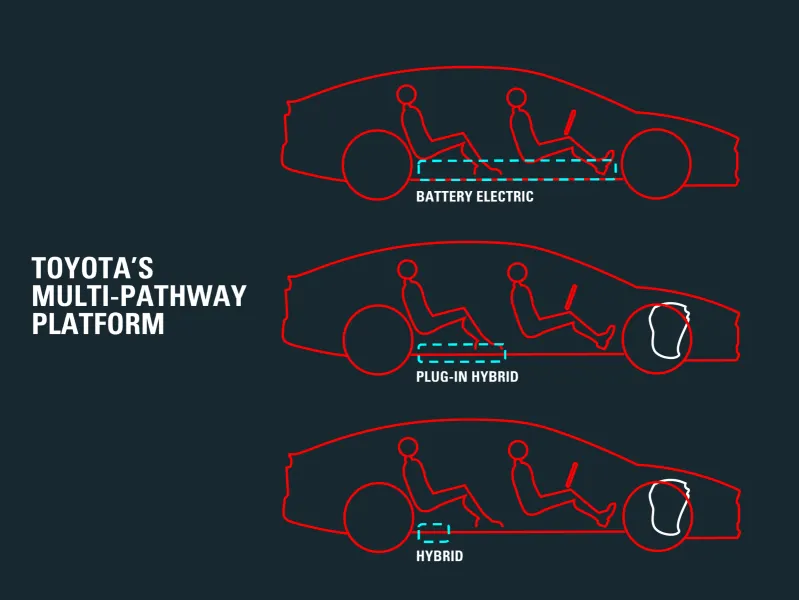
“Hybrid and plug-in hybrid powertrains can be integrated into the same basic architecture without affecting vehicle silhouette, interior space or vehicle capability,” explained Toyota in the release, also noting that its Multi-Pathway approach won’t compromise the performance of fully electric vehicles.
While some automakers, including Nissan with its e-Power system in the Rogue Hybrid, see series hybrids as the key to achieving economies of scale, Toyota’s approach shows a commitment to balancing its future product mix with electrification and internal combustion engine models.
“This extends the contribution that combustion-based electrified vehicles can make to reducing emissions while battery-electric and fuel cell electric technologies continue to expand,” summed Toyota Motor Europe.
Furthermore, Toyota noted that it is aiming to increasingly sell its hybrid system to other automakers in coming years — and it’s developing the system to run on renewable and carbon-neutral fuels.