PLYMOUTH, Mich. — Emerging battery-management-system technology could make electric-vehicle batteries safer, boost their performance capability, extend their range and, some believe, maybe even become a market differentiator for soon-to-be first movers.
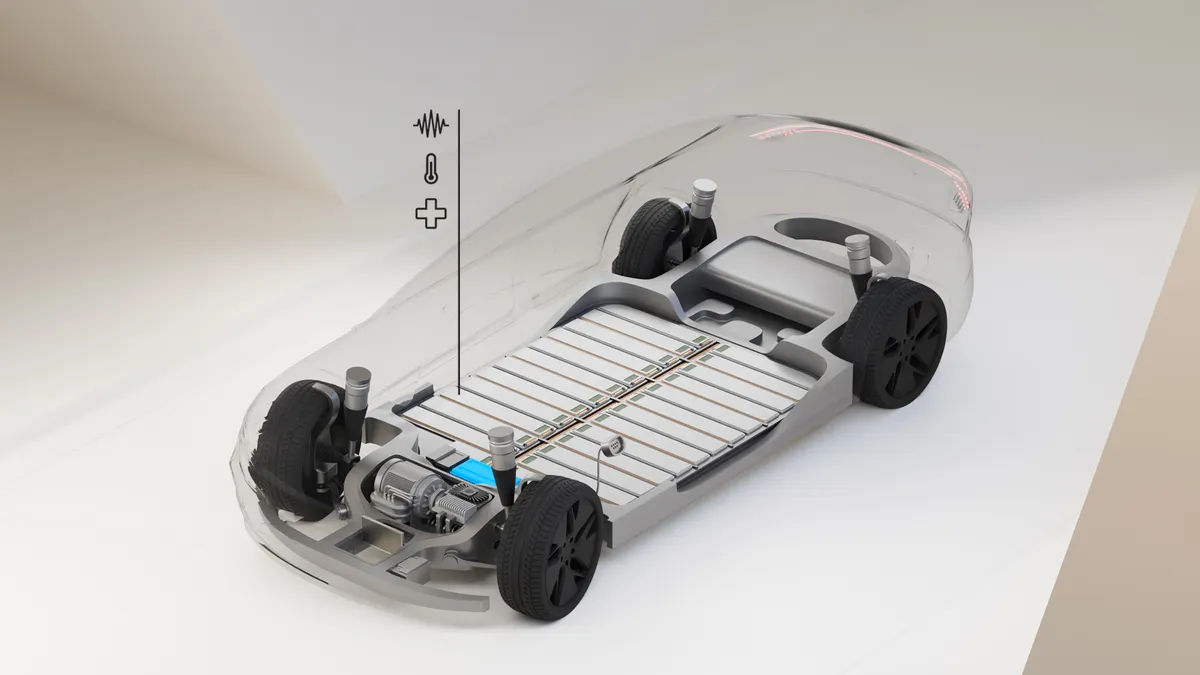
Not exactly household nomenclature for now, EIS, or electrochemical impedance spectroscopy, looks to be a next step in heightening BMS capabilities, allowing more accurate measurement of battery-cell condition and early detection of potential failures — some of which can lead to catastrophic fires.
To date, EIS has been limited to use in labs during battery development and along manufacturing lines. But at a wide-ranging backgrounder here on future technology in late October, microprocessor supplier NXP Semiconductors announced it would offer battery-management-system chipsets embedded with EIS technology that can be incorporated into high-voltage battery packs onboard vehicles.
NXP is at least the second multinational supplier to promote EIS technology for battery-management systems, following on the heels of automotive Tier 1 Marelli’s unveiling of a complete BMS equipped with EIS-based technology at the 2024 CTI Symposium in Berlin.
At the time, Marelli said it would release its full BMS to the market sometime this year, but that now appears to be delayed. It’s possible Marelli will work with NXP in finalizing its technology, but the supplier isn’t revealing its chip-sourcing plans at this stage.
NXP declined to comment on the potential of providing its EIS chipsets to Marelli. In a statement to WardsAuto, Marelli says only that next year it will “focus on further consolidating [its] EIS technical solution, as we are already in the process of identifying a partner for the chipsets, with some possible players in target. We are preparing to engage with customers next year, once the proof of concept is complete.”
EIS analyzes the impedance of the battery and determines its current state by measuring its internal resistance to electrical flow. That data can be used to predict its performance, meaning an impending failure can be detected before it happens, allowing proactive repairs to be made. It also can optimize recharging speeds, help manage battery loads to extend range by reducing the need to build in state-of-charge buffers and maximize available output for when the driver mashes the accelerator.
Some of the feedback from this more accurate and predictive analysis can help manufacturers in the design of future batteries as well, NXP executives believe, shortening product-development times.
“With today’s battery-management systems, it’s not possible to accurately measure the resistance of a cell,” Wenzel Prochazka, senior product manager electrification systems for NXP Semiconductors, pointed out. “EIS makes all this easier.”
NXP says automakers appear to be convinced of the technology’s advantages.
“We see a lot of enthusiasm in the market,” said Naomi Smit, NXP vice president and general manager for the product line Driver and Energy Systems. “Almost all OEMs are looking at doing EIS, but not necessarily across all their platforms.”
China, where BEVs have seen significant market penetration, is moving the fastest with EIS. Smit says at least one Chinese automaker already is beginning to tout the advantages of EIS to car buyers, even though its planned EIS-capable battery pack is yet to appear on any of its production vehicles.
In China, automakers are looking for any edge they can find to differentiate their models in the hotly contested BEV sector, Smit says. They’re beginning to market EIS as a safety feature, she notes, “so there’s a push in that direction” when it comes to application of the technology in China.
Although fires in BEVs statistically have been rather limited, they can be harder to extinguish than fires involving an internal-combustion-engine vehicle, adding to their danger level. According to some estimates, fires have occurred in about 25 per 100,000 BEVs sold, compared with 3,475 out of every 100,000 hybrid vehicles and 1,530 of every 100,000 ICE vehicles.
Despite the relatively modest numbers, BEV fires have been highly publicized and potentially have contributed to consumer resistance to BEV adoption, making any affordable solution to improving high-voltage battery safety potentially worth incorporating.
NXP says the EIS-ready BMS chipsets are highly scalable and aren’t more expensive than today’s technology when judged at the systems level. So there’s a reasonable chance EIS could proliferate quickly — particularly in a BEV-active market such as China — as next-generation high-voltage battery packs begin to roll out to the market.