Giant dealership acquisitions get headlines, but the big dealership groups like Penske Automotive also selectively sell a fair number of dealerships.
In the first quarter of 2026 and late 2025, there were several examples of this among the publicly traded dealer groups.
“We will continue to prune the portfolio. We are still in the acquisition business,” said Roger Penske, chair and CEO of Penske Automotive Group, Bloomfield Hills, Michigan, in an April 29 conference call to announce financial results for the first quarter of 2026.
Penske Automotive announced a big acquisition in November 2025, buying the former Penske Motor Group from a related business.
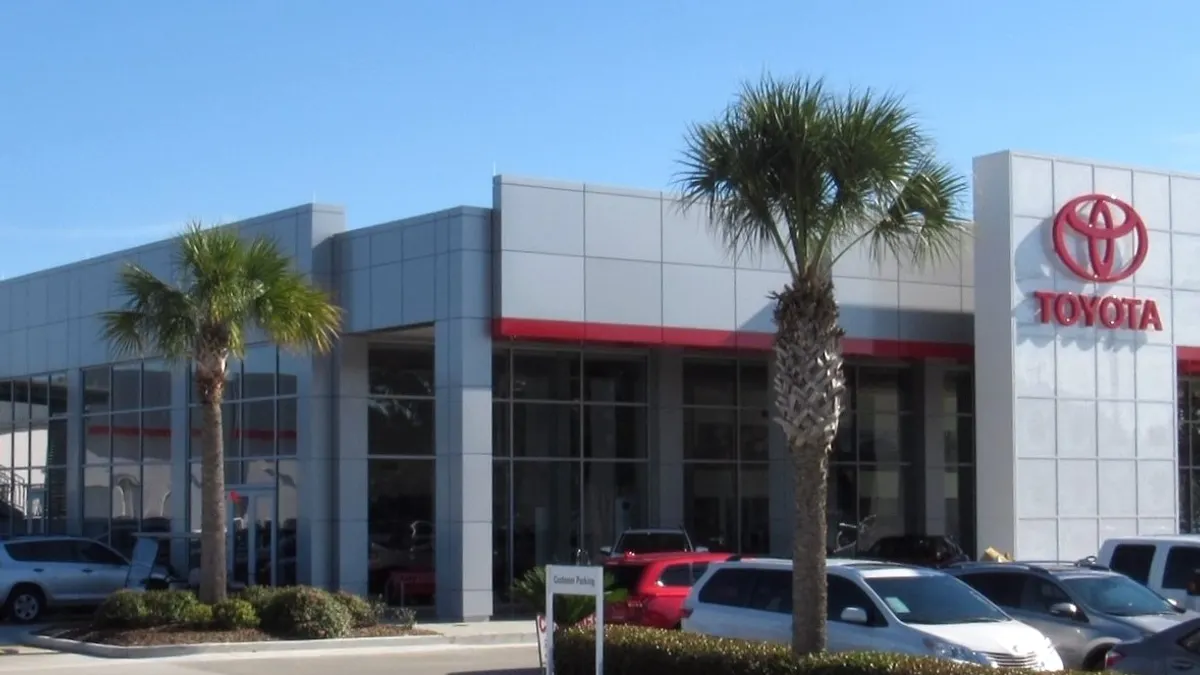
Penske Motor Group included one Toyota store in Texas and three dealerships in California. The California dealerships were two Lexus stores, and Longo Toyota in El Monte — the biggest-selling Toyota dealership in the United States.
The flip side was, Penske Automotive also did some selling as part of the grand plan. In connection with the Penske Motor Group transaction, Roger Penske said Penske Automotive also sold two Lexus stores — one in Warwick, Rhode Island and one in Madison, Wisconsin.
Penske reasons out why selling makes sense
In earnings calls and in interviews, the public groups and dealership brokers cite a number of reasons to sell off dealerships. In some cases, the chains may have too many dealerships of a certain brand to conform to franchise agreements that limit concentration of ownership.
Roger Penske said selling the Lexus stores in Rhode Island and Wisconsin “gave us the opportunity to buy” the Penske Motor Group dealerships, plus two Lexus stores in Central Florida, Lexus of Orlando and Lexus of Winter Park, in a separate transaction.
Notably, Penske Automotive came out of those transactions with Longo Toyota, a crown jewel of a dealership, plus two Lexus stores in a desirable and growing Florida market, while selling stores in quieter New England and Wisconsin.
It’s rare to see one Toyota or Lexus dealership on the market, let alone several, said Alan Haig, founder and president of buy-sell specialist Haig Partners, in a session at the firm’s Maximizing Value Conference on Feb. 3 in Las Vegas. The conference was right after Penske Automotive announced Jan. 26 it had purchased the Florida Lexus stores.
“They are not common assets. They don’t become available very often,” he said. Lexus and Toyota tend to be at or near the top of dealer-satisfaction surveys, in part because those brands operate on very lean inventory. In turn, that supports better dealer margins.
Haig said at the conference, on the sidelines of the 2026 NADA Show, that any dealer who gets the chance to buy a Toyota or Lexus store should jump on it, even if the price seems a little high. “If you’re sitting there thinking, ‘I think I’ll wait for a better market,’ well, I hope your kids are understanding about it,” Haig said.
That got a knowing laugh from an audience full of dealers. Haig was saying the “kids” had better be understanding someday, when they inherit a business that passed up a rare chance to buy a Toyota dealership.
Roger Penske said in the April 29 conference call that portfolio management requires a long-term plan.
“We sat with our board about 18 months ago to determine our strategy on brands and locations, domestically and internationally. We looked at our low performers, the manufacturers’ CapEx [capital expenditure] expectations, and what we could grow in those businesses. We determined there were a number of locations we needed to sell in order to get the returns we wanted,” he said.
During 2025, Penske Automotive acquired or opened dealerships representing approximately $1.6 billion in annualized revenue. Penske Motor Group accounted for the vast majority of that amount. Penske Automotive’s Florida acquisition is expected to add $450 million in estimated annualized revenue, according to the company.
Two other recent examples of how these ins and outs are taking form come from the first-quarter reports of Group 1 Automotive and Lithia Motors.
Group 1 aims for disciplined management
Houston-based Group 1 Automotive reported separately on April 30 it acquired one Škoda and two Volkswagen dealerships in the United Kingdom representing an estimated $135 million in annual revenues.
Group 1 also in the first quarter disposed of two Mercedes-Benz dealerships in California, and one Volkswagen and one Škoda dealership in the U.K. Together, the disposals represented an estimated $570 million in annual revenues.
“As we’ve said for years, the largest and best dealership groups increasingly practice disciplined portfolio management, and this transaction is the latest proof,” said Alex Watterson, managing director at Presidio, in a May 1 press release.
The Presidio Group, with offices in the Atlanta and Denver metro areas, advised Group 1 in the sale of Mercedes-Benz of Beverly Hills to Fletcher Jones Automotive Group. That deal closed March 30.
Lithia goes for a long game
Meanwhile, on a longer time frame, Oregon-based Lithia Motors, reported in February that from 2020 to 2025, it divested a total of 70 dealerships representing an estimated $2.8 billion in annual revenues, versus 190 acquisitions, representing $18.2 billion.
Bryan DeBoer, Lithia president and CEO, said for now, Lithia plans to lean toward share buy-backs while remaining open to “disciplined” acquisitions when the price is right.
DeBoer said, “We have been able to find some pretty nice acquisitions at appropriate pricing, but the market is still quite frothy.”