If the robot revolution is to happen — and many appear convinced it will — the automotive industry is likely to be front and center in the movement.
Thanks to advances in artificial intelligence, many in and around the sphere of robotics paint a picture in which automated and even human-like machines take over many routine jobs in the future, relieving people of mundane or physically challenging work while helping consumers handle everyday tasks around the house.
Driving the market’s interest in robotics, said Alex Panas, senior partner and global leader of industry sectors for consultants McKinsey & Co., is a shrinking workforce and a Chinese industrial complex that is setting the pace when it comes to factory automation.
He pointed to forecasts that the U.S. will suffer a shortage of 1.9 million factory workers by 2033 and current data indicating a 40% turnover rate for warehouse employees as the impetus for accelerated robotics adoption. Factories in China are out-automating their U.S. counterparts by a factor of 10, he said, suggesting America’s ability to compete globally could be at risk if it doesn’t step up the pace.
“Automation is back on the CEO agenda,” Panas said in kicking off a panel discussion in January at CES 2026 in Las Vegas on “Physical AI” — the migration of artificial intelligence from the digital space into the physical world.
Companies are no longer treating automation simply as a capital purchase within an operations context, he said, but as something that could trigger transformational capabilities for their organizations.
“The imperative is there; the excitement is there,” Panas said. “And we’re seeing a significant number of enterprises move in that direction. The amount of mentions about [industrial] robotics and automations in public filings has more than doubled in the last 18 months.”
ABI Research forecasts the robotics industry to grow from $50 billion today to $111 billion by 2030, when it believes some 13 million robots will be deployed worldwide. Goldman Sachs predicts the market for humanoids alone could hit $38 billion by 2035.
But getting to there from here isn’t without huge challenges. Industry insiders at CES 2026 pointed to still-considerable technology hurdles, initial high costs, the dearth of production-grade components and — maybe most importantly — cultural issues that must be overcome before robotics can reach the market potential envisioned. Progress could be slower than some of the rosier projections suggest.
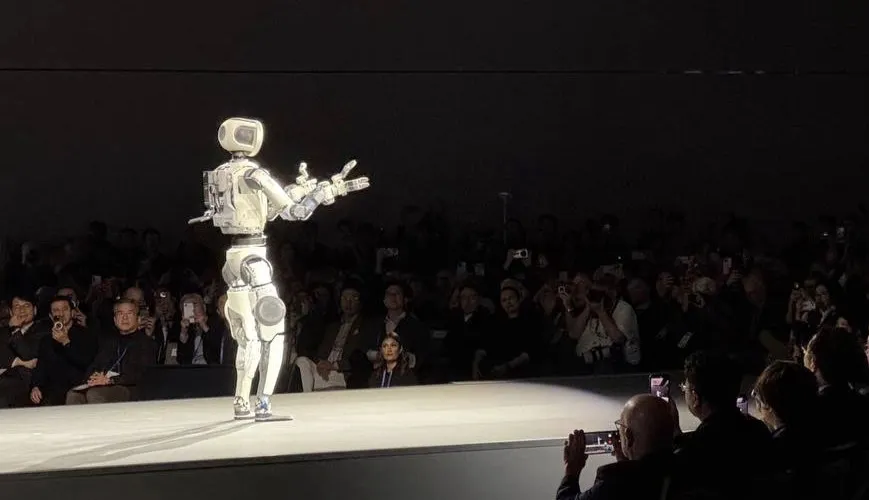
“It takes two to three years for our customers to get used to having robots in their facility to where they’re ready to start expanding [applications],” said Robert Playter, CEO of humanoid developer Boston Dynamics, now part of Hyundai Motor Group. “There’s almost this cultural piece: 'Am I going to trust this technology?’ We’ve got to get better at that.”
“But this adoption cycle is two to three years, and nobody who is predicting exponential growth thinks about that today,” he said.
Automotive industry in pole position
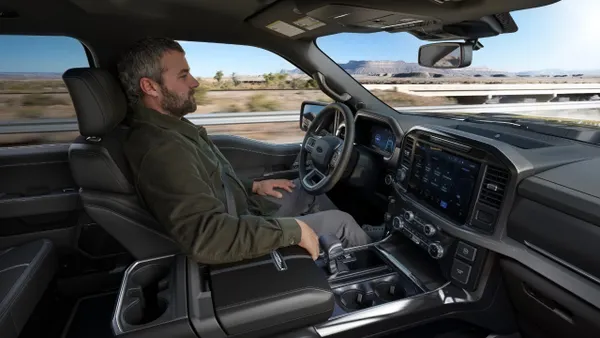
Automakers, traditional automotive suppliers, chip producers and tech companies are jumping into the space, believing those in the automated-driving ecosphere have a leg up in developing advanced robotics. Autonomous vehicles are seen as the first real examples of Physical AI in action, and although it won’t be easy to spin that technology into more-versatile robots of the future, many believe AVs represent a solid first rung on the ladder to humanoids.
In addition to developing the technology, automotive companies will be key early adopters. Much of the robotics and other automation they’ll be helping to invent will get their initial deployment in factories producing automobiles and their components.
The business prospects have companies beginning to mobilize. Recent moves into robotics by automotive players, many announced at CES 2026, include:
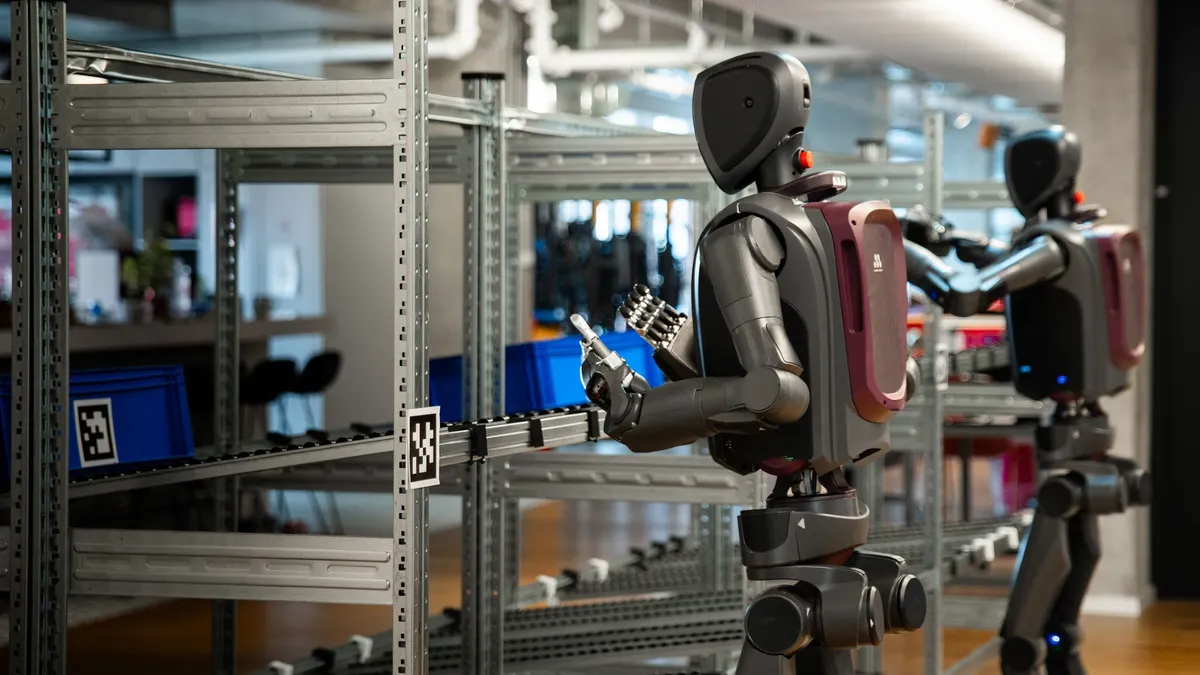
- Boston Dynamics will begin testing humanoid robots in industrial installations at Hyundai manufacturing plants this year, with full deployment targeted for 2028.
- Qualcomm is offering a suite of robotics technologies built around the launch of its Dragonwing IQ10 processor. The chip and solutions provider drew a direct line from autos to robotics in revealing an organizational structure that puts both operations under its current automotive chief, executive vice president Nakul Duggal.
- Nvidia president and CEO Jensen Huang said the process used in developing its Alpamayo open-source platform underpinning its automated-driving stack will be applied to developing humanoids. The chip company also is expanding its work with industrial-equipment producer Siemens, with plans to make a Siemens Electronics factory in Germany the world’s first AI-driven adaptive manufacturing site later this year. The companies said they aim to scale these automation capabilities across key verticals, with such customers as Foxconn, HD Hyundai, KION Group and PepsiCo currently in the evaluation stage on future programs.
- The world’s biggest automotive supplier, Germany’s Bosch, is collaborating with Microsoft on Agentic AI factory systems. The co-intelligence robotics (where AI machines and and people work collaboratively) will leverage lifecycle data from 1 billion-plus products and 700 million digital twins in its own AI-enabled factories.
- Mobileye completed a $900 million purchase of humanoid developer Mentee Robotics, a move executives said establishes the Israeli chip provider as a global leader in Physical AI. The company says it has signed a deal for humanoid manufacturing with Aumovio (formerly Continental Automotive) to begin in 2027 and expects industrial deployment in 2028 and in-home applications beginning in 2030.
- Automotive supplier Schaeffler Group said it is working closely with humanoid developers, supplying actuators and batteries to various projects expected to reach production later this year. Executives noted humanoids require about 28 actuators to function, making robotics a potentially lucrative sector for Schaeffler. The company said it also would look to deploy the robots in its own factories in order to expand production without increasing the size of its workforce.
- Tesla has confirmed that it would end production of its Model S sedan and Model X SUV this year and convert some of that capacity in Fremont, CA, toward producing up to 1 million of its Optimus humanoid robots annually.
Huge synergies with automated driving
Although robotics is a much more complex problem to solve, giving auto-industry players the confidence needed to move into the space is the leap in autonomous-driving capability — marked by the arrival of Agentic AI — that has re-energized that market sector and put the technology on a path to widespread adoption early next decade.
“When you think of it, there are many commonalities between these two frontiers,” Nimrod Nehushtan, executive vice president-business development and strategy for Mobileye, said of the ties between automated driving and robotics. “In the last year, it’s become a lot more apparent there is a correlation — starting from the research side of things, and then moving into development of common components to common tools and practices.”
“We think being a company that does both will accelerate the progress in our AI R&D,” he said.
But while autonomous vehicles are designed to do one thing, move occupants from Point A to Point B in the very structured environments of urban roads and highways, robotics — particularly humanoids sold to consumers — must be designed to handle a variety of tasks in unlimited types of settings.
That means robots will have to be able to perceive the world and react to it in ways humans do — a magnitude in performance well beyond the capability of autonomous vehicles.
“There’s a tremendous amount of work still to be done in AI in terms of making the robot aware of its physical surroundings,” Qualcomm’s Duggal admitted.
Developers also will have to solve physical limitations, giving robots hands with much greater levels of dexterity and sensitivity so they can perform more demanding and complex jobs, such as manning a vehicle assembly line.
“Even today it’s hard for robotics to do the tasks you see in automotive,” noted Carolina Parada, senior director of AI-research lab Google DeepMind.
Following the automotive ecosystem, market approach
Beyond tackling the technology challenges, the robotics industry faces many of the same business hurdles core to automotive, meaning experienced auto industry players may be best positioned to get the job done.
Topping the to-do list is cultivation of a reliable ecosystem of component suppliers that can produce high-grade, safety-certified parts in high volume with operational lifespans of 15 years or more.
“We’ve seen what’s happened in automotive,” Duggal said. “How do you build a supply chain that you can control from end to end, especially the hardware side of it — the scale, the cost structure, the raw material?
“Robotics is taking that to the next inflection point. That is why this space is so exciting.”
Some of that needed scale is beginning to take shape, Playter said, noting suppliers of batteries, actuators, sensors and other key components are eager to step into the sector.
“Ultimately, what’s going to be required to scale is that industrial might behind it,” Playter said. Hyundai already has begun stitching together an entire ecosystem for building robotics components in volume as it moves toward it’s own industrial applications, he pointed out.
Getting to the tipping point
Because of the complexity involved, developers are looking at industrial applications, where environments are more structured than in the consumer space, as a logical first step with humanoids. But even there, solving the return-on-investment equation and getting manufacturers to buy robotics in big enough numbers to support an entire industry will be no easy task.
Although automation has been around for decades, it still hasn’t scaled to levels originally envisioned, often due to substantial business-case barriers.
“This is not just about the robot, it’s about all the other environmental and infrastructure spending that goes into making a robot useful,” Panas said. Despite innovation that has taken place, many industrial sectors lack “catchers,” people in management who see the potential of advanced technology and are willing to spend to deploy it, he said.
Removing cultural barriers may be an even tougher puzzle. Ultimately, workers will need to be convinced robots are safe and that they will help them do their jobs, rather than replace them entirely.
“The automotive industry has been a bellwether of employment for every country that has dipped its toe into automotive,” said C.J. Finn, U.S. automotive leader for consultant PricewaterhouseCoopers. “The robotics industry has the opportunity to greatly reduce the labor cost within a vehicle. That’s a deflationary pressure everyone wants, to bring the price of cars down.”
Providing full transparency, making sure employees understand how robots think and function and ensuring workers are included when devising an application strategy will be critical, according to Mikell Taylor, director-Robotics Strategy at General Motors’ Autonomous Robotics Center.
“But that’s a deliberate process; it’s not an accidental process,” Taylor said. “It has to be part of product design and the deployment plan. That’s where a lot of companies struggle. People don’t quite want to give up the work; management doesn’t trust [the technology].”
“That gets easier as the robots are allowed to do more, so those first few years are a critical period to getting it right,” she said.
Qualcomm’s Duggal believes an aging workforce ultimately will see the benefit of leaving unwanted tasks to the robots.
“Over the next five years, it’s going to be about robotics becoming exponentially better than today,” he said. “And the next decade is going to be about what are the jobs that should not be performed by humans, that should be just automated jobs. I think it’s massive.”
Companies should start now to introduce automation where they can so they are better prepared for the revolution to come, Playter said.
“You can’t go from zero to humanoid,” he said. “There’s a cultural evolution that your company has to adapt to of hosting a few robots and how to be more interactive with them.”
Given the challenges, it may be robotics simply is having its moment in the technology hype cycle. But for now optimism reigns.
“I believe 10 years from now there will be millions,” Mobileye CEO Amnon Shashua said of the potential for humanoid robots in operation. “There’s a labor shortage out there. The technology is ready; it is just a matter of productizing it. This is an exciting stage.”