


Editor’s note: This story highlights takeaways from a November 11 panel that was part of a virtual event hosted by WardsAuto and Manufacturing Dive. Register here to watch the replay on demand.
Automakers are heavily investing in three areas when it comes to artificial intelligence and other advanced technologies, including “flexible automation”, enhanced communication and software, Ryan Kelly, senior vice president of technology at the Association for Manufacturing Technology, said during the State of Automotive Manufacturing virtual event Wednesday.
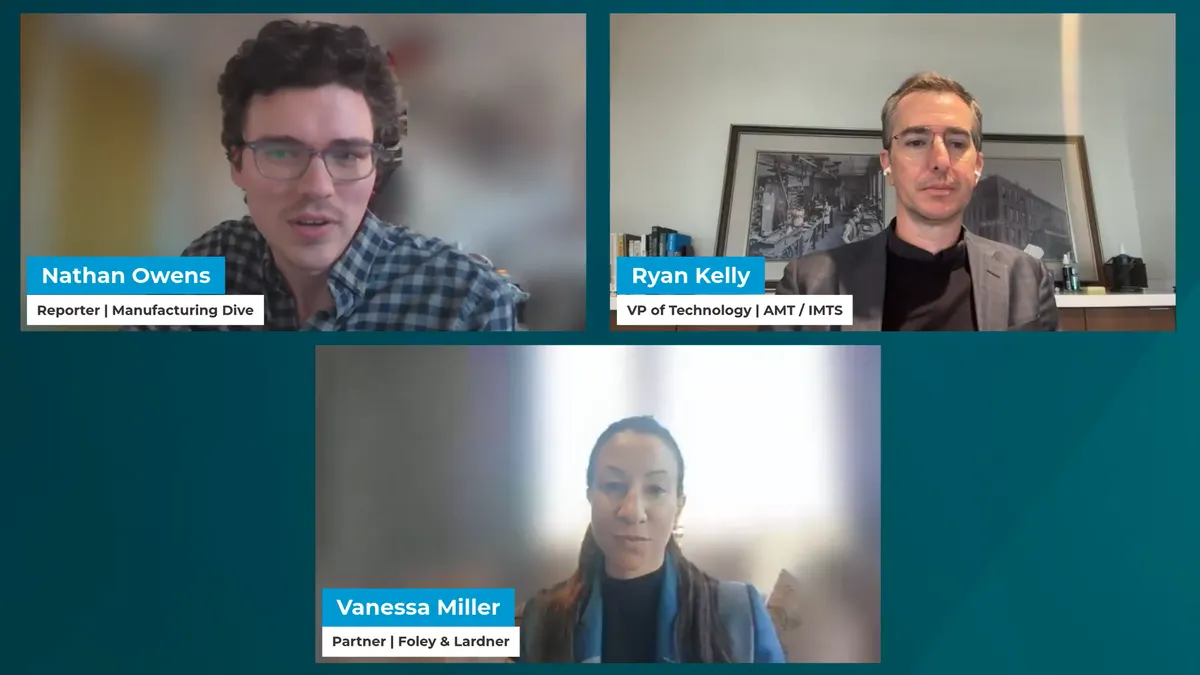
Kelly was joined by Vanessa Miller, a litigation partner with Foley and Lardner and chair of the firm's national automotive team, to discuss how automakers are incorporating AI and other advanced technologies into their operations, as well as some of the challenges they’re facing.
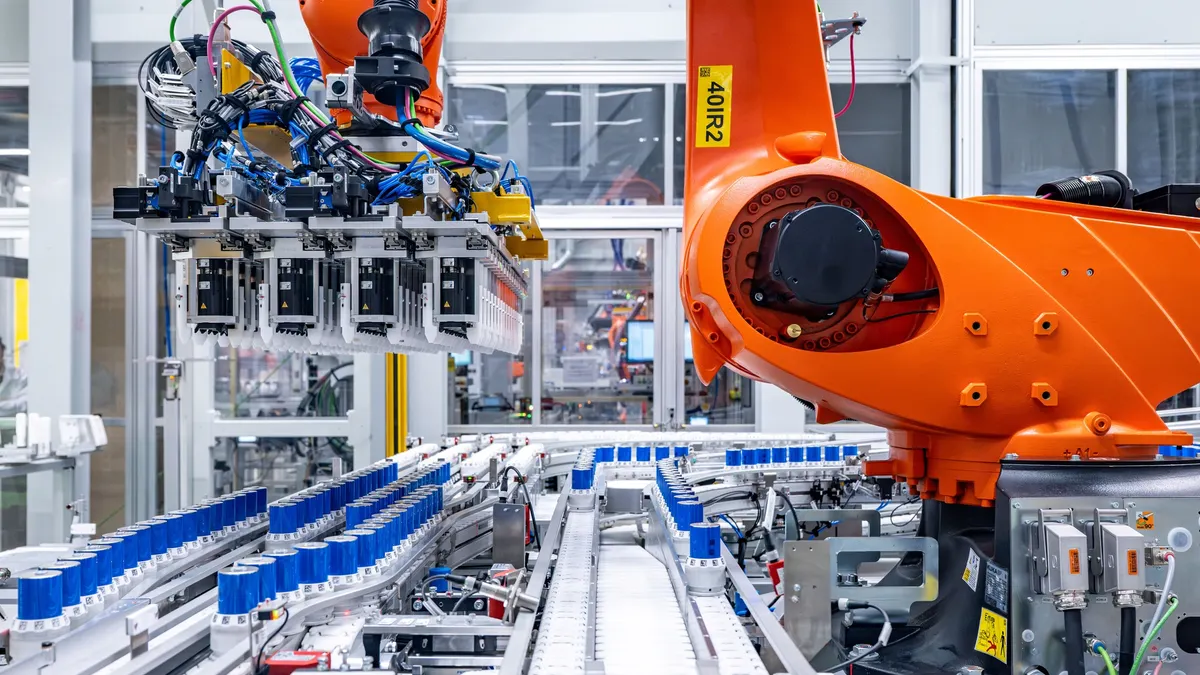
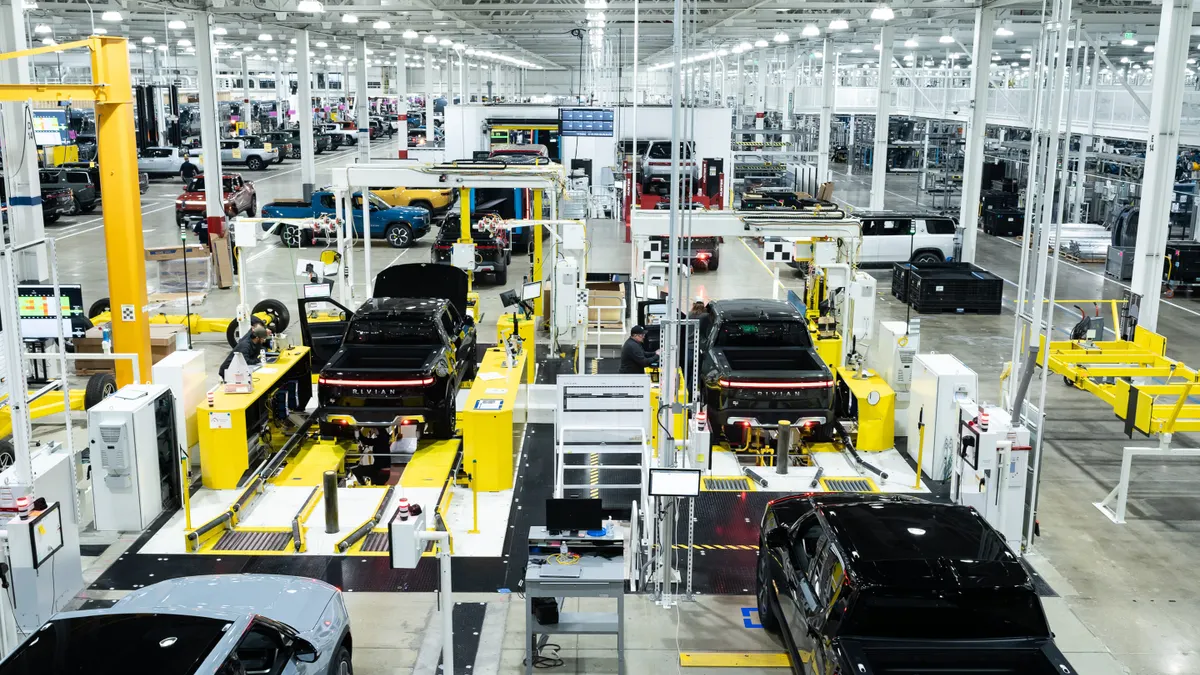
In terms of automation, manufacturers are focusing on “robots, cells and machines that can be retooled when a program moves or the power train makes changes,” Kelly said. "At this point, no one wants a dedicated line for a vehicle that might be a hybrid next year.”
Communication is also vital for effective technology implementation, according to Kelly.
“[In] factories, many of the pieces of hardware are online, and so there's a big push to be able to connect all of the assets on the factory floor,” he said.
Better communication also enables software enhancements for simulations, digital twins and analytics.
“Without all of those assets being connected, then you can't use AI at all,” Kelly said. “And that's where I think... the investment in the connectivity is probably where I would say the biggest value is.”
Miller said she expects automakers and other manufacturers to increasingly use AI to “manage certain overlapping pressures” such as optimizing supply chains in terms of cost inflation, labor, freight, software integration and other factors.
“Those are the things where I think AI is going to be very useful, and it's going to be looking at not just recovering from the disruption, but building systems that can absorb the next disruption,” she said.
Modernization drivers, investment priorities
Kelly said competitive pressures, cost reduction and customer expectations are some of the factors that are driving automakers to modernize their operations.
The automotive industry has “always been kind of on the leading edge of technology adoption, both because of the level of competition and also because of the volumes that they're working at,” he said. “Manufacturers are always looking to eliminate waste and to make a bit more money, but certainly in today's economic environment, there's actually more of an imperative to bring down costs.”
Miller said automotive manufacturers in particular are seeking greater resiliency and visibility, along with better forecasting, traceability and response speed.
The auto industry is “kind of like the pressure cooker test case for any manufacturer because they're just-in-time, usually sole-source manufacturing, a highly regulated industry with one supplier that will fit into the program or the application,” she said. “Other companies may be able to pivot and backfill with a different supplier, different product, but you can't do that in automotive.”
As a result, Miller predicted the automotive industry will see several changes in the next few years, including greater digitization of supply chains, more robots and cobots, a higher emphasis on predictive maintenance and further adoption of advanced AI automation tools in areas like shipping.
Legal and regulatory landscape, data sharing
Miller said the United States has a looser regulatory structure than Europe when it comes to technology.
“We will never have a federally mandated AI protocol or regulatory framework,” she said. “It's going to be state by state, and it's going to be almost lesson learned by lesson learned. We're a very litigious country, so... there's going to be companies that are going to be made examples of in the AI landscape, and those are the ones that aren't thinking about these things.... like data ownership and how you use that data.”
Kelly agreed that data management and ownership will be key factors when it comes to implementing new technologies on the factory floor.
“I think some of that higher tier of the [original equipment manufacturers] are going to say, ‘That data should belong to us,’” he said. “The reality, though, is that so much of what those downstream suppliers think is their value-add and their special sauce is in how they're making those parts or how they're making the components, and they don't want to share that with the OEMs.”
He added that AI’s need for data is “going to demand different ways of working.”
“My personal hope is that it becomes much more collaborative...so that people feel better about sharing data,” Kelly said. “Maybe it’s sort of the sensitive stuff stays in some kind of secure vault, but I think everybody's got the same goal, which is to have a more efficient supply chain, to have more collaborative interactions.”
‘Start with baby steps’
When it comes to implementing AI and other technologies into manufacturing operations, Miller said companies need to walk before they can run.
“Start with baby steps,” she said. “Everyone should have a grand plan, but you should start with the lowest-risk opportunity for maximizing your profits and your value stream... versus running headlong into something that your customers might not want, your suppliers might not agree with, and you could be running afoul of a number of different laws with respect to data, confidentiality, IP ownership, audit rights.”
She noted that many existing contracts “were drafted before AI existed, so they’ll have to take a while to catch up.”
“Everyone will have some kind of an AI provision in their contracts, but we're not there yet because we don't even know the lessons learned yet,” she said. “Unfortunately, the American way is to learn the hard way, and there'll be some kind of litigation that will result, and companies will then say we need this provision in our contracts to protect ourselves.”
Workforce issues
Although many fear that AI will take manufacturing jobs, Kelly said that concern is overblown given the persistent skills gap in manufacturing that is hindering technology adoption.
“The reality is in the manufacturing industry, we've got many more open jobs that just seem to go unfilled,” he said. “And so my hope is that flexible automation and AI will make it so that manufacturers of all kinds can do more with fewer people.”
He also said that as experienced workers age, there’s a risk that their knowledge will go with them when they leave the workforce. “I think that AI and other tools can help capture some of that knowledge so it's not lost,” he said.
Kelly did say that technology will change the types of available manufacturing jobs, from monitoring operations to working with AI agents that run systems and “redesigning and thinking about processes in a new way so that they're a better fit for robotics."
“I think that those changes will make it so that these jobs are more attractive to a broader swath of the population because they're going to be more techy,” he said. “They're going to be more critical-thinking oriented. So I actually look at these things as very much a boon for the job market in manufacturing as opposed to something to be scared of.”