
In the closing months of 2025, automotive supply chains are navigating one of their most complex environments in decades. Evolving trade policies, shifting tariffs, and cross-border challenges are raising costs and compressing delivery windows across the industry.
For an industry built on precision timing and just-in-time flow, every new regulation ripples across thousands of suppliers. With 2026 around the corner and little indication that trade pressures will ease indefinitely, OEMs and tier suppliers are rethinking how to keep freight moving without losing efficiency.
The solution isn’t to overhaul everything overnight—it’s to build flexibility into every mile of the journey.
Localizing to stay competitive
After years of global expansion, the automotive industry is recalibrating closer to home. Manufacturers are increasing production in Mexico, Canada, and the U.S. to reduce exposure to tariff-sensitive materials and long ocean lead times.
What was once a contingency plan has become a competitive strategy. Suppliers that once shipped subassemblies from Asia are now investing in facilities in Monterrey, Guanajuato, and northern Mexico, while U.S. distribution centers reposition inventory near major OEM plants to shorten replenishment cycles.
The trend is clear: localization isn’t about abandoning global sourcing—it’s about shortening the risk horizon.
Averitt’s cross-border logistics and transportation network plays directly into that shift. With bilingual customs coordination and partnerships in Mexico, freight can move seamlessly from supplier to final assembly plant without crossing multiple hand-offs or communication gaps. That continuity keeps both parts and production schedules on track.
Reengineering transportation for tariff agility
Tariffs don’t only affect what manufacturers buy—they affect how materials move. Shippers are redesigning routing strategies to minimize exposure and accelerate turnaround times.
Many automotive logistics teams are now building dual-path transportation models:
- Primary lanes that use traditional port gateways for steady-state operations.
- Alternate lanes through Gulf or East Coast ports to maintain throughput when costs or congestion spike.
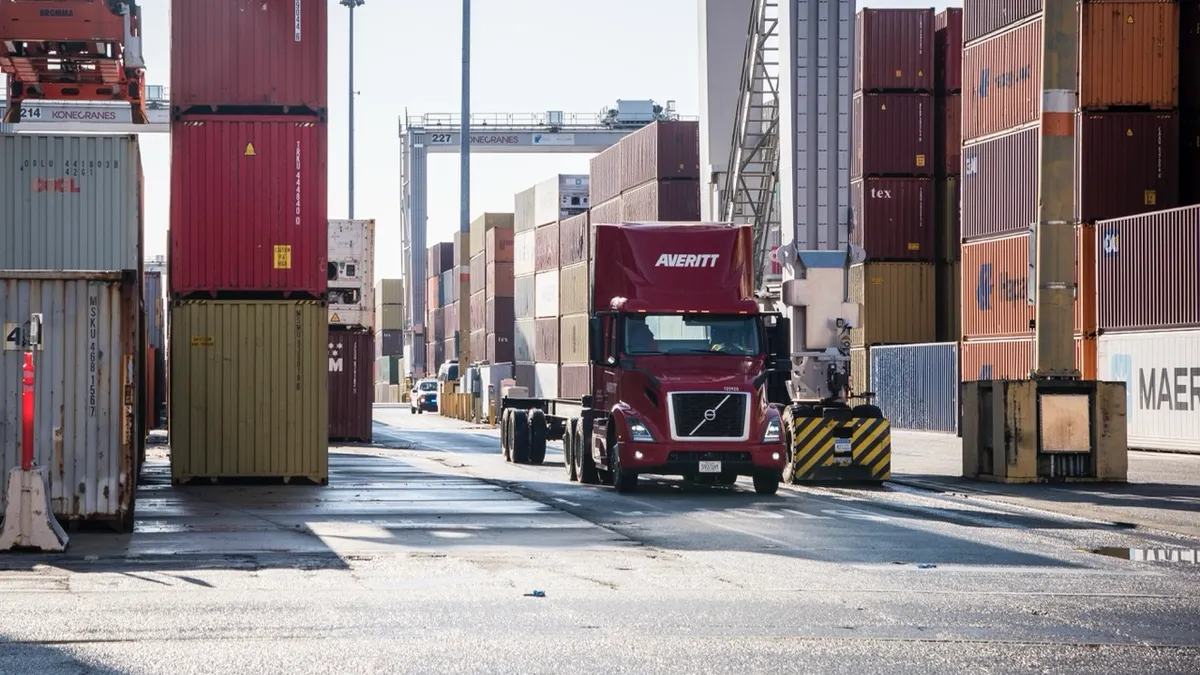
Averitt’s asset-based operations at major U.S. gateways—Savannah, Charleston, Houston, Mobile and Long Beach/Los Angeles—give shippers multiple entry options backed by coordinated drayage, transload, and inland trucking. When production deadlines tighten or port slowdowns threaten critical parts, air cargo becomes the industry’s release valve.
With Averitt’s international forwarding and domestic air services, automakers can expedite essential components directly from global suppliers or reposition finished parts to keep assembly lines running. Whether it’s a time-critical electronics shipment or an emergency replenishment order, air provides the speed and reliability to close supply chain gaps before they ripple through production.
By combining ground, ocean, and air within an integrated network, Averitt gives manufacturers the ability to pivot—without pausing the line.
Warehousing: The new financial shock absorber
Rising tariffs have turned warehousing from a cost center into a cost-management tool. Holding inventory closer to assembly plants helps buffer supply fluctuations and reduce the risk of tariff-related surcharges.
Port-adjacent facilities, in particular, have become vital. By transloading containers immediately upon arrival, shippers free equipment faster and avoid per-diem or demurrage fees.
Averitt’s PortSide® and Distribution & Fulfillment network provides this flexibility across major port regions and inland markets. For automotive suppliers, that can mean staging imported components near port cities like Houston or Charleston before final delivery to Midwest or Southeast assembly lines. The result: greater control over timing and total landed cost.
Visibility as a competitive advantage
When tariffs and policies shift quickly, visibility becomes the ultimate hedge. Knowing where freight is, when it will arrive, and how to reroute in real time separates companies that can adjust from those that are forced to react.
Modern transportation management systems (TMS) and dynamic-pricing platforms are replacing static spreadsheets with data-driven agility. Averitt Connect and ExactRate enable shippers to see performance, cost, and capacity trends across modes, helping them make informed decisions about mode shifts, pre-pulls, or consolidated moves.
For OEMs managing thousands of inbound SKUs, this kind of real-time insight helps maintain production continuity even as tariff costs fluctuate.
Building for agility, not anxiety
Automotive logistics is entering an age where policy uncertainty is the baseline—not the exception. But companies that design for agility can treat disruption as just another variable, not a crisis.
Three practical strategies stand out as manufacturers prepare for 2026:
- Reexamine and/or diversify your entry points. Spread freight across multiple ports and gateways to mitigate localized tariff or congestion risks.
- Regionalize inventory. Use port-adjacent and inland warehousing to stage high-value components closer to production lines.
- Integrate your partnerships. Work with partners that can manage international forwarding, customs, drayage, and inland transport through a single point of contact.
- Leverage dedicated fleet solutions. Lock in consistent, high-quality capacity with the ability to flex up or down when demand shifts. Providers like Averitt, with both dedicated fleet services and other asset-based capabilities—LTL, truckload, and expedited—offer shippers the control of a private fleet with the scalability of a unified network.
That combination—global coordination with regional execution—is how the automotive industry keeps its supply chain in gear, even as trade policies keep shifting.
The road ahead
Tariffs and trade shifts may change weekly, but the solution remains constant: supply chains built for flexibility. Manufacturers that diversify entry points, regionalize inventory, and work with partners who can coordinate every mode and border will be best positioned to control cost and maintain production flow.
That’s where Averitt comes in. With asset-based drayage capacity at key U.S. ports, port-adjacent warehousing, cross-border integration throughout Mexico and Canada, and visibility tools that connect every shipment from pickup to plant, Averitt helps automotive shippers turn uncertainty into opportunity.
Whether it’s transloading imported components, managing time-sensitive cross-border freight, or streamlining inland distribution, Averitt delivers the end-to-end coordination that keeps supply chains in gear—no matter how trade policies shift.
Learn more or schedule a consultation at Averitt.com/Consultation.