

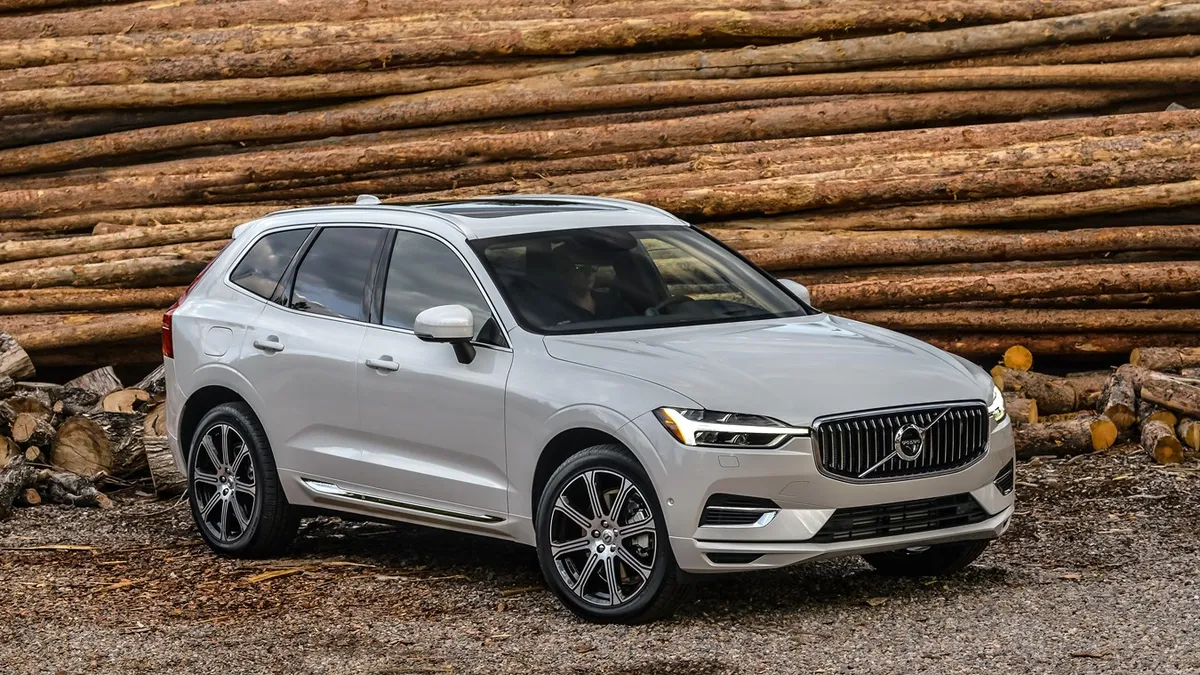
Volvo Cars has been granted special permission to continue to sell cars with connected car technology despite its ties to the China-based Zhejiang Geely Holding Group, the company reported in a May 26 release.
The specific authorization, granted by the Office of Information and Communications Technology and Services, removes a regulatory obstacle from Volvo Cars that threatened to slow its growth after model year 2027.
"We needed a special authorization (the one we were granted) to continue selling any cars in the US (even those with Swedish software and hardware) due to our ownership structure, as our primary shareholder is Geely Sweden Holdings AB," Thomas McIntyre Schultz, senior manager of product and technology communications at Volvo Cars, told WardsAuto in June.
Geely Sweden Holdings AB, a subsidiary of China-based Zhejiang Geely Holding Group, owns a 78.65% stake in Volvo Cars, according to the automakers' latest corporate governance report.
The reason Volvo Cars needed a special authorization dates back to January 2025, when President Joe Biden's administration finalized rules under his Inflation Reduction Act barring nearly all China-built cars and trucks from the U.S. market as part of a crackdown on vehicle software and hardware from China.
The rules included a ban on most software developed and maintained in China that took effect in March 2026 for 2027 model-year vehicles.
However, they also technically barred vehicle manufacturers "that are owned by, controlled by, or subject to the jurisdiction or direction of [China] or Russia" from selling any vehicles in the U.S. after model-year 2027 — even if they did not use technology developed in those countries.
The government left a door open for exceptions, though, and Volvo says it has followed a process required by the U.S. Department of Commerce to obtain a specific authorization for the continued import and sale of connected cars. However, the approval does not mean Volvo can use hardware or software linked to China under any different rules than other OEMs.
The process is carried out on a case-by-case basis and the issuance of a specific authorization follows discussions with the Department of Commerce and other U.S. officials regarding Volvo Cars' governance, technology and data security, the company said.
The U.S. is one of the largest markets for Volvo Cars and home of a manufacturing facility in Charleston, South Carolina where it has invested over $1.3 billion to date, creating more than 2,000 jobs.
In September 2025, Volvo Cars announced additional investments in the plant to bring two new vehicles into production before 2030.
Last year, Volvo Cars celebrated its 70th anniversary in the U.S. Currently, Volvo Car USA has 281 dealers in 48 states, employing approximately 11,500 people, the company’s statement added.
Correction: A previous version of this story misstated the special authorization's scope. It has been updated to clarify Volvo Cars' special authorization allows it to continue selling connected vehicles in the U.S. after model year 2027.