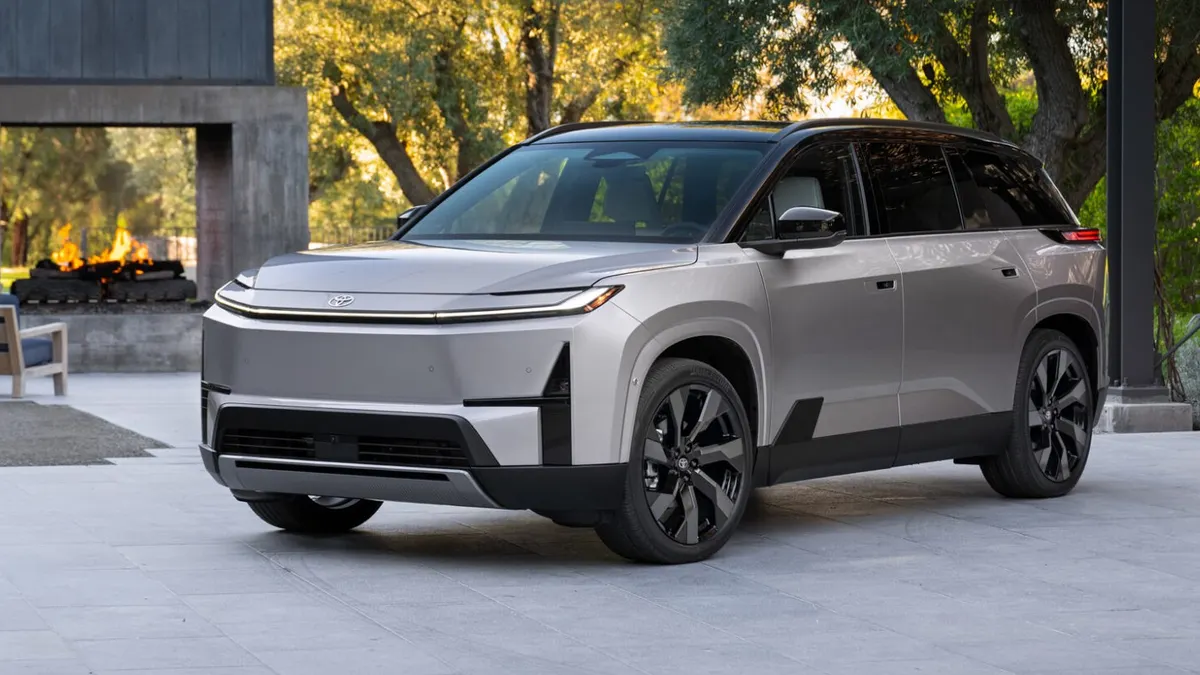
OJAI, California — Toyota Motor North America took the wraps off its long-anticipated 2027 Toyota Highlander BEV. It is the fourth BEV in Toyota’s U.S. lineup and the automaker’s first three-row, seven-passenger BEV model in the U.S., said David Christ, group vice president and general manager of the Toyota Division at Toyota Motor North America.
The automaker plans to offer only the BEV Highlander after it goes on sale in the fourth quarter, phasing out the gas and hybrid versions, Christ told WardsAuto.
The completely redesigned model will come exclusively with a battery-electric powertrain and will be built in Georgetown, Kentucky, Christ said. Battery modules will be assembled at the newly opened Toyota Battery Manufacturing North Carolina (TBMNC).
Toyota has long been an advocate of giving customers a choice of powertrains, but the company is increasingly bullish on EVs, he said.
“As people get more familiar with the EVS, the market will grow,” Christ says in an interview. “Obviously, the end of the government subsidies brought the market back a bit. But again, even if it's 5% of the market, you still want to have offerings. I don't know that it will be 5% of the market. I think it's going to be bigger than that. We're all in.”
Toyota now sells 19 different electrified models, which accounted for 49% of the automaker’s volume last year, Christ said.
“That number was just 16% in 2020, which puts us at over 7 million electrified vehicles sold in the U.S. since 2000,” Christ said.
The gas-powered Highlander is currently built at the Toyota Motor Manufacturing Indiana plant in Princeton, Indiana. Sales have slid during the past two years, with 2025 U.S. sales totaling 56,208 units, a 37% decrease from the previous year, and 2024 sales totaling 89,658 units—a 47% decrease from 2023.
Despite the recent downturn, over its four generations since launching in 2001, Toyota has sold more than 3.6 million Highlanders in the U.S. and almost 6 million globally.
The new Highlander will offer over 45 cubic feet of rear storage with third-row seats folded flat. It will be offered in two grades, Limited or XLE, with available front- or all-wheel drive.
The XLE grade will be available in front- or electronic all-wheel drive (FWD or AWD); XLE FWD models will have a 77.0-kWh battery, standard; XLE AWD models will have a choice of 77.0-kWh or 95.8-kWh battery. The Limited grade will have AWD and 95.8-kWh battery, standard.
The new Highlander has 338 net combined system horsepower and a satisfying 323 lb.-ft. max torque on AWD-equipped models. FWD-equipped models have 221 net combined system horsepower and 198 lb.-ft. max torque.
It can also serve as a mobile power source with vehicle-to-load (V2L) technology, a first for a Toyota model sold in the United States. It will be equipped with a North American Charging System (NACS) charging port.
This technology can potentially power outdoor appliances, like at a tailgate party, or serve as a power backup at home in case of an outage.
It also complements Toyota’s Charge Assist and ECO Charge features, which are designed to give Highlander the capability to charge during lower-rate times or when energy may be created from renewable resources.
Both the exterior and interior design is a departure from the current generation and include broad fenders, full-length LED daytime running lights and flush door handles for an aerodynamic appeal.
One distinctive interior feature is an available fixed-glass panoramic roof that will be the largest in the Toyota lineup, adding an open feeling to the cabin.
Christ would not reveal the volume target for the new model. Pricing will be announced closer to on-sale date.