Dive Brief:
- Tesla disclosed a major pivot in its financial strategy and is raising its capital expenditure forecast to over $25 billion in 2026 as its aims to become an AI and robotics company, the automaker announced in its Q1 earnings report.
- The company’s massive spending jump is nearly triple the roughly $8.5 billion in 2025 and $5 billion more than its original projection from earlier this year. The investments will help transform the Fremont, California assembly plant into a large-scale robot factory, and convert the facility’s Model S and Model X production lines accordingly.
- During Tesla’s Q1 earnings call on Wednesday, CFO Vaibhav Taneja said the capital spending increase will likely lead to negative free cash flow for the remainder of 2026 as the company leans in on robotics and AI. “We believe this is the right strategy to position the company for the next era. We'll make such investments in a very capital-efficient manner,” he said.
Dive Insight:
Tesla’s projected spending in 2026 will support its long-term growth plans of becoming more of an AI company than an automaker. The company’s plans include a having a global fleet of autonomous vehicles, a robotaxi business and humanoid robots powered by in-house-designed chips.
Tesla’s Q1 operating expenses jumped 37% year-over-year to $3.8 billion, which it said was primarily driven by investment in AI and other R&D projects.
“I think you've seen most, if not all, certainly the major technology companies substantially increasing their capital investments,” Tesla CEO Elon Musk said in the earnings call. “And we're going to be doing the same. I think it's going to pay off in a very big way.”
As Tesla invests in other areas to support its long-term vision, its Fremont factory will remain a key production hub for the Model 3 and Model Y. In its earnings presentation, Tesla said the Fremont plant currently has an installed manufacturing capacity of over 550,000 EVs a year. But the company said it's optimizing its current vehicle portfolio to build EVs “designed for a fully autonomous future.”
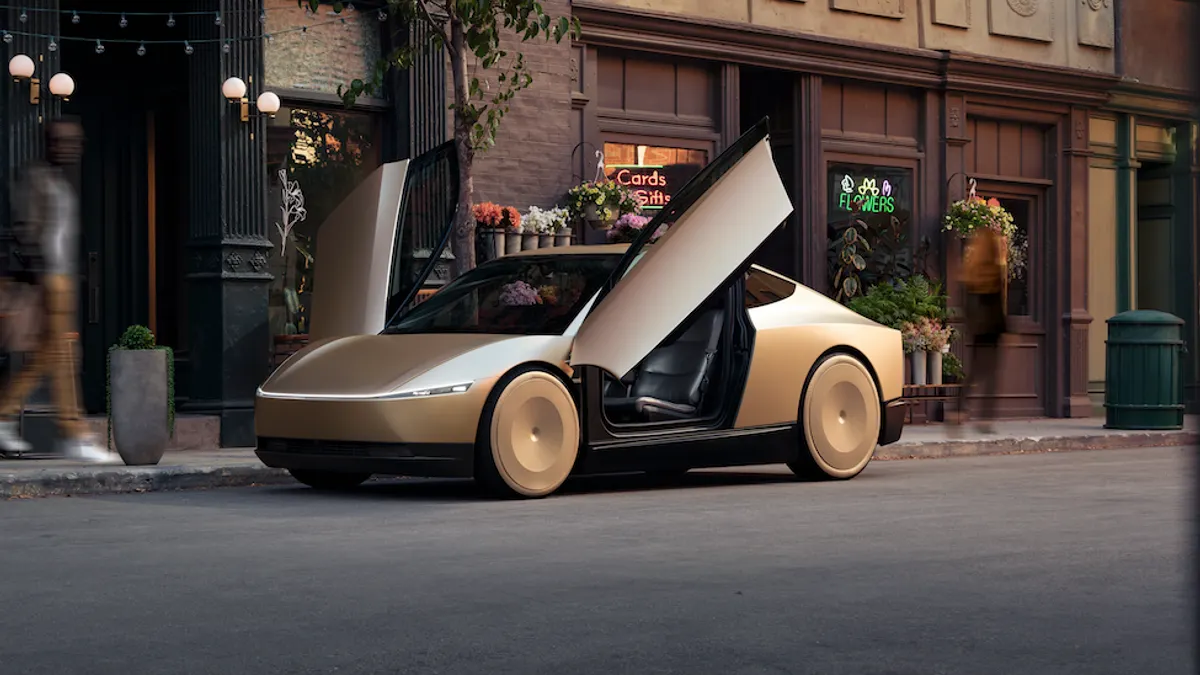
Tesla said it expects that the two-passenger Cybercab robotaxi will begin to replace the existing Model Y fleet and become its largest-volume vehicle over time. However, Tesla will continue the launch of new Model Y and Model 3 trims globally, including the new three-row Model YL in markets outside of China. Tesla also said it expects to start volume production of its Cybercab robotaxi and Tesla Semi this year.
Alongside EV production in Fremont, Tesla said the factory will be capable of producing 1 million Optimus robots a year. The company is also preparing its Gigafactory Texas for robot production, with a long-term production goal of 10 million units a year, per its earnings presentation.
“Tesla has broadened its scope over the past few years, shifting from just making and selling cars towards newer bets like autonomous mobility and robotics,” said Paul Miller, VP and Principal Analyst at Forrester, in an emailed statement to WardsAuto. “Beyond the headline numbers around cars built and sold, we should all be watching for the company’s latest news on these new bets.”
To support Cybercab and Optimus production, Tesla is also expanding its manufacturing to include in-house semiconductor fabrication to ensure it has the chip supply it will need. As part of its partnership with SpaceX, Tesla aims to build what it calls “the largest chip fab ever” with vertical integration of logic, memory and advanced packaging.
At Tesla’s Research Fab on its Gigafactory Texas campus, the company said it completed the final chip design this month for its next-generation AI5 inference processor. The in-house-designed system-on-chip will be specifically optimized for Tesla’s autonomous vehicles and robotaxis, as well as for Optimus humanoid robots.
Musk reiterated on the call that he believes Optimus will become its biggest product.
“Tesla is working on a lot of large, ambitious projects,” Musk said. “They're all very challenging, but I think they're going to be revolutionary. And that's what the team does best, solve the hardest problems and build amazing products,” he added.
Tesla’s CFO also noted that the company’s current battery capacity remains a bottleneck. “Our biggest limiter continues to be our battery pack capacity, and we are actively working on resolving that,” said Taneja on the earnings call.
Tesla said production ramp-up has started across its new battery and material factories, including lithium iron phosphate cells and its battery plant in Nevada, and cathode material and lithium refining in Texas. Tesla also plans to produce batteries for its energy storage business.
In March, Tesla and LG Energy Solution reached an agreement to build a $4.3 billion manufacturing facility in Lansing, Michigan, that will produce lithium iron phosphate cells for its Megapack 3 utility-scale energy storage systems. Production is slated to begin in 2027.