NOVI, MI – Automakers and suppliers are losing at least 18 months of forward planning because of the variable and changing Trump White House tariff policies, says Michael Robinet, vice president for forecast strategy at S&P Global.
In a presentation here at AutoTech 2025, Robinet notes with caution that Chinese automakers, with whom Western automakers are competing in the global electric-vehicle industry, will continue to grow and are not impeded by the U.S.’s unpredictable tariff policies.
“We are shooting ourselves in the foot…with respect to having to deal with these short-term issues and navigate them,” when there are already issues to solve with critical minerals, changing battery-electric targets, compliance with regulations that may or may not be changing and Chinese domestic OEM competition, says Robinet.
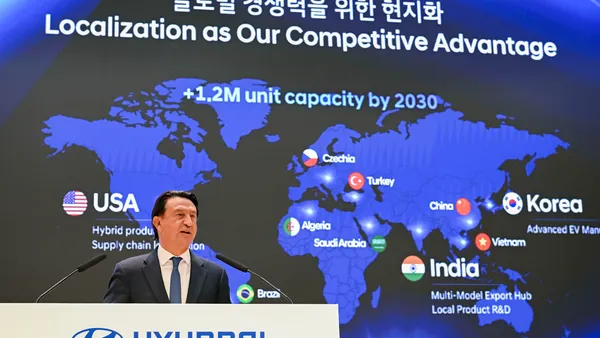
Because of the 25% tariffs, especially on automobiles manufactured in Canada and Mexico, there are small proposed moves by OEMs to shift production to the U.S. But Robinet warns that those shifts are not simple to achieve on any kind of short timelines like the ones the White House has imposed with tariffs.
Additionally, Toyota, Honda and Hyundai don’t have significant excess capacity in the U.S., Robinet notes. Nissan is the only Asian automaker with substantial excess capacity in the U.S., but demand for Nissan vehicles is lower than for its Asian rivals.
BEVs at Risk
Tariffs imposed on long-standing trade partners like Canada, the EU and Mexico are roiling boardrooms in general, but the trade tensions with China are of particular concern for battery-electric-vehicle makers as China controls 90% of the processed rare-earth metals required for batteries and motors, Robinet says. As of press time, President Trump and Chinese leader Xi Jinping had agreed to further trade talks after weeks of no progress.
S&P Global provides forecasting services to the auto industry; these days those forecasts are being updated weekly, says Robinet, based on on-again, off-again and shifting tariff pronouncements. “I’ve become known as the tariff guy,” quips Robinet.
Tariffs on vehicles are only part of automakers’ headaches. The administration doubled tariffs on steel and aluminum this week from 25% to 50%.
Inflation and Recession Looming
Tariffs are impacting several economic factors needed for accurate forecasting that automakers and suppliers rely on. Uncertainty around tariffs “makes forecasting very much a moving target, and we add in how tariffs will impact unemployment, what the Federal Reserve does on interest rates and then the impact on GDP,” he notes, adding that automakers are pulling ahead sales now while they have pre-tariff inventory, and consumers are pulling ahead purchases for those reasons and because of the likelihood that federal tax incentives for BEVs are being targeted for elimination. “We are still convinced that inflation is going to rear its ugly head. It’s going to show up in some way because of these tariffs,” Robinet says.
Added-Value Headache
One of the biggest headaches of the tariffs for automakers and regulators is that no one has ever tracked value-added content for vehicles coming in from Canada and Mexico, which factor into tariff calculations, because trade agreements among the three countries for decades has not given companies a reason to track it. “The administration didn’t know that when it started the tariffs,” he adds.
Robinet says clients are throwing up their hands somewhat when it comes to planning. “They are saying, ‘I don’t know what the regulations are going to be…I don’t know what the environment is going to be. I don’t even know where I am going to profitably build my vehicle.’ So, they are saying, ‘I’m just going to push this out because there is nothing else I can do.’”