Dive Brief:
- Electric automaker Rivian reported a 78% year over year increase in total revenue growth to $1.56 billion in Q3, the company announced in its Q3 earnings on Tuesday.
- The jump in revenue helped the company post a modest consolidated gross profit of $24 million following a $260 million loss in Q2 and a $392 million loss in the same period a year ago.
- The automaker’s total automotive revenues in Q3 were up 47% year over year to $1.1 billion compared to $776 million a year ago. Rivian said the increase in vehicle sales was fueled by the expiration of federal tax credit on Sept. 30. Additional revenue of $416 million came from software and services as part of its joint venture with Volkswagen Group.
Dive Insight:
Rivian said it produced 10,720 vehicles in Q3 at its Illinois factory and delivered 13,201 vehicles to customers during the quarter. It’s expected to be the company’s highest quarterly delivery total for the year, according to its earnings report.
Still, Rivian reported a net loss of $1.1 billion in Q3 and $130 million loss in automotive gross profit, which was a $249 million improvement from a year ago. The narrowing losses were the result of increased average selling prices and reductions in the cost of revenues, according to Rivian. But the EV maker is facing an uncertain Q4 as EV demand falls with the ending of the federal EV tax credit.
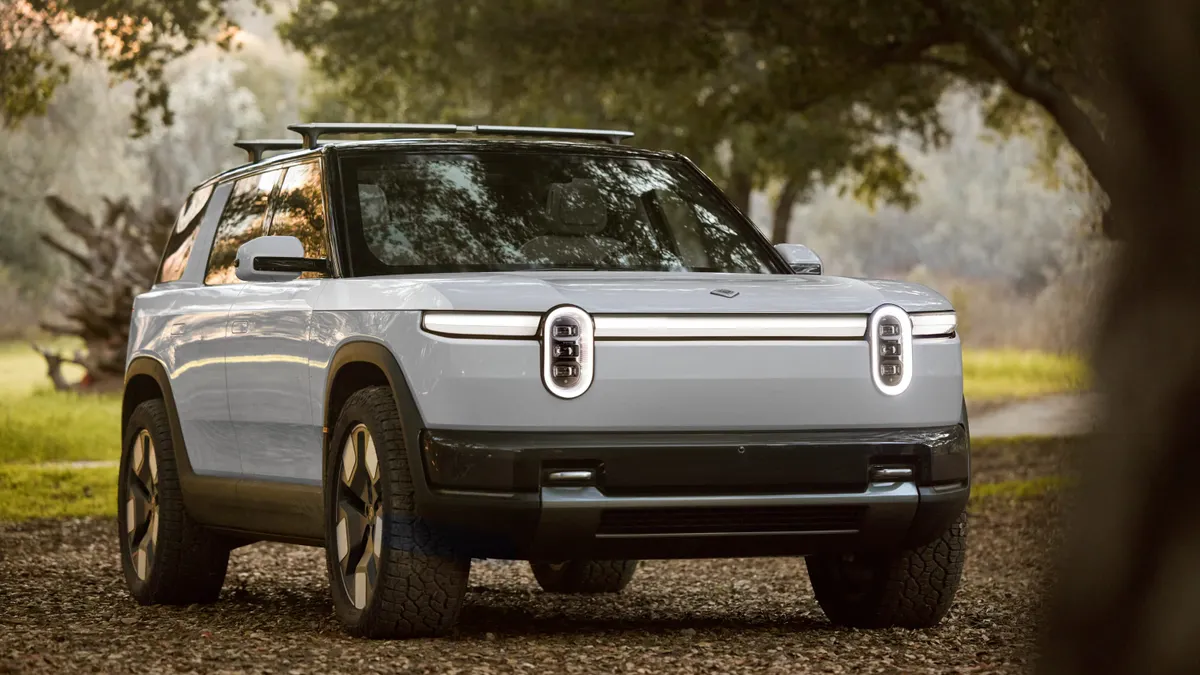
The company is now focused on the launch of its more affordable R2 SUV. Rivian is counting on the R2 to grow its sales and boost revenue in both the U.S. and Europe. The automaker said that progress on the EV remains on track with deliveries slated to begin in the first half of 2026. The R2 will be built at the automaker’s Illinois factory.
Rivian recently completed construction of a 1.1 million square foot body shop and general assembly facility, along with a 1.2 million square foot supplier park and logistics center, near its manufacturing facility in Normal, Illinois. The factory updates will boost its capacity to 215,000 units per year.
“In Q3, we continued to make significant progress across our strategic priorities which includes R2 and our technology roadmap,” said Rivian founder and CEO RJ Scaringe in a statement.
Expenditures associated with the R2 launch were $453 million in Q3, compared to $350 million in the same period last year. Rivian cited higher engineering and design costs, as well as higher software costs to support new in-vehicle technologies including the company’s autonomous driving platform. The company’s total operating expenses were $1 billion in Q3.
Looking ahead, Rivian aims to deliver 41,500 to 43,500 EVs in 2025, according to its guidance. Adjusted EBITDA is expected to be $2 billion to $2.25 billion, with capital expenditures between $1.8 billion and $1.9 billion.
Rivian also announced it will host an “Autonomy & AI day” on Dec. 11, where it will share more details on its autonomous driving vision and future technology roadmap.
“Over the long term, we believe the automotive industry will be fully electric, autonomous and software-defined,” said Scaringe.