Dive Brief:
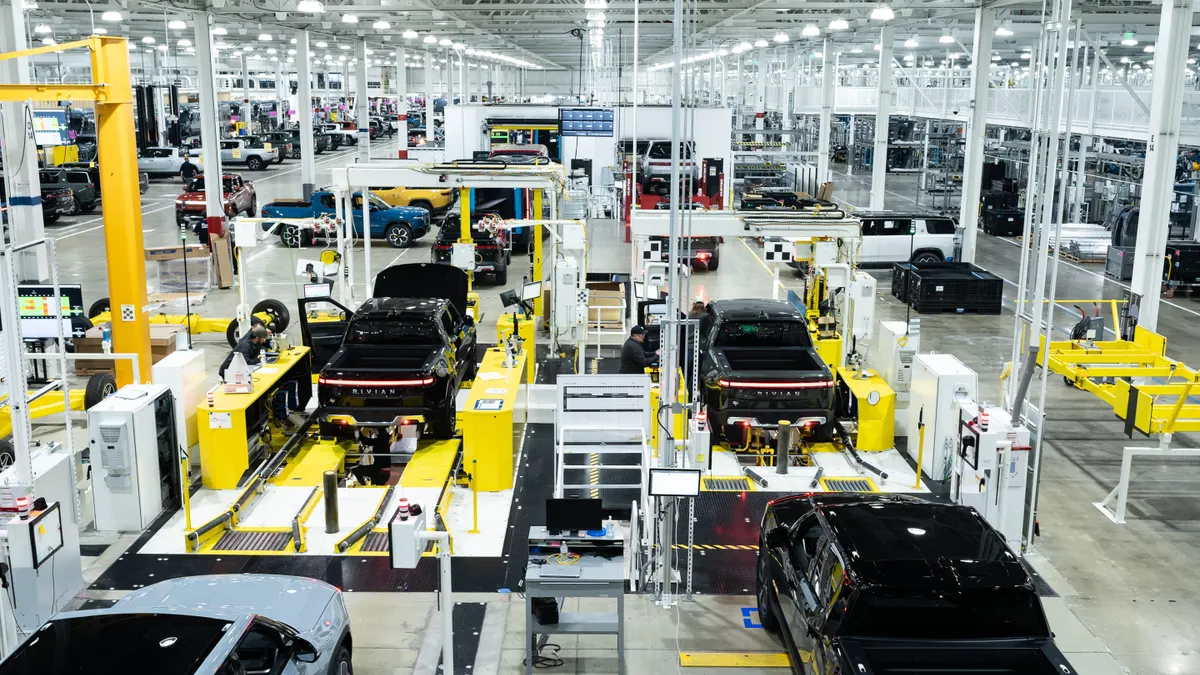
- Electric vehicle maker Rivian and battery recycling firm Redwood Materials announced a partnership to deploy an energy storage system at the company’s assembly plant in Normal, Illinois, Rivian announced in a press release.
- Rivian will provide more than 100 second-life EV battery packs to Redwood Materials. They’ll be repurposed for an energy storage system initially providing 10 megawatt-hours of energy to the factory to help reduce utility costs and grid demand during peak times.
- “Our partnership with Rivian shows how EV battery packs can be turned into dispatchable energy resources, bringing new capacity online quickly, supporting critical manufacturing, and reducing strain on the grid without waiting years for new infrastructure,” said Redwood Materials founder and CEO JB Straubel, in a statement.
Dive Insight:
In June 2025, Redwood Materials announced a new business unit named Redwood Energy that’s focused on assembling and deploying low-cost stationary energy-storage systems to help meet the growing power demands of AI data centers and other commercial applications.
"Electricity demand is accelerating faster than the grid can expand, posing a constraint on industrial growth," said Straubel in a statement. "At the same time, the massive amount of domestic battery assets already in the U.S. market represents a strategic energy resource.”
According to Rivian, the Redwood Energy storage system is highly scalable and offers significant cost benefits by using safe and proven EV batteries. It enables faster and more flexible deployments at high-demand sites, per the release. Rivian said it can instantly deploy the energy stored in second-life batteries at its factory to reduce grid demand at peak times and avoid having to purchase more expensive electricity.
In addition, EV batteries remain healthy even when the vehicle reaches the end of its service life, so they are extremely valuable to be repurposed for stationary energy storage applications, according to Rivian. By repurposing EV battery packs in stationary energy storage units before recycling, it extends their useful life and can defer billions of dollars in costly infrastructure upgrades, the company said in the release.
“EVs represent a massive, distributed and highly competitive energy resource," said Rivian Founder and CEO RJ Scaringe, in a statement. “As energy needs grow, our grid needs to be flexible, secure, and affordable.”
With the rapid growth of large-scale data centers across the U.S. to support the massive compute processing requirements of AI technology, there is a growing need for energy storage systems to reduce grid demand and save on utility costs. By 2030, over 600 GWh of energy storage is estimated to be needed to meet growing demand and stabilize peak demands on the grid, Rivian said in the release.
With lower-than-anticipated demand after billions of dollars in EV investments, other automakers, including General Motors and Ford Motor Co., are turning to stationary energy storage systems for new revenue streams.
In July 2025, GM signed a non-binding memorandum of understanding with Redwood Materials to accelerate the deployment of stationary energy storage systems built using both new modules and second-life batteries from the automaker’s EVs.
In December, after Ford and battery maker SK On reached an agreement to dissolve their EV battery joint venture BlueOval SK, the automaker said a subsidiary would take full ownership of an EV battery plant in Kentucky to manufacture 5 MWh+ advanced battery energy storage systems for data centers, utilities and large-scale industrial and commercial customers.
Redwood Materials was founded in 2017 by Straubel, a co-founder of Tesla and its former CTO. He is a current member of Tesla’s board of directors. In February 2023, the company received a $2 billion conditional loan commitment from the Department of Energy to expand battery recycling capacity in the U.S.