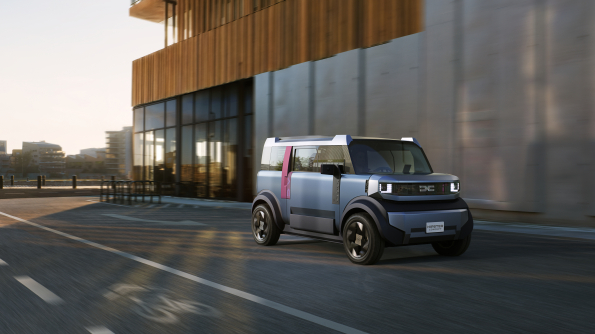


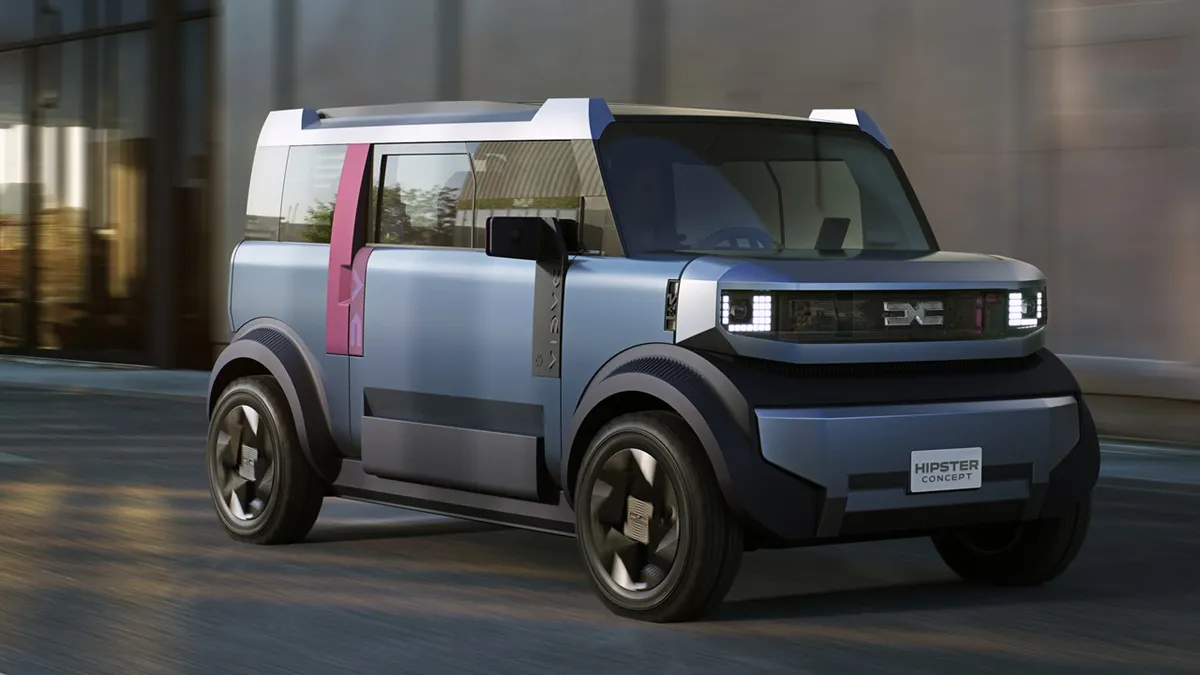
Renault’s budget sub-brand, Dacia, has revealed an entry-level electric vehicle concept to take on the rival Chinese brands currently attracting European consumers with cheap cars.
The brand unveiled its Dacia Hipster Concept that it claims will not only be affordable but also boast a carbon footprint nearly half that of most current EVs on the road, Dacia said in a company release.
Despite accommodating four adult passengers, the Hipster measures just 3 meters (9.8 feet) long, 1.53 meters (5 feet) high and 1.55 meters (5.1 feet) wide and boasts a trunk capacity of 70 (2.47 cubic feet) to 500 liters (17.6 cubic feet) with rear seats folded.
Its design, described by Dacia as “simple and robust” has echoes of the old Nissan Cube being essentially a box on wheels to make the most of its interior dimensions.
It’s clear that the brand is looking to play on its disruptor reputation now for the EV segment that began with the launch of the first Romanian built Renault-platformed model at a bargain-basement price, the Dacia Logan sedan launched in 2004.
“This is the most Dacia-esque project that I have ever worked on,” said Romain Gauvin, the brand’s head of advanced design and exterior design in a company release. “It has the same societal impact as the Logan did 20 years ago and it involves inventing something that does not exist today.”
Dacia already markets the cheapest EV currently sold in European markets in the shape of the Dacia Spring Electric 45 with a recommended retail price of €16,900 ($19,776) in Germany, some €2,000 ($2,340) less than the Leapmotor T03.
Assuming the Hipster makes it into series production, it is likely to be even cheaper with a small battery pack, adequate enough to meet the real-world needs of daily commuters.
The company points out in its release that in France, for example, 94% of motorists travel less than 24 miles a day.
Hipster also adopts a minimalist approach to construction being 20% lighter than its sibling Spring model.
Less weight “means less raw materials and less energy used” in its manufacture and also “means less mass to move, so less energy is consumers,” Dacia said in its statement.