Dive Brief:
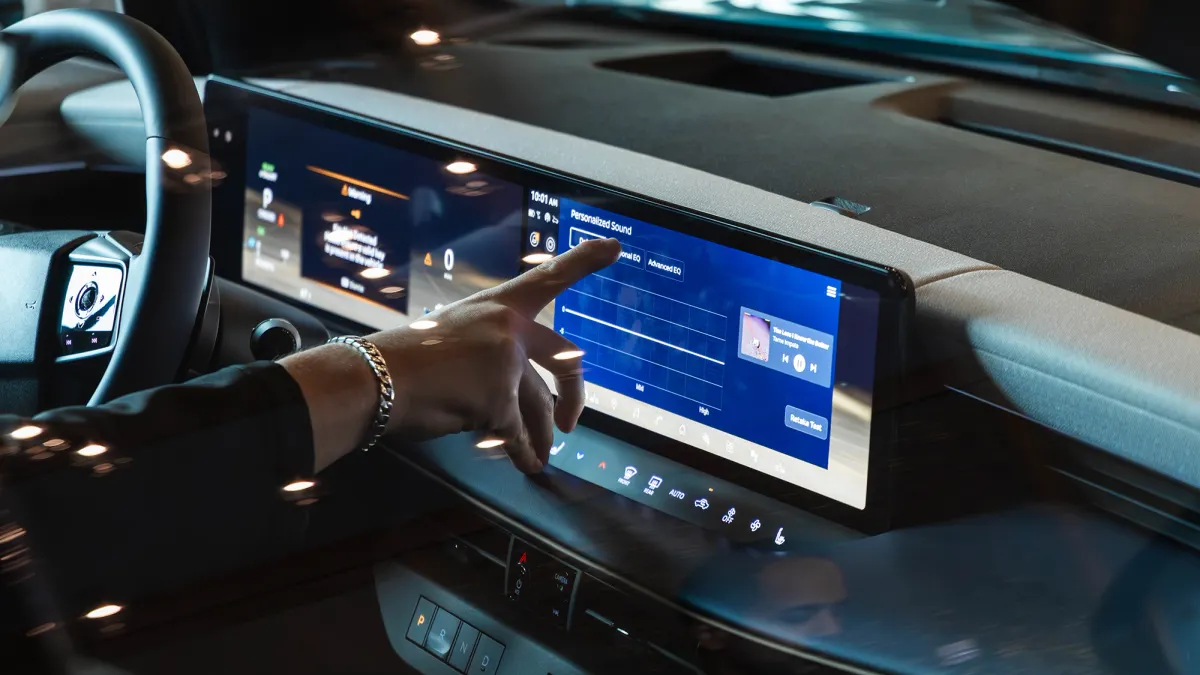
- Nissan Motor has introduced a novel audio feature called “Personalized Sound” that creates a custom audio equalizer setting based on an individual’s unique hearing, the automaker announced in a Dec. 15 press release.
- The Personalized Sound technology is available for all Nissan and Infiniti vehicles equipped with infotainment systems with Google built-in, including the 2026 Leaf EV. The Personalized Sound app can be downloaded for free via the Google Play store an added to the vehicle.
- "We want to elevate every driver's experience, whether they have a hearing impairment, are audiophiles, or simply want to get the most out of their sound system," said Mitchell Pope, a senior product planner at Nissan who led the development of the audio technology, in a statement. "Offering an individually tailored audio experience like this is a big first in the U.S. auto industry."
Dive Insight:
Once the app is downloaded and launched, Nissan’s Personalized Sound technology begins with an interactive in-cabin hearing test. An occupant is instructed to listen to a series of 10 separate audio test frequencies playing tones of varying loudness and pitch through the vehicle’s speakers.
The infotainment screen shows a user-friendly interface that prompts users to press the screen once each of the audio test tones becomes loud enough to hear. Once confirmed, the next sound automatically plays and the steps are repeated until the audio test is completed, which takes about three minutes, according to Nissan.
Once the test is finished, the audio system automatically stores a customized equalizer setting based on when the user confirmed the sound of each audio test tone. Personalized Sound uses the test results to precisely adjust a 10-band equalizer setting with frequencies ranging from 50 hertz to 1,200 hertz.
The personalized EQ setting can easily be compared to the previous audio settings, allowing an occupant to select the one that sounds the best to their ears. But the automaker found in its internal testing that 96% of participants said they would keep the Personalized Sound profile created for them active, which is often a big improvement, according to Nissan.
"After taking the test, most drivers will notice a clear difference with their new audio profile," said Pope. "They'll often pick up details they didn't before, even in songs they've listened to countless times. But above all, they'll know their audio was customized just for them."
Nissan says a key member of the Personalized Sound development team was Ashley Baird, a Michigan Technological University student working as an intern at the Nissan Technical Center North America in Michigan. She helped write the software for the listening evaluation, but still faced challenges in integrating the technology into Nissan’s infotainment system.
"It took extensive testing to find a way to interact with the car's media system,” Baird said in a statement. “I ended up discovering an Android audio processing effect that lets you tap into the sound that's already going to the speakers and adjust it, so the app could apply the changes directly to supported audio sources in the vehicle."
“It was awesome to see them realize that something they could just download from the Google Play store could offer so much audio customization that their car didn't previously have,” she added.
Nissan’s Personalized Sound also supports settings for multiple drivers, as each person can download their own Personalized Sound app and link it to their Nissan driver profile. When starting the vehicle under a driver profile, the app automatically loads.
As an amateur musician, Pope pitched the idea for Personalized Sound to Nissan in early 2024. He soon began working on the project with Nissan engineers and other product planners.
"I loved the level of customization offered in some premium headphones, and I wanted to bring that to the automotive world,” he said in the release.
Other Nissan models compatible with Personalized Sound include the 2024 and newer Rogue; 2025 and up Armada and Murano; the 2025 Infiniti QX80; and 2026 QX60.