


Dive Brief:
- MicroVision has acquired former Volvo Cars lidar supplier Luminar Technologies for $33M as the winning bidder in a Section 363 bankruptcy auction conducted by Luminar, according to a Feb. 3 securities filing.
- MicroVision plans to integrate certain Luminar assets, including inventory related to its “Iris” and “Halo” lidar sensors, as well as retain its engineering talent pool in Japan, Sweden and Florida, in order to better position the company to compete with low-cost lidar sensors from China, MicroVision CEO Glen DeVos said during a media briefing.
- "We are thrilled with this opportunity to strategically accelerate MicroVision's commercial objectives and to further progress the unique products developed by the Luminar team," said DeVos in a press release announcing the acquisition. “We intend to very efficiently integrate the acquired business with an intense focus on streamlining operations and managing costs."
Dive Insight:
MicroVision is a Redmond, Washington-based hardware and software technology company specializing in micro-electro-mechanical systems and solid-state lidar systems.
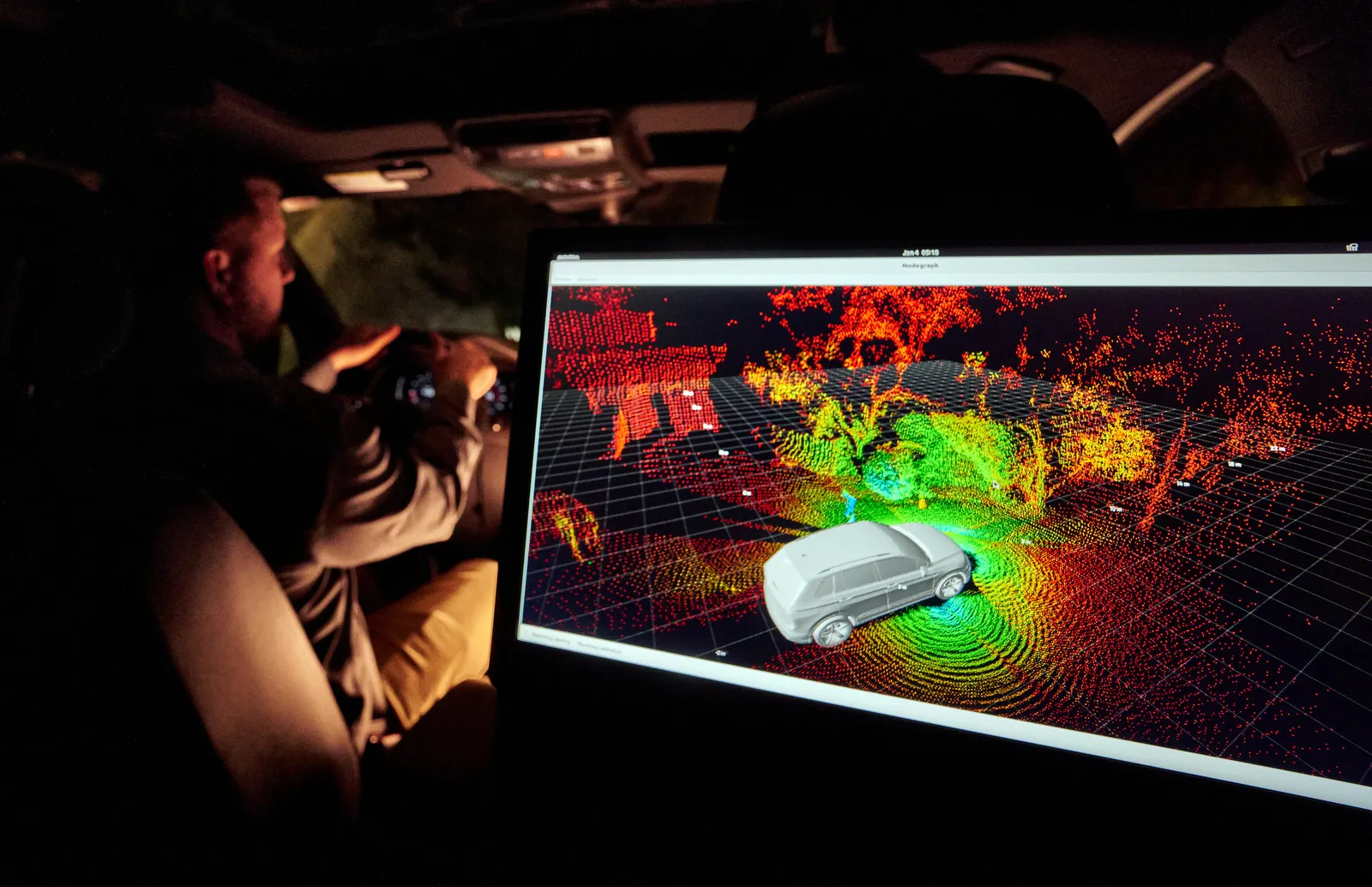
Lidar, which is an acronym for “Light Detection and Ranging,” is widely considered as an essential sensor for advanced driver assistance systems and self-driving vehicles.The technology emits pulses of laser light that reflect back off solid objects to render a 3D view of the environment. Lidar essentially acts as the “eyes” of an autonomous vehicle or robot to perceive the surroundings.
Waymo, for example, integrates lidar into the autonomous driving technology stack of its commercial robotaxis currently picking up paying passengers in U.S. cities with no safety drivers onboard.
U.S.-based lidar developers are facing an uphill struggle toward economies of scale, as well as growing competition from lidar companies in China, including Hesai Technology. The Shanghai-based company said it was the world’s first lidar developer to deliver 2 million units last year, and it plans to double annual lidar capacity to 4 million units in 2026, the company announced at CES in January.
In addition to competition from China, the mass-market deployment of autonomous driving in the U.S. that would boost demand for lidar still appears to be years away.
Just over five years ago, Luminar was seen as a leading developer of long-range lidar technology. In March 2020, Volvo Cars signed a framework purchase agreement with Luminar that officially designated the company as the sole provider of lidar technology for the automaker’s next-generation global vehicle platform. The deal helped Luminar gain the confidence of investors leading up to its high-profile November 2020 IPO.
Luminar launched its IPO in a SPAC merger. In December 2020 a month after its shares debuted on the NASDAQ, the company’s stock reached a peak-high of $47.80 and its market cap topped $12 billion.
The first Luminar lidar sensors were installed in Volvo EX90 SUVs in October 2023, and Luminar officially started volume production of lidar units for Volvo Cars in April 2024.
But in November 2025, Volvo confirmed that it cut off plans to use hundreds of thousands of Luminar’s lidar sensors in its upcoming vehicles, citing the need for more testing and development of the technology. The agreement between Volvo Cars and Luminar was officially terminated in November 2025, per a securities filing, leaving Luminar with no viable revenue streams.
EV brand Polestar also backed away from plans to use Luminar’s lidar sensors in models such as its Polestar 4, and a separate supply relationship with Mercedes-Benz announced in February 2023 did not result in the automaker using any of the company’s products.
Beyond this stage of consolidation, the lidar market is expected to grow over the long term. According to Sam Abuelsamid, Telemetry Insights’ VP of market research, vehicles equipped with Level 2 autonomous driving hardware using lidar will dominate the market for the rest of this decade, hitting about 58 million units by 2030.
MicroVision’s CEO hopes to capitalize on that expected growth, including with Luminar’s former automotive customers. “We intend to stabilize, restart those relationships [with former Luminar OEM customers] and take care of those customers, and we know how to do that,” said DeVos during a Feb. 2 press briefing.
Although DeVos acknowledged that the two companies’ technologies might be different, acquiring Luminar’s IP may help it offer a better, more unified product at a lower price. Similar to Luminar’s technology, MicroVision’s long-range lidar uses 1550-nm frequency-modulated continuous wave technology.
MicroVision has, up until now, focused its efforts on low-cost, short-range lidar sensors that might be used in industrial environments as well as for vehicle sensing suites. By acquiring Luminar, DeVos expects to have a complementary lineup that includes long-range lidar sensors spanning a wide range of potential uses.
“I’m not going to end up with two competing long-range lidar,” DeVos said. “It’s more about how do I integrate those technologies in a way, in the best way possible, to lower cost.”
Automakers aren’t yet using short-range lidar like MicroVision’s solid-state Movia S, according to DeVos, but that may soon change as they seek redundant sensing systems capable of seeing around the vehicle in urban situations. DeVos wants MicroVision to be on the shortlist of top global lidar suppliers and sees the acquisition of certain Luminar assets as a move towards that.
DeVos also hopes to bring some of the cost optimizations that he’s applied to MicroVision in terms of the chip-scale packaging and transceiver modules with the acquisition for Luminar’s IP. The expectation is that long-range lidar units need to cost under $500 by the time they launch in 2028 or 2029 — which would still be more than double the price of Hesai’s ATX long-range offering today.
While the acquisition announcement fell short of revealing to WardsAuto any projections of how soon MicroVision can get from niche supplier to global lidar player, DeVos promised that soon — at MicroVision’s next earnings call.
Luminar is MicroVision’s second recent acquisition. It finalized its purchase of Germany-based Scantinel Photonics in January after announcing a deal to acquire the company in November. The company is a developer of photonic chip lidar technology that can be applied to long- and ultra-long-range applications beyond 300 meters.