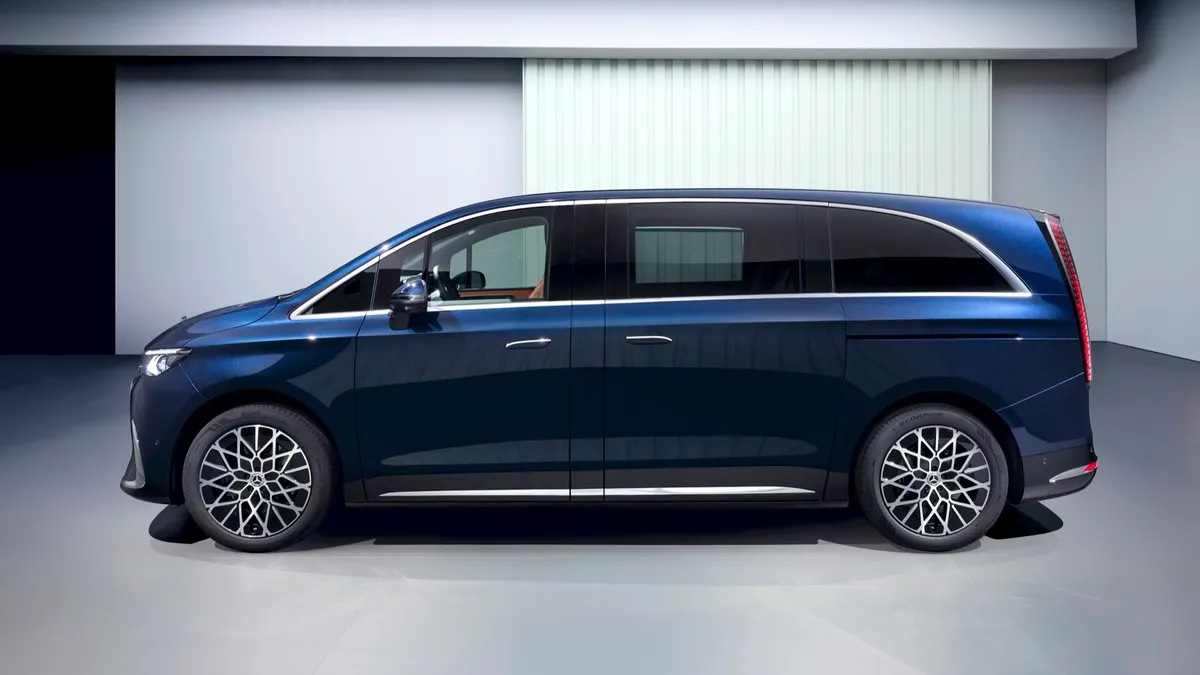
STUTTGART, Germany – Mercedes-Benz has revealed the VLE, an upmarket MPV conceived to deliver executive-car levels of comfort, refinement and technology within a roomy, smartly trimmed and versatile interior.
The new model, expected to go on sale across North America before the end of the year, replaces the V-Class. It becomes the first production vehicle based on Mercedes-Benz’s new VAN.EA (Van Electric Architecture) platform, a modular structure developed to underpin the German automaker’s next generation of large passenger and commercial vans.
The VLE will be sold initially with fully electric drivetrains running on a new 800-volt electric architecture, with internal-combustion variants incorporating both gasoline and diesel engines set to follow later this year, according to Mercedes-Benz Vans division head Thomas Klein.
The introduction of the VLE marks the beginning of a new two-tier MPV lineup for Mercedes-Benz. Sitting above it will be the more luxurious VLS, positioned as a flagship model comparable in status and equipment levels to the company’s S-Class sedan and GLS SUV and due to be unveiled during the second half of 2026.
The VLE, by contrast, is intended to occupy a position similar to the E-Class and GLE SUV.
The two-tiered model strategy aligns with shifts in the global market. The VLE is intended to attract buyers who might otherwise consider higher-end sedans and SUVs, Klein told WardsAuto in a preview of the new MPV ahead of Tuesday’s reveal. While traditional MPVs remain a relatively small segment compared with sedans and SUVs, they still represent significant volume in many regions.
At the same time, a niche has begun to emerge globally for high-end MPVs, particularly in China, the world’s largest car market, where MPVs such as the Buick GL8 have become a staple of corporate and executive transport fleets. While the segment remains small in North America, Mercedes-Benz sees potential growth in chauffeur services, corporate transport and large family car buyer groups.
Mercedes-Benz says the VLE combines the driving characteristics of a luxury sedan with the flexibility of an MPV. Unlike the outgoing V-Class, it receives dedicated styling and design language intended to distance it from the next generation of the Vito commercial van, with which it shares its VAN.EA platform and drivetrains.
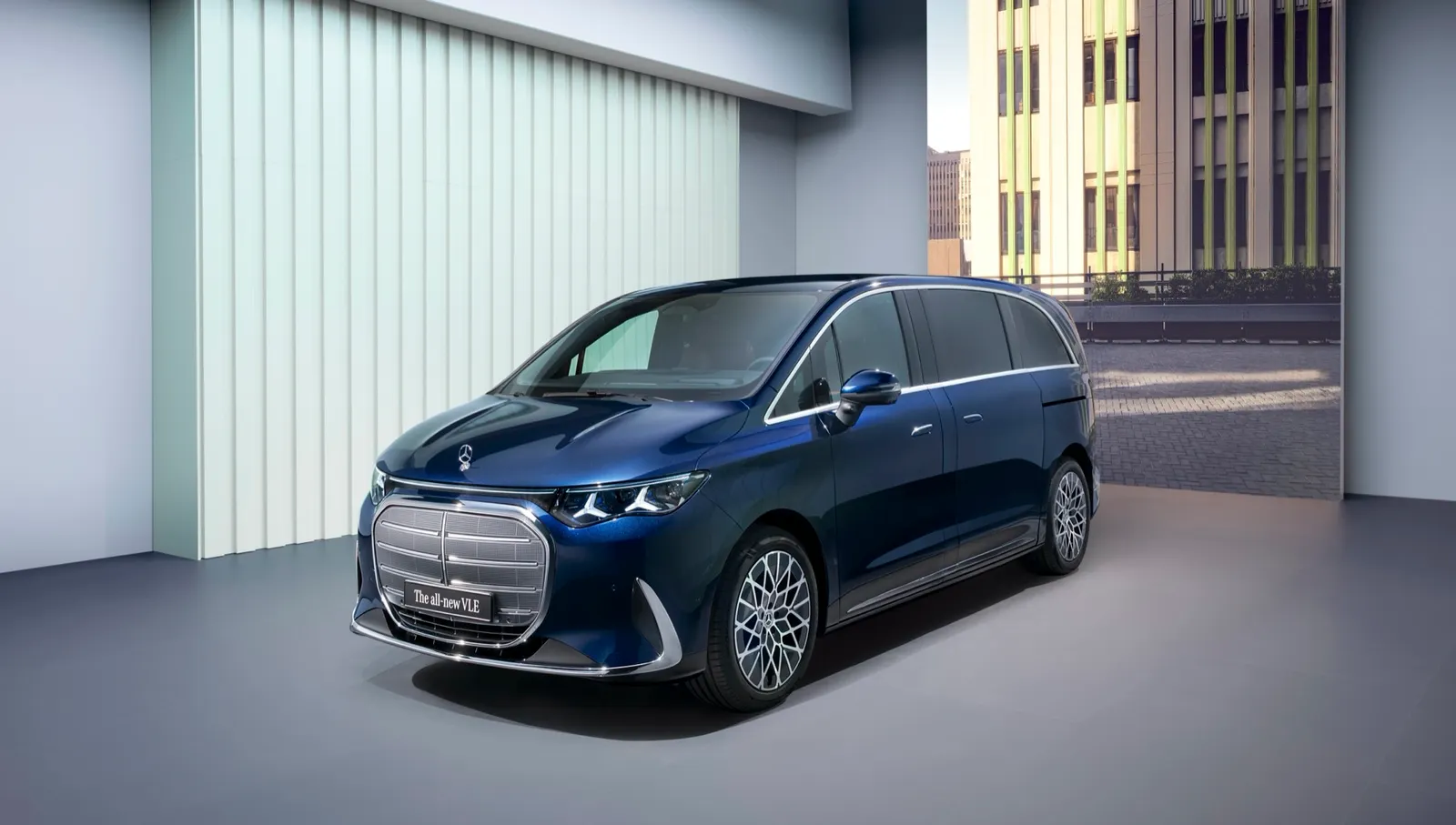
The initial models, the single-motor, front-wheel-drive VLE 300 and dual-motor, four-wheel drive VLE 400, offer a respective 268 hp and 409 hp. Mercedes-Benz provides tow ratings of up to 5,511 lb.
Electric energy is supplied by a 115-kWh lithium-ion battery housed within a flat floor structure, which Mercedes-Benz claims enables a driving range of more than 435 miles on the WLTP test procedure used in Europe for the VLE 300. An official North American range figure based on the latest EPA procedure is yet to be announced.
The VLE supports DC fast charging at up to 315 kW, allowing the battery to be replenished from 10% to 80% in roughly 25 minutes, according to Mercedes-Benz. Under favorable climatic and charging conditions, roughly 162 miles of driving range can be added in around 10 minutes, the automaker claims.
Further electric drivetrains are planned. Meanwhile, details of the gasoline and diesel engines to be offered in the VLE are yet to be revealed, though Klein hinted they will include updated versions of the V-Class’s turbocharged 2.0L 4-cyl. engines in combination with a standard 9-speed automatic gearbox.
Efficiency has been a key development focus. Mercedes-Benz says the electric drivetrain used by its latest MPV achieves up to 93% efficiency from battery to wheel, while a drag coefficient of 0.25 places the VLE among the more aerodynamically efficient offerings in the large MPV segment.
The VLE has so far been revealed in a single configuration measuring 209.0 inches long and riding on a 131.6-inch wheelbase for the European market. WardsAuto has been told the U.S.-market VLE model will only ride on this longer-wheelbase version.
As with its predecessor, the VLE receives two conventionally hinged doors at the front and two sliding doors at the rear, in combination with a large vertical tailgate that opens to reveal a low-set luggage compartment.
Inside, the VLE introduces the latest evolution of Mercedes-Benz Operating System (MB.OS). It supports over-the-air software updates and integrates the newest generation of Mercedes-Benz’s MBUX infotainment system with AI-based conversational voice interaction.
Rear passengers can be treated to an optional 31-inch panoramic display integrated into the roof liner, designed to support streaming media, gaming or videoconferencing during long journeys.
Interior flexibility is described as a central element of the VLE’s design. Mercedes-Benz offers multiple seating layouts accommodating between five and eight occupants depending on configuration. A seven-seat arrangement with two front seats, two individual seats in the second row and a three-seat bench in the third row forms the standard layout. Alternative versions include a six-seat configuration featuring four individual rear seats, either forward-facing or in a so-called conference layout with rear passengers facing each other.
The seating system itself has been engineered to deliver a high level of versatility. Customers can choose between manually adjustable comfort seats, electrically operated premium comfort seats and a more luxurious Grand Comfort seat offering extended cushioning, massage functionality and integrated leg support.
All rear seats are mounted on Mercedes-Benz’s Roll & Go rail system, allowing them to slide, lock into position or be removed entirely to maximize luggage capacity. Electrically adjustable seats can also be repositioned remotely through the VLE’s MBUX infotainment system, side-panel seat controls or a Mercedes-Benz smartphone app. Depending on the seating configuration, luggage capacity can reach 144.0 cubic feet with the rear seats removed.
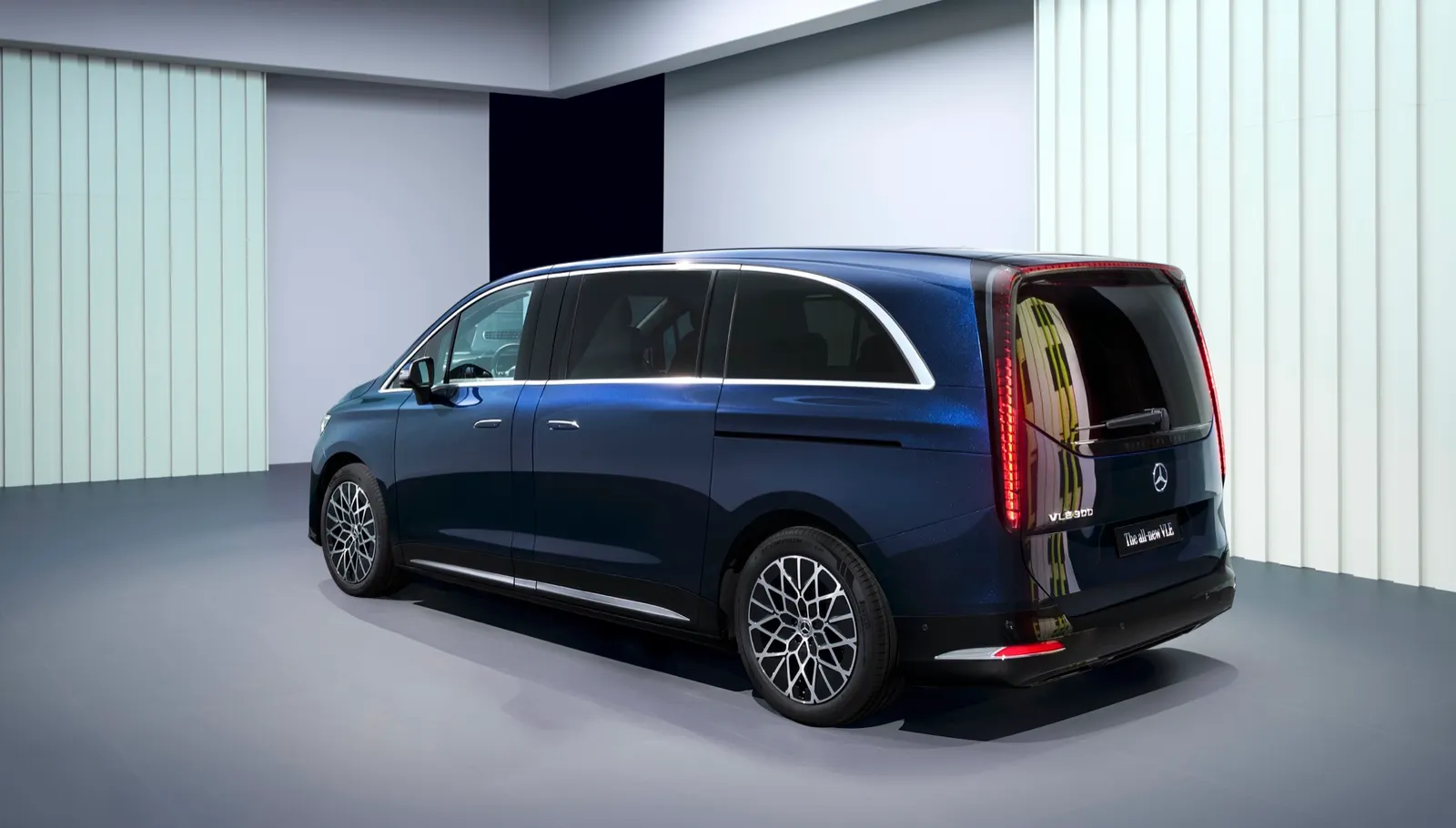
Chassis technology also reflects the model’s more premium positioning. The VLE features an air suspension with adaptive damping and rear-wheel steering, providing up to seven degrees of steering angle. According to Mercedes-Benz, this reduces the turning circle to just 35.8 feet.
The VLE will be produced at Mercedes-Benz’s Vitoria plant in Spain and the Fujian Benz Automotive operation in Fuzhou, China. The new VAN.EA architecture will also for the basis for additional derivatives, including a successor to the Vito commercial van and other work-focused pick-up style models.
Pricing and launch timing for the VLE in the North American market has yet to be finalized, though officials at Mercedes-Benz’s headquarters in Germany say the current production timetable at the Vitoria plant calls for U.S. variants of the MPV to be ready in time for deliveries during “second half 2026.”