Dive Brief:
-
In its 2030 mid- to long-term strategy update released Thursday, Kia Corp. confirmed the future launch of a body-on-frame pickup truck with hybrid and range-extended EV versions, as one of the centerpieces of U.S. sales growth by 2030.
-
Kia aims to top 1 million annual sales and claim a 6.2% market share in the U.S. by then, with a focus on strengthening SUV volume and doubling its lineup of hybrid vehicles to eight. Globally it aims for 1.1 million annual hybrid sales by then, by expanding the global lineup of hybrid models to 13.
-
The company has again lowered EV targets. It now aims for 1 million EVs by 2030, down from 1.6 million by 2030 just two years ago. Other targets included the rollout of an urban autonomous vehicle starting in early 2029 and a fully software-defined vehicle by late 2027.
Dive Insight:
Last year, Kia clarified that the upcoming U.S.-bound pickup would be a midsize truck and emphasized that the truck won’t be a version of the Tasman, a body-on-frame pickup offered in Australia, the Middle East and other markets. Now with powertrain details and Kia’s consideration of the model at the center of U.S. growth, it's looking like a potential rival to the Toyota Tacoma, Ford Ranger, and Chevrolet Colorado.
Kia has been considering the idea of a pickup for the U.S. market for years. In 2022 Kia presented a broad EV product plan that included a dedicated electric pickup truck set to arrive by 2027. But in the time since, as the EV market has changed, the electric-truck project appears to have been sidelined.
The Kia announcements broadly build on a 2026 business plan presented in March. There it detailed “flexible market strategies” for the U.S. to address tariffs, regulatory changes, and the loss of the federal EV tax credit. It aims to reach 25% hybrid sales in the U.S. in 2026, while EVs will remain less than 4% of U.S. retail sales for the brand.
Globally by 2030, Kia now plans a lineup of 14 EVs, including 2 cars, 9 SUVs, and 3 of its modular Platform Beyond Vehicle models.
Last week at the New York Auto Show, the automaker confirmed the 2027 Kia EV3 as U.S.-bound later this year, and while it outlined a number of versions and trims it hasn’t yet named a production location or put a price on the U.S. model. And another model that had been previously confirmed for the U.S., the Model 3–sized EV4 sedan, has been put on an indefinite hold.
The U.S.-market announcements are part of a broader goal to accelerate Kia’s global sales volume and its share of the global vehicle market. That means going from 3.35 million units and a 3.8% global market share in 2026 to 4.13 million units and a 4.5% market share by 2030.
Kia’s retail sales in the U.S. reached a record-high of 852,000 vehicles in 2025, up 7% from 2024. The automaker sold nearly 3.1 million vehicles globally last year, including combined sales of 749,000 electrified vehicles.
Kia plans to invest 49 trillion South Korea won over the next five years, with 21 trillion won allocated for “future businesses”—Kia noted more than $500 million in “investments in AI infrastructure and talent,” with strategic partnerships with Google DeepMind and Nvidia.
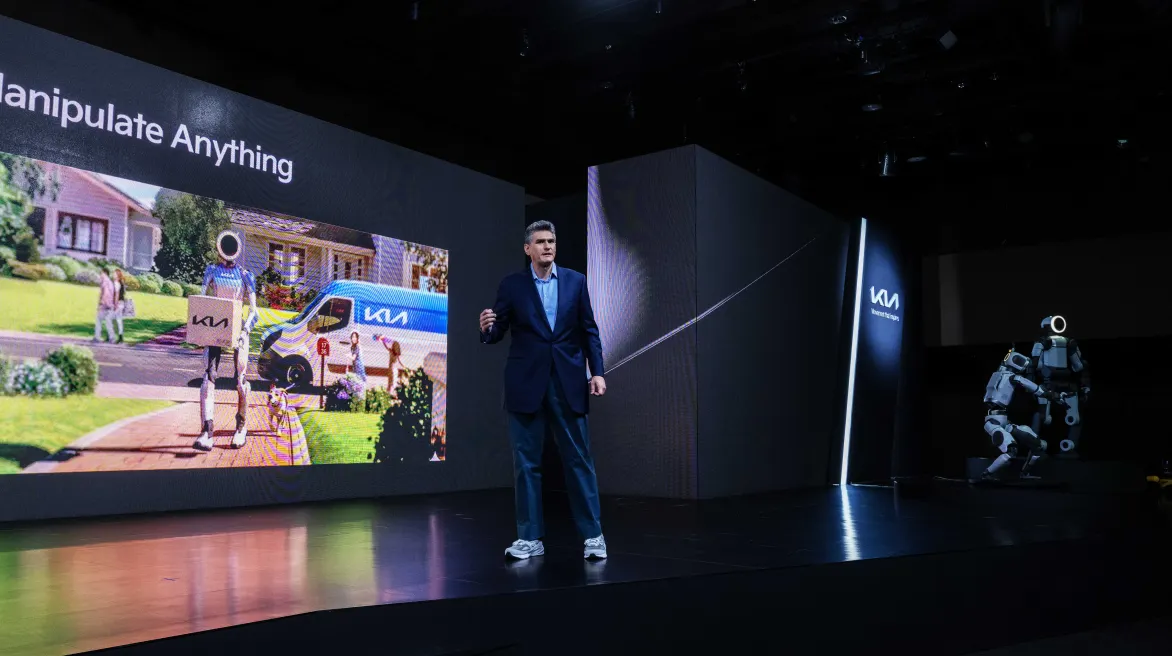
Robotics are part of the plan, too. Kia aims to develop last-mile delivery solutions that integrate robots with its PV7 and PV9 vans. It plans to deploy Atlas, the humanoid robot from Hyundai Motor Group subsidiary Boston Robotics, at Hyundai’s Metaplant America facility in Georgia starting in 2028, and then at Kia’s own West Point, Ga., plant from 2029.
Globally, Kia has 13 mixed-production plants that allow greater flexibility, plus two EV-dedicated plants that aim for efficiency with fewer parts and processes plus cost savings through dedicated EV platforms.