Dive Brief:
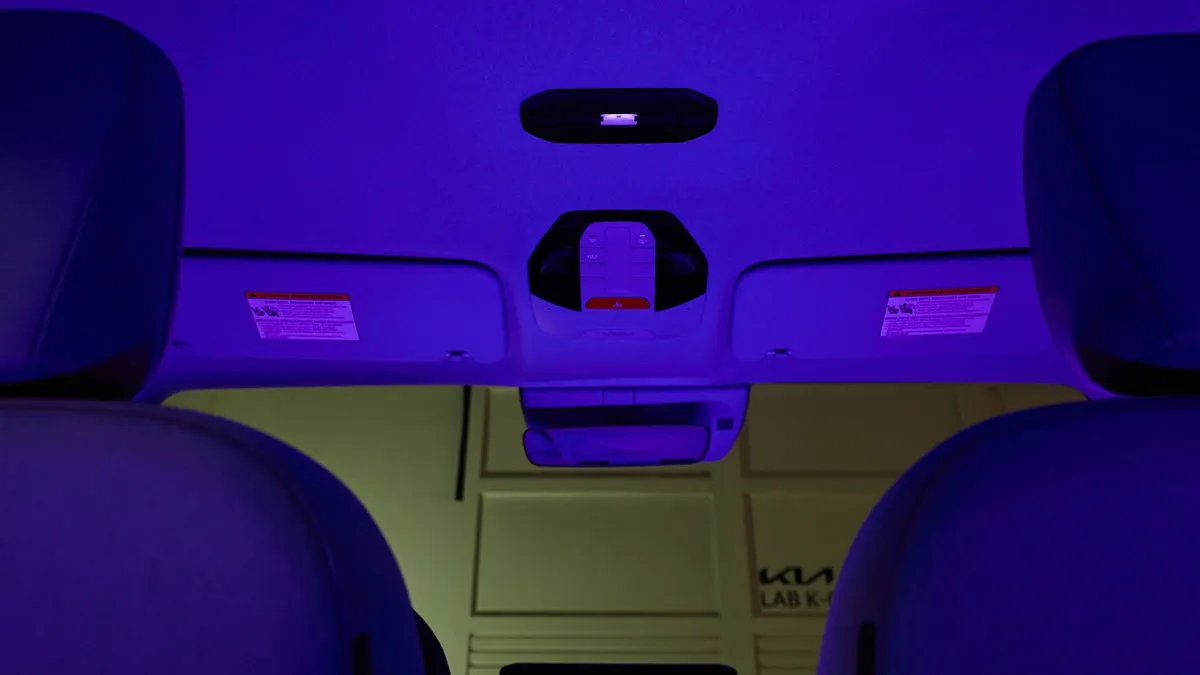
- Hyundai Motor Company and its sister company Kia unveiled the world’s first in-vehicle sanitization technology that uses a plasma lamp to sanitize the vehicle cabin space and reduce odors, even when passengers are present, per a June 24 press release.
- The technology called “Plasma Care UVC” utilizes Far-ultraviolet light in the 200-230 nanometer wavelength, which delivers sufficient energy to reduce microorganisms and odors but won’t be absorbed through human skin, according to the release.
- “Plasma Care UVC was developed for use in open vehicle cabin environments with passengers, moving beyond conventional sanitization methods that are limited to enclosed areas,” said Han Joo Jang, senior research engineer at Hyundai. “We expect it to serve as a valuable cabin hygiene solution that delivers a more pleasant mobility experience across future mobility scenarios, including autonomous driving and purpose-built vehicles.”
Dive Insight:
Conventional UV sanitizers, such as those used for electric toothbrushes and inside vehicle glove compartments, use a higher 255-280 nm wavelength that can be harmful when directly exposed to humans. However, Far-UVC light in the lower 200-230 nm wavelength is safer as it won’t penetrate human skin. It’s widely used in hospitals, schools and other high-traffic public spaces.
Hyundai, however, said it faced challenges in applying Far-UVC to open vehicle cabin spaces, which required solutions to address. Among the challenges is the high concentration of vehicle electrical components and the close proximity to passengers.
First, Hyundai engineers had to miniaturize the plasma-based system to operate in an enclosed space with passengers present. Hyundai also made improvements to improve power efficiency and durability to ensure proper operation under vibrations and temperature fluctuations that a vehicle’s electronics are frequently subject to.
Hyundai engineers also developed “Optical Safety Control,” which is a specialized optical filter to provide an additional layer of protection. It ensures that the system only emits controlled Far-UVC wavelengths in the safer 200-230 nm range.
To validate the effectiveness of the sanitization technology, Hyundai and Kia conducted various tests at the component level along with full-vehicle evaluations in collaboration with certified testing bodies and specialized research institutions, according to the release.
The test included operating the Plasma Care system in an 8-cubic-meter chamber that simulates a vehicle’s cabin space. Testing performed by the Korea Testing Laboratory confirmed a 96.8% reduction in airborne viruses within 30 minutes, demonstrating its effectiveness cabin-wide.
Hyundai cautioned that its Plasma Care UVC system is a research and development project and is currently not available in production vehicles. Commercialization or application of the technology is still subject to further testing, validation, engineering development and applicable legal, regulatory and certification requirements, per the release.
Hyundai and Kia will continue conducting technical validation in line with international safety standards prior to offering the bacteria-reducing technology in production vehicles.