Editor's note: This article was originally published in Automotive Dive, which has merged with WardsAuto to bring you expanded coverage of the industry. For the latest news, sign up for our free, daily newsletter.
Dive Brief:
- Mercedes-Benz aims to use more than 200,000 tons of reduced-carbon-dioxide steel annually, according to a company news release Tuesday.
- European suppliers Salzgitter, Thyssenkrupp Steel, Voestalpine, SSAB and others will supply Mercedes-Benz with more climate-friendly steel.
- By 2030, the automaker aims to slash average CO2 emissions per passenger car by half compared to 2020 as part of its long-term plan to make its new vehicle fleet carbon-neutral.
Dive Insight:
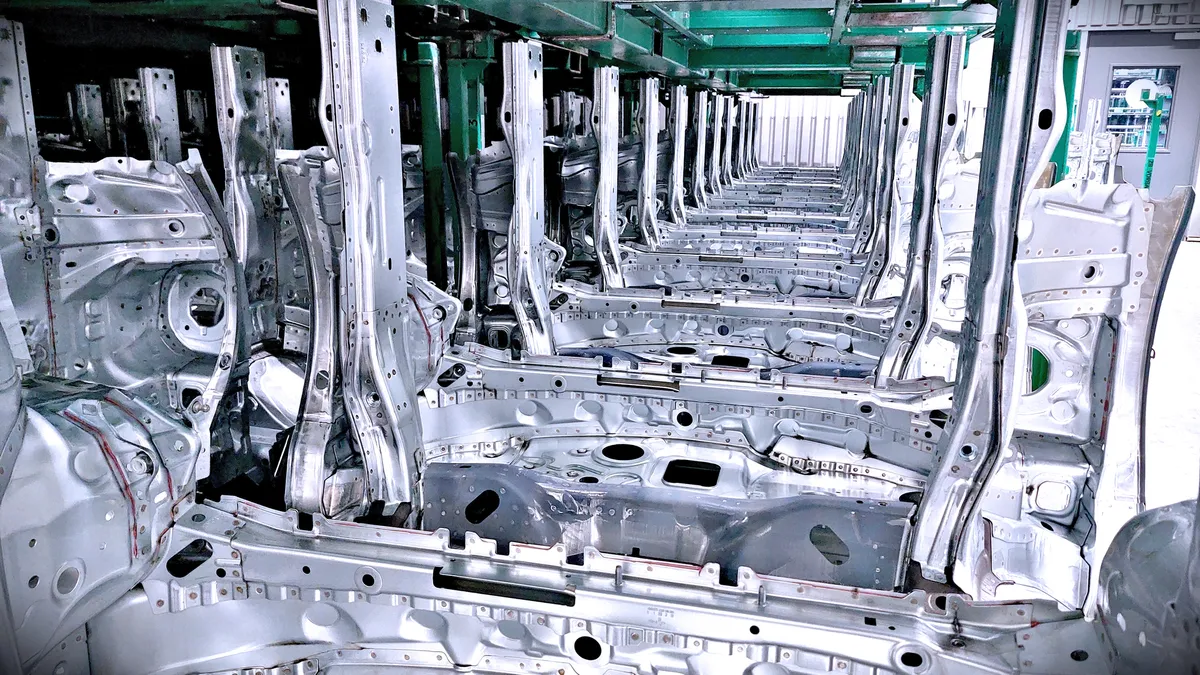
Automotive steel production typically uses immense, carbon-emitting blast and oxygen furnaces, generating more than 2 tons of CO2, on average, to refine 1 ton of final product. To address these environmental concerns, Mercedes-Benz plans to purchase steel that’s refined using more environmentally friendly electric arc furnaces, which can also generate the high heat needed to process steel for vehicle production.
Mercedes-Benz and Thyssenkrupp Steel signed an agreement to use CO2-reduced steel, aiming to make the entire production process nearly carbon-free. Thyssenkrupp plans to commission the first of these greener steel plants in 2026.
“The increased availability of green steel enables us to gradually introduce CO2 reduced steel and in a second step to use almost CO2 free steel in our vehicles, significantly helping to lower our carbon footprint," said Dr. Gunnar Güthenke, head of procurement and supplier quality at Mercedes-Benz Cars, in a statement.
Mercedes-Benz already sources CO2-reduced steel from Salzgitter in Germany. The steel is produced entirely from scrap using an electric arc furnace, which can reduce carbon emissions by more than 60% compared with blast furnaces. Mercedes-Benz has a similar deal with Italy-based Arvedi, which plans to increase the production of CO2-reduced steel for the automaker.
As Mercedes-Benz electrifies its model lineup, the company will use CO2-reduced steel body components and crossmembers supplied by Sweden-based SSAB for its scalable, modular electric vehicle platform, which will be used across several Mercedes-Benz EV models starting in 2026.
Last week, Mercedes-Benz announced an agreement with Sweden-based H2 Green Steel to supply 50,000 tons of nearly CO2-free steel per year to its European stamping facilities. The agreement aims to establish a more sustainable steel supply chain for Mercedes-Benz in North America.
Mercedes-Benz acquired an equity stake in H2 Green Steel in May 2021.