
System under test – from software to virtual ECU
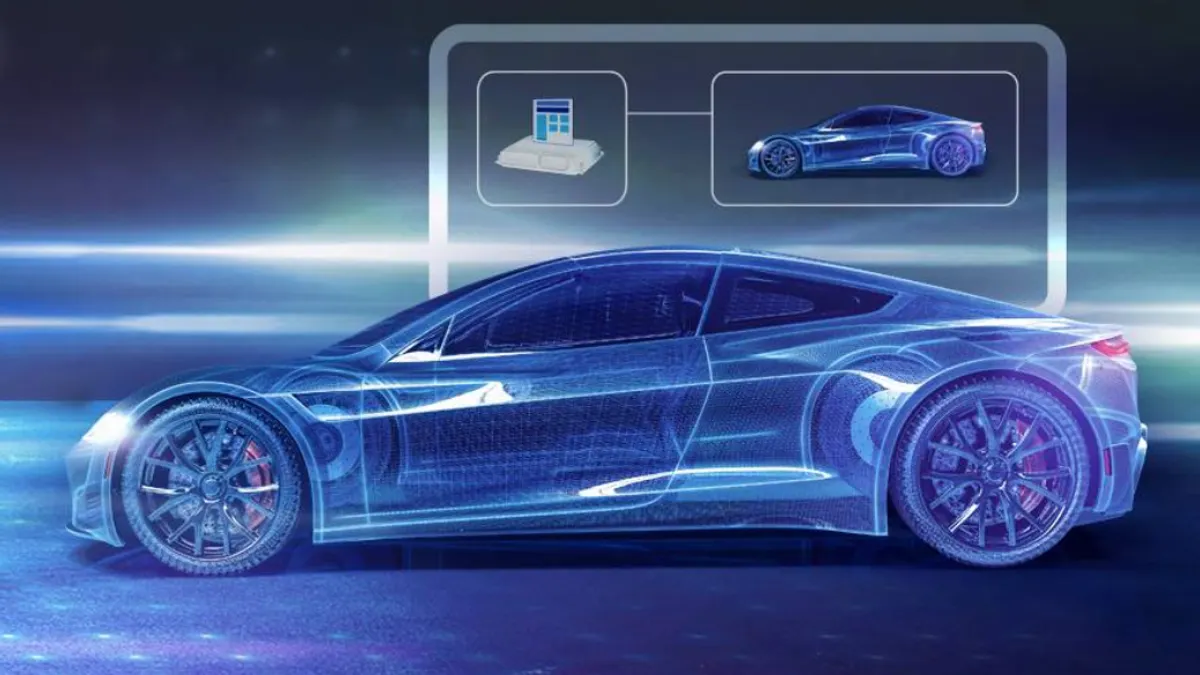
The system under test (SUT) is the focus of every test because it is precisely the software that will later have to prove itself on an ECU in real-world use. The Software-in-the-Loop (SIL) tests run completely without ECU hardware, which leads to many advantages, e.g., lower costs, easy scalability in the cloud, etc. But can realistic operating conditions even be represented without hardware?
Simulation and integration platform
VEOS is used as a central platform for the simulation and integration of the various simulation components. There, the V-ECUs and simulation models as well as everything else needed for simulation can be brought together. VEOS is not limited to dSPACE artifacts and tools but supports all relevant standards. If integration via standards is not possible, co-simulation can be used. This allows the integration of versatile components ranging from third-party models to other middleware (ROS etc.), POSIX-based ECUs and level 4 V-ECUs (instruction set simulation).
Automatic validation
Tests can be carried out 24/7 and allow collaboration across locations. At the same time, direct traceability of requirements, test cases and test reports is possible, as recommended by ISO 26262.
According to the official prostep white paper, five distinct V-ECU levels are defined:
| Level | Description | Typical Use Cases |
| 0 – Controller Model | Pure functional model for algorithm design and early validation | Algorithm development and early design iterations |
| 1 – Application Level | Application software without BSW; ideal for initial integration | Algorithm development and early design iterations |
| 2 – Simulation BSW | Adds simulated BSW for communication and timing analysis | Integration testing and network simulation |
| 3 – Production BSW | Includes real BSW for realistic behavior and compliance testing | Integration testing and network simulation |
| 04 – Target Binary | Full ECU software including the operating system (OS) and drivers | Pre-HIL validation and full system simulation |
The benefits of SIL:
-
Faster time-to-market: V-ECUs allow integration and functional testing months before hardware prototypes exist, reducing delays and helping teams move faster.
- Parallel development: Multiple teams can work concurrently on application software, basic software and integration tasks, boosting collaboration and resource efficiency.
- Scalable CI/CT workflows: Automotive software increasingly follows agile and DevOps principles. As V‑ECUs can be executed entirely in the cloud without hardware dependencies, they fit naturally into continuous integration and continuous testing (CI/CT) pipelines, enabling scalable automated regression tests, rapid updates and early defect detection.
- Reduced costs: Reduced reliance on prototypes and test benches lowers overall costs. Cloud-based testing reduces travel and logistics costs.
- Scaling for complex architectures: Modern electric/electronic (E/E) architectures include domain controllers, centralized computing and service-oriented communication. V-ECUs allow the simulation of entire vehicle networks, including CAN, LIN, FlexRay and Ethernet – without physical setups.
- Early safety and compliance assurance: Early validation of functional safety in accordance with ISO 26262, the automotive standard for safety-related systems and cybersecurity requirements reduces late-stage risks and helps teams stay compliant right from the beginning.
How do SIL and HIL form a unified workflow?
A standout innovation from dSPACE is the seamless integration of SIL and HIL environments. This unified workflow allows developers to reuse models, test cases and configurations in both domains, ensuring consistency, reducing duplication of effort and improving development speed.
AI-assisted V-ECU generation
Automotive OEMs and Tier‑1 suppliers can create and update V-ECUs faster, with reduced manual effort. At CES 2026, dSPACE demonstrated a GitHub Copilot-based concept, that shows how developers could generate V-ECUs directly within their development environment. This approach highlights how AI can accelerate the integration of ECU code into CI/CT pipelines, enhancing the efficiency and scalability of SIL validation. It also illustrates the potential to accelerate development pipelines for software-over-the-air (SOTA) updates and the digital homologation of software-defined vehicles (SDVs).
Conclusion
dSPACE is building a future where virtual validation is faster, smarter and more globally connected. They are moving beyond isolated workflows to integrated ecosystems powered by AI, cloud platforms and real-time collaboration – with safety and compliance built in from the start.
If you want to learn more about SIL, visit here.