The engineers behind the Chevrolet Corvette earn a Wards 10 Best Engines & Propulsion Systems trophy for the third year in a row with the ZR1, following wins for the E-Ray last year and the Z06 in 2023.
Starting with the already potent naturally aspirated LT6 5.5L V-8 from the Z06, General Motors engineers add twin turbochargers and an array of technology to create the most-powerful factory Corvette and America’s most-powerful automaker-produced V-8 ever.
“Stupendous,” “staggering” and “phenomenal” are adjectives judge Christie Schweinsberg suggests to describe the ZR1’s mill. “Those same adjectives could be used to describe the continued work of GM powertrain engineers, who without fail, year after year, manage to wring ever more power out of the LT engine.”
Dustin Gardner, assistant chief engineer-small block engines for General Motors, points out the ZR1 V-8 isn’t “an LT6 that we just slapped turbos on.”
The LT7 shares a common core with the flat-plane-crank, double-overhead-cam LT6, Gardner notes in a discussion with 10 Best judges, but nearly every part and system is optimized to support the engine’s prodigious demands. They include cylinder-head castings that feature unique CNC-machined ports and cylinder-block machining that create larger combustion chambers, along with upgraded pistons and connecting rods and related changes to crankshaft counterweights. The compression ratio drops to 9.8:1 compared with the LT6’s 12.5:1 ratio.
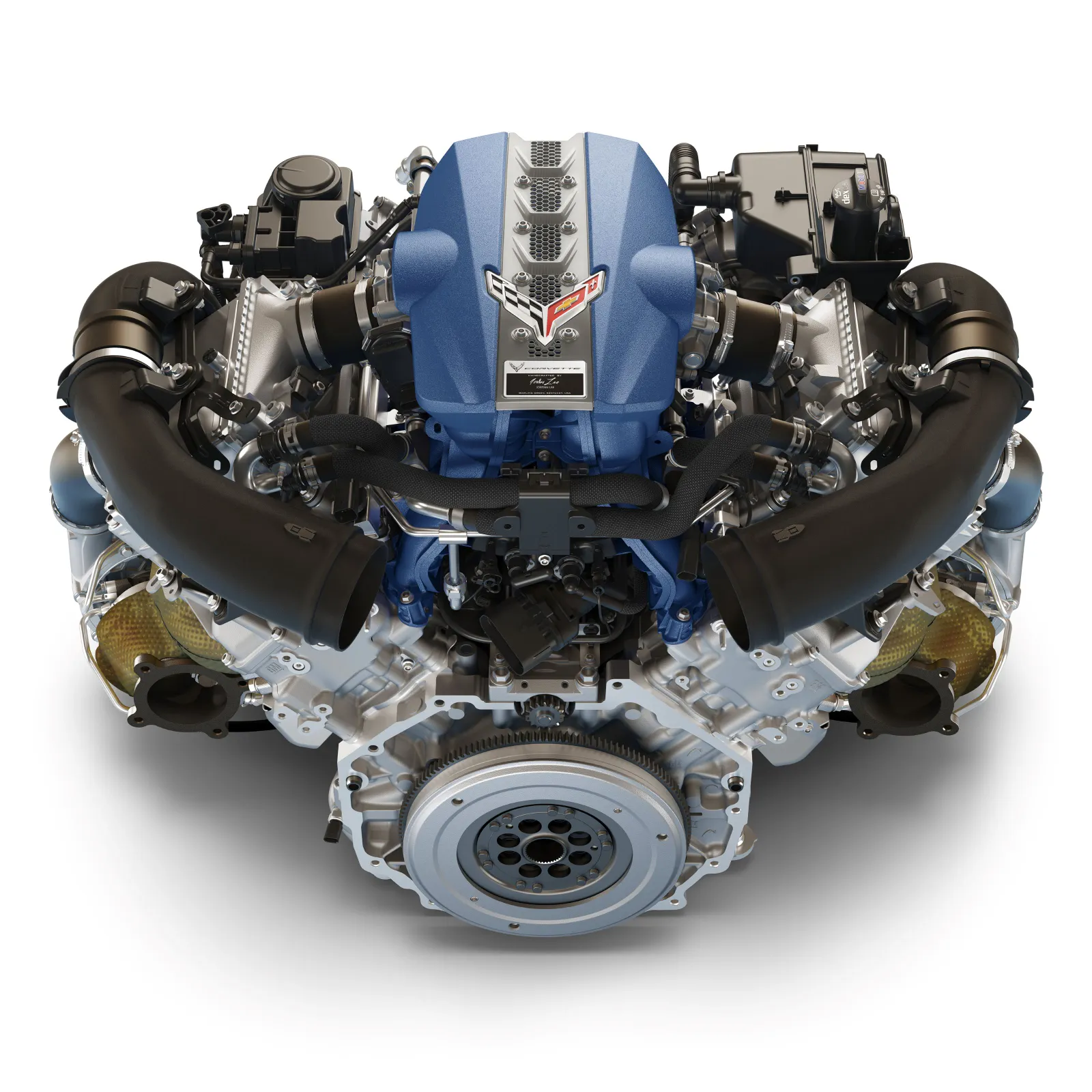
A completely revised intake system to support the turbos adds port injection to direct injection to supply enough fuel — as much as two gallons per minute at peak power. Water-jacketed exhaust-side injectors create tumble in the combustion chamber without impeding air flow.
Exhaust manifold-integrated turbos — the world’s largest on a production car at 76 mm — employ speed sensors that help keep the turbos spinning at the boost limit for immediate response. “It’s like having a stick shift without a tachometer,” Gardner explains. The turbos spin at up to 137,000 rpm, while 15 heat exchangers – two more than on the Z06 — cool air to the turbos while drawing heat away from the powerplant.
As a result, the hand-built Gemini V-8 “twin” in the ZR1 blows past the 850-hp goal set 15 years ago when development began for the mid-engine C8 Corvette, says Jordan Lee, GM’s global small-block chief engineer. The actual number? An impressive 1,064 hp — 193 hp/L — backed by 828 lb.-ft. (1,123 Nm) of torque.
Engineers also made numerous changes to the ZR1’s 8-speed, dual-clutch transmission to make it more robust and capable of channeling the powerplant’s output.
Fuel economy is hardly a consideration for intended buyers, but it should be noted that the ZR1 still manages 18 mpg (13.1 L/100 km) on the highway.
Yes, the ZR1 is a beast, setting track records here and abroad and posting 233 mph (375 km/h) on a track with none other than performance cheerleader GM President Mark Reuss at the wheel.
At the same time, our judges applaud our carbon-fiber-clad $225,000 test car’s ability to run relatively composed and quiet on demand.
“The NVH engineers did a fantastic job of taming the beast that lies within, for moments when you don’t want to jolt the neighborhood,” says Schweinsberg.
Adds judge Dave Zoia, of the LT7 and the ZR1: “This is an engineering tour de force. It’s a quick-to-respond rocket of a sports car that also is easy to drive, settling down nicely at highway cruising speeds. Bottom line: The powertrain is definitely on brand. Does it sell the car? Oh yeah.”
Quips judge Drew Winter: “It’s not the car’s fault if you get arrested taking your kid to baseball practice.”