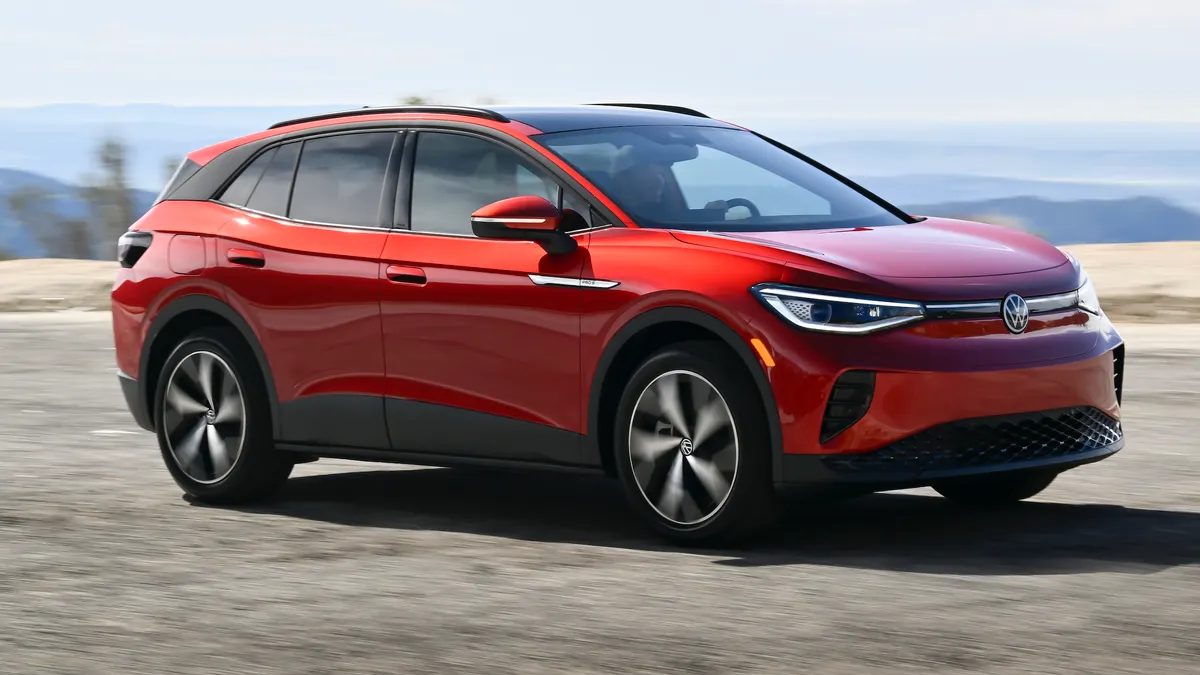
Volkswagen Group of America has recalled more than 44,000 model year 2023-2025 ID.4 electric SUVs for the risk of battery fires across two separate recalls that were submitted to the National Highway Traffic Safety Administration on Jan. 21.
One of the recalls covers 43,881 ID.4s and the second, more urgent recall, which includes a “park outside” warning immediately after charging due to fire risk, covers 670 vehicles. The two recalls followed another in December for 629 ID.4s, also due to the risk of battery fire.
Dealers will inspect the batteries on ID.4 models and install updated diagnostic software to better monitor battery health at no cost to owners.
Based on the dealer test results and discovery of potential software warnings, any defective high-voltage battery modules found in ID.4 models will also be replaced. However, vehicles included in the smaller, more urgent recall will have their battery packs replaced immediately due to fire risk
The defect is due to misaligned electrodes during manufacturing, which were confirmed by Georgia-based supplier SK Battery America, a subsidiary of South Korea-based EV battery manufacturer SK On.
The two latest recalls include ID.4 models produced at various times between Sept. 2, 2022, and April 10, 2025. Within the larger recall of 44,881 EVs, just 1% of the vehicles are estimated to have the defect. However, for the second, more urgent recall covering 670 ID.4 EVs, 100% of the recall population is estimated to have the battery defect.
ID.4 owners are also being advised not to use Level 3 DC public chargers and to limit the maximum charge of their vehicle’s battery to 80% until a remedy is available.
Owner notification letters for both recalls are expected to be sent March 20.
A multi-year investigation into ID.4 battery fires
The two recalls stem from a multi-year investigation of battery fires in ID.4 EVs equipped with cells supplied by SK Battery America. In rare cases, defective battery cells may experience “thermal propagation,” where heat or fire from a single failed cell spreads to adjacent cells within the high-voltage battery pack, resulting in a dangerous chain reaction within the module that can result in a fire.
Volkswagen first learned of a battery fire on Jan. 18, 2024, involving a ID.4 vehicle that was charging at a Level 3 charger in Illinois. After examining the suspect vehicle and its high-voltage battery, the automaker determined that the fire originated within the battery module.
The company also traced three additional ID.4 fires in 2024, two in California and one in Utah, which were potentially related to defective battery modules, according to the December 2025 recall report chronology.
In June 2025, Volkswagen's battery supplier SK analyzed cell modules from three different battery fire incidents using CT imagery, but the results were inconclusive.
But two months later in August 2025, Volkswagen was informed of another thermal event involving an ID.4 that was charging at a Level 3 DC charger in Colorado. This vehicle was inspected by the automaker’s engineers in September and the fire’s origin was traced to the high-voltage battery.
After regular discussions between Volkswagen and SK in late September 2025 to identify a root cause, SK conducted a teardown analysis of the vehicle’s fire-damaged battery modules and confirmed the presence of a “shifted electrode” condition, according to the recall report. After comparing the teardown results with the CT scans conducted in June 2025, SK Battery America confirmed that the same defect was present.
In October 2025, Volkswagen voluntarily shared these thermal incidents with the NHTSA’s Office of Defects Investigation during its quarterly meeting with the agency, and said it was working with SK to “finalize root cause, risk assessment, affected population and countermeasures,” per the report.
In November 2025, SK identified specific battery modules manufactured with misaligned electrodes, allowing Volkswagen to build an affected vehicle population based on its supplier records. Based on SK’s findings, the automaker’s Product Safety Committee elected to issue a recall.
However, the initial Dec. 3 recall only included 311 ID.4 vehicles based on the manufacturing records SK provided to Volkswagen. Still, 100% of these recalled vehicles were estimated to have the battery defect.
Less than a week later, SK notified Volkswagen that it had identified additional defective battery cell modules with misaligned electrodes, widening the initial recall population of 311 vehicles. The automaker then amended the initial recall to include these additional vehicles on Dec. 15, 2025, bringing the total population to 629 ID.4 EVs.
But as the investigation into defective battery cells remained ongoing, Volkswagen determined that additional recalls were necessary after SK identified a second hardware issue that could cause a different “shifted electrode condition” during the manufacturing process, per the recall report. While the issue could not be linked to any known vehicle incidents, Volkswagen identified another 670 ID.4 vehicles with defective battery modules confirmed by SK.
As a result, a second recall was approved by the automaker’s Product Safety Committee Jan. 14, which was submitted to the NHTSA on Jan. 21.
Volkswagen also identified additional vehicle fires in ID.4 vehicles outside of the initial population of 629 identified by SK, including three incidents in 2025.
According to Volkswagen's internal data, its “Self-Discharge Detection” software available on some ID.4 models at the time might have issued warnings to the driver before these fires occurred.
Therefore, out of an abundance of caution, the company elected to issue a third recall to inspect the batteries on an additional 43,881 ID.4s, to ensure that the self-discharge detection software is installed on 100% of the recall population.
In January 2025, SK installed cameras at its manufacturing facility that can identify anomalies during the battery cell stacking process in an effort to prevent future battery manufacturing defects, per the recall report.
The ID. 4 was also recalled for other issues last year. In February 2025, Volkswagen recalled nearly 14,000 ID.4 and Audi e-tron models for a printed circuit board fault that can cause the battery not to charge and lead to a loss of drive power.
A second recall was issued that month for nearly 61,000 ID.4 and Audi e-tron models for a software error causing the gearshift indicator to not display the neutral position, increasing the risk of a rollaway if the parking brake was not engaged.