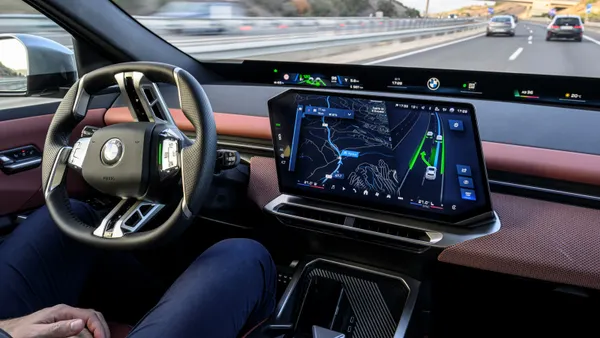
A deal to collaborate with Volkswagen and Valeo on next-generation Level 2-plus (hands off, eyes on) advanced driver-assistance system technology puts Mobileye more firmly on the path to achieving the autonomous-driving ambitions the Israel-based developer detailed at CES 2025 in Las Vegas in January.
Under the collaboration, Mobileye will provide its Surround ADAS platform to VW for application in its next-generation MQB-based vehicles that will launch in the next few years. Valeo will provide its suite of high-performance ECUs, sensors and parking-solutions software, marking the first time the Valeo and Mobileye applications will be combined in a single system.
The integration of the Mobileye and Valeo technologies will improve efficiency, upgrade system performance and enable over-the-air updates that could be used to enhance capability and meet future safety requirements, the companies say.
“This cooperation supports us on our road to transformation: By sourcing hardware and software together, we streamline procurement, reduce complexity and improve efficiency,” says Dirk Große-Loheide, head of procurement for the Volkswagen brand.
VW’s MQB platform underpins a variety of models for the German automaker, including the Golf, Passat and Polo, as well as vehicles from other Volkswagen Group brands, representing a high-volume application for Mobileye and Valeo.
Mobileye’s ADAS ambitions include application of its more-advanced SuperVision platform, which adds capabilities beyond Surround ADAS, including true point-to-point navigation and urban piloting.
The company, part of Intel, also is working to further develop its Chauffeur technology, which is a Level 3 (hands off, eyes off) system, and its Drive platform that is designed for Level 4 operation (driverless vehicles operating in geofenced territories).
The SuperVision and Chauffeur platforms are targeted at retail-vehicle buyers, while Drive is aimed at mobility-fleet operators and is nearing a testing phase with VW’s MOIA mobility division. Vehicles developed with MOIA are slated for series production in 2026, and the Drive software platform is expected to become more widely available in 2027.
Current-generation Supervision technology already is on the road in China on the Zeekr 001 sedan and will be offered in Polestar 4 models in Europe and the U.S. beginning later this year. However, that ADAS platform is headed for an upgrade to Mobileye’s EyeQ6 chip that will allow urban and rural driving scenarios at speeds up to 81 mph (130 km/h). EyeQ6 is said to be 10 times more powerful at Mobileye’s current EyeQ5 processor.
Mobileye believes its two paths toward automated driving technology – Level 2-Level 3 ADAS systems for retail buyers and Level 4 systems for mobility fleets – will ultimately converge in a scalable, Level 5 (fully autonomous driving) technology solution that is cost-effective for both automakers and consumers by the end of the decade.
In its CES backgrounder, the company puts the cost to OEMs of its base ADAS platform at $700-$800, while SuperVision systems running on the EyeQ6 should be available for $2,000-$2,500 at launch next year and then decline to $1,200-$1,900 in future generations.
Its Chauffeur platform is targeted at under $6,000 for its launch in an Audi vehicle next year.
“These are costs that fit high-volume production, and this is critical,” CEO Amnon Shashua said in January, emphasizing, “(This is) systems cost. It’s not EyeQ cost. It’s the entire system cost to the OEM.”
Speaking of the latest collaboration with VW and Valeo, Shashua says,“By improving efficiency and costs while upgrading capabilities for safety and comfort in driver assist, this system points the way to a new class of driving technology.”