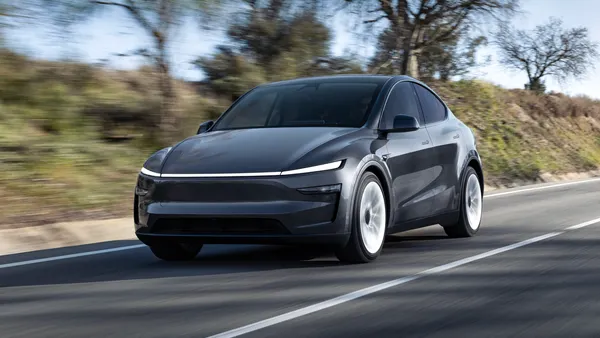


Volvo Cars claims one of the smallest lifecycle carbon footprints of any model it has ever produced for its new flagship battery-electric luxury sedan, the ES90.
Yet, hard on the heels of trumpeting its climate-conscious credentials, the automaker warns that it will probably lose money on the new luxury model owing to tariffs on Chinese-built BEVs in North America and Europe.
The model, which starts production this summer, is built on the same platform as its SUV sibling, the EX90, at parent company Geely’s plant in Cixi, Zhejiang, China, and gets hit by the U.S.’s 100% tariff on Chinese-made BEVs, which has moved Volvo to decide not to sell it stateside.
Volvo announced a one-time SEK 11.4 billion ($1.23 billion) non-cash impairment charge in the first quarter of 2025 linked to previous launch delays for the EX90, the new import tariffs in both the U.S. and Canada and even the much less punitive tariffs imposed on Chinese BEVs by the European Union.
In a company release, the automaker says its EX90 model will have a reduced lifecycle profitability because of “significant launch delays in the past and subsequent additional development costs.”
At the same time, import tariffs mean Volvo will be “unable to sell the Volvo ES90 profitably in the United States” while the EU tariffs will squeeze production margins for models sold in Europe.
“Given market developments such as import tariffs in the U.S., development and launch delays for the EX90 and strategic investment prioritizations, we have reassessed volume assumptions for these two cars. This has resulted in a lower than planned lifecycle profitability,” says Fredrik Hansson, chief financial officer at Volvo Cars.
On top of this, the ES90 model is being launched during a slowdown in sales of luxury BEV models in most of Europe and is slated to enter most European markets later this year priced from €71,000 ($82,900).
According to the latest data from Jato Dynamics, vehicles in the plus-€50,000 ($58,380) bracket, including most Tesla Model Y options, BMW i4, Volvo EX30, Audi Q4 e-tron and the Mercedes EQA, have all seen declines in new registrations for May 2025.
Still, the automaker is proud of the new model’s climate-friendliness, claiming a total carbon footprint of the ES90 of 31 tons when using a European energy mix for electric charging.
This falls to just 26 tons when using energy created by wind farms and is only marginally bested by hydrogen fuel-cell vehicles when similarly fed exclusively on hydrogen produced through renewable energy, according to the latest study from Europe’s International Council for Clean Transportation (ICCT).
In Volvo’s own commissioned carbon footprint report, the ES90’s footprint is about half that of the Volvo S90 mild hybrid model and is also 30% lower than that for the Volvo plug-in hybrid S90. It’s even lower than its BEV stablemate, the EX40 compact SUV.
The ES90 is built with about 29% recycled aluminum, 18% recycled steel and 16% recycled polymers and bio-based materials such as real, FSC-certified wood in the cabin.
Inside, customers can pick a Nordico upholstery option made from recycled material such as PET bottles and bio-attributed material.
It also comes with Volvo’s world-first battery passport, based on blockchain technology that allows the company to track the origin of raw materials and the overall health of the battery.
“We go above and beyond existing legislation and have clear ambitions, because that is important to us,” says Vanessa Butani, head of global sustainability at Volvo Cars.