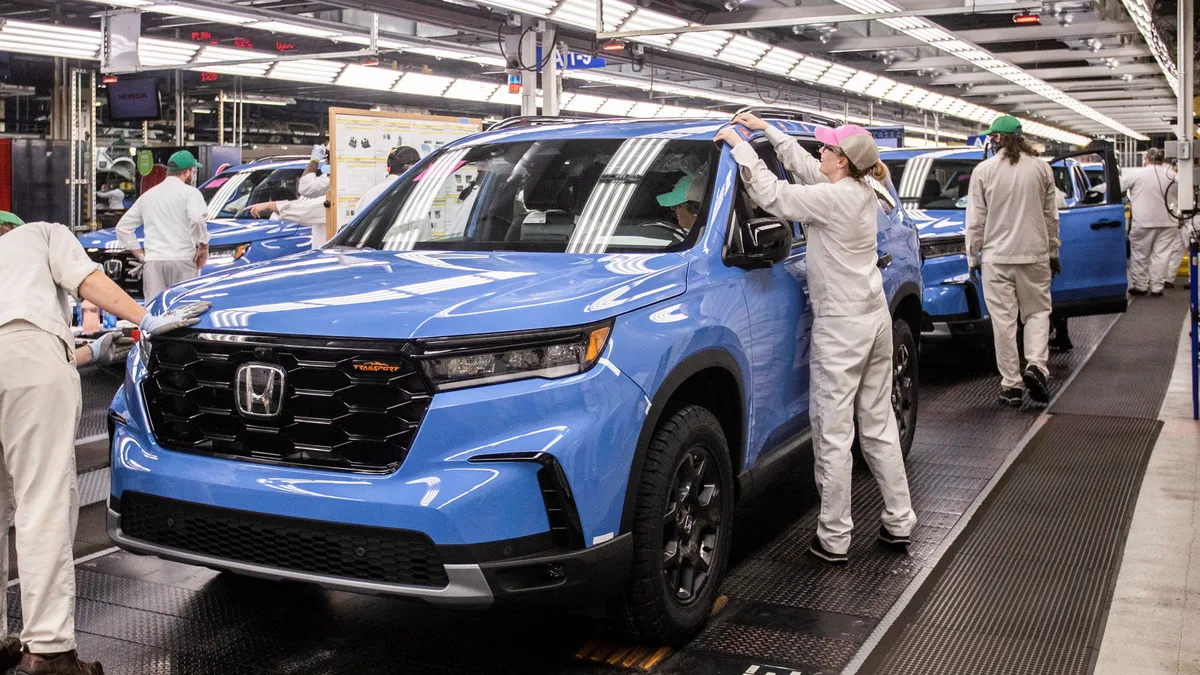
The auto industry is the target of much disruption by the Trump Admin. as the White House delays implementation of 25% tariffs on autos and auto parts crossing the northern and southern borders by a month. Meantime, the administration favors new legislation that would give enormous tax advantages to automakers who relocate manufacturing from Canada and Mexico to the U.S. long term.
If the tariffs are meant to be a stick against auto companies and other manufacturing sectors to move more jobs into the U.S., there is also a carrot.
A new bill favored by President Donald Trump, the Transportation Freedom Act, has been introduced by Ohio Republican Sen. Bernie Moreno. The bill proposes a 200% tax deduction for wages paid to American auto workers, applicable up to $150,000. This measure seeks to invest in domestic manufacturing and ensure that companies utilize the savings for purposes other than stock buybacks.
The bill has garnered support from major automotive industry stakeholders, including General Motors, Stellantis, Toyota, the National Automobile Dealers Assn. and the Alliance for Automotive Innovation. The UAW, despite not endorsing Trump last year, have also applauded the long-term effect of tariffs to compel automakers to locate more plants in the U.S.
The tax benefits to automakers in the Republican bill are intended to offset the burden of paying healthcare premiums for employees, which are far higher in the U.S. than in Canada and Mexico.
Auto companies have shifted manufacturing and parts production to Mexico and Canada over the years due to several key economic and regulatory factors: chiefly wage levels and the high costs of providing healthcare for U.S. employees.
The average cost of employer-sponsored health plans is greater than $16,000 per employee, according to professional services company Aon. Canada has a workforce comparable to the U.S., and that country has universal healthcare for all citizens, saving automakers at least $200 per vehicle in employee healthcare costs. In Mexico, healthcare costs for employers are considerably lower than in the U.S., as well, and daily wages for an auto worker are just $33.44, per Mexican professional services company Tetakawi. All three Detroit automakers met Wednesday with Trump and his trade advisors to hear details of the expected fallout from the tariffs, expected to add between $3,000 and $12,000 to the cost of new vehicles manufactured in Mexico and Canada, including the cost of parts made in the two countries for vehicles assembled in the U.S.
The White House regularly misrepresents how tariffs work, implying to voters that Canada and Mexico will pay the tariffs. In fact, tariffs are paid, in this context, by the automakers and parts companies, which in turn pass the higher costs on to consumers.
Before the one-month reprieve, Alliance for Automotive Innovation CEO John Bozzella said, “All automakers will be impacted by these tariffs on Canada and Mexico. Most anticipate the price of some vehicle models will increase – by as much as 25% – and the negative impact on vehicle price and vehicle availability will be felt almost immediately.”
According to the White House press office, Trump told the automaker CEOs to “start investing, start moving” and that they should “shift production here to the United States of America, where they will pay no tariff.”
Labor Shortages an Obstacle
Returning manufacturing jobs to the U.S. is a popular political goal, but it faces some difficult realities. Before the tariffs were talked up in last year’s campaign, U.S. companies were already complaining of labor shortages. The manufacturing sector has a substantial number of workers nearing retirement age. The departure of these experienced employees creates a gap that is difficult to fill promptly. Modern manufacturing increasingly relies on advanced technologies requiring specialized skills. There’s also a shortage of workers with the necessary technical expertise, leading to unfilled positions.
And according to research by insurance company Liberty Mutual, there are shifting workforce preferences with younger generations often perceiving manufacturing jobs as less attractive compared to careers in technology or services. This perception reduces the influx of new talent into the manufacturing sector.
The loss of manufacturing capacity in Mexico and Canada will make for a bumpy transition. And the likelihood of the Trump Admin. encouraging immigration of displaced labor from Mexican auto plants seems unlikely.