

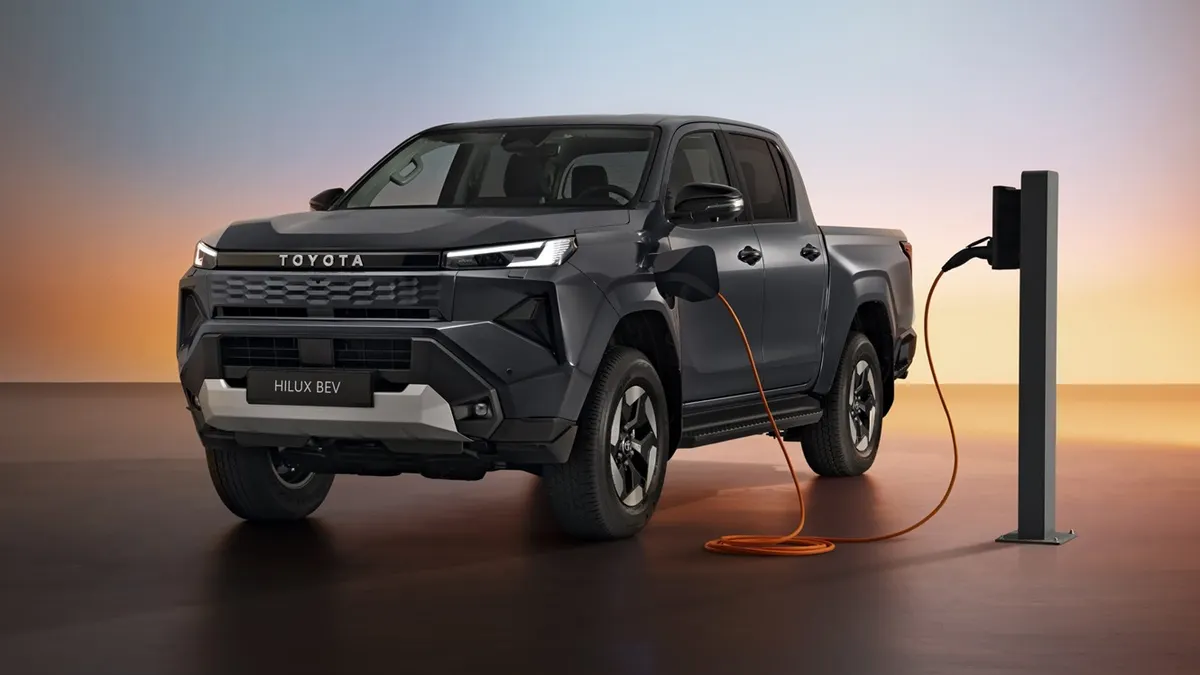
Toyota has unveiled its ninth-generation Hilux mid-size pickup as double cab to meet consumer demand, with the range that includes a battery-electric version, an existing 2.8-liter turbodiesel mild hybrid and a hydrogen fuel cell scheduled to reach markets in 2028.
In a news release, the company highlights its multipath powertrain strategy which “recognizes that different customer needs and local conditions cannot be addressed by a single solution.”
The Toyota Hilux BEV targets commercial fleet customers requiring zero tailpipe emissions, especially in urban areas where clean-air regulations apply.
Yet, the automaker insists the vehicle loses nothing against its ICE siblings by maintaining the same wading depth of 70 cm, while employing “measures to protect the battery from damage or water ingress,” its release stated.
Its powertrain features a 59.2 kWh lithium-ion battery and front and rear eAxles providing permanent all-wheel drive, with 205 Nm of torque generated at the front and 268.6 Nm at the rear.
On this version, the aerodynamics package dispenses with the traditional grille and dedicated light alloy wheels are fitted to save weight.
Initial testing data approximates 715 kilograms (1,576 lbs.) of payload capacity and a towing capacity of 1,600 kg, with an European WLTP-rated driving range of about 150 miles.
The 2.8L turbodiesel version, paired with a mild-hybrid powertrain system, first introduced in the Hilux range earlier this year, continues to build on its volume selling status in Europe. Production will begin in spring 2026.
Its powertrain features a 48-volt lithium-ion battery, an electric motor-generator and a DC-DC converter to support the 2.8-liter turbodiesel engine.
The system claims 204 hp and 500 Nm delivered between 1,600 rpm and 2,800 rpm. It boasts a payload up to 1,000 kg and towing capacity is 3,500 kg with a braked trailer.
Internal-combustion engines will be available in some global markets such as Eastern European nations.
Toyota promises a hydrogen fuel cell system variant will be marketed in Europe within three years following extensive testing by its U.K. vehicle production facilities.
Visually, the new model features slim-line headlight units linked by a central bar carrying the Toyota brand name. New features for all versions include a rear deck step for easy access while selected models have a redesigned side step.
Inside, the vehicle draws design cues from the Toyota Land Cruiser and includes a new horizontal design and, depending on the model selected, incorporating a 12.3 in., customizable driver’s instrument display and central multimedia touchscreen of up to 12.3 in.
All the AWD and off-road controls are centrally grouped for ease of operation with the BEV model adopting a single-action shift-by-wire drive selector.
Hilux owners can access remote and connected services using the MyToyota app while fleet managers can view data from up to 10 vehicles, including location, fuel level and BEV charging status and driving analytics such as journey history.
The Toyota Safety Sense advanced driver assistance system includes Low Speed Acceleration Suppression, Proactive Driving Assist, Emergency Driving Stop System, Blind Spot Monitor, Safe Exit Assist and a driver monitor camera. The system also supports over-the-air updates.