

As both legacy and emerging automakers turn to digital specialists for the software in their vehicles, they should also be considering hardware solutions for powertrains.
That’s the message from Horse Powertrain’s CEO Matias Giannini. WardsAuto caught up with him at the IAA Mobility 2025 in Munich, where he said he envisioned automakers being able to react quickly to consumer demands with his company’s all-in-one powertrain solutions.
Horse Powertrain, a joint venture between Geely and Renault established in 2024, boasts a production network that includes 17 plants and five research and development centers in Europe, China and South America.
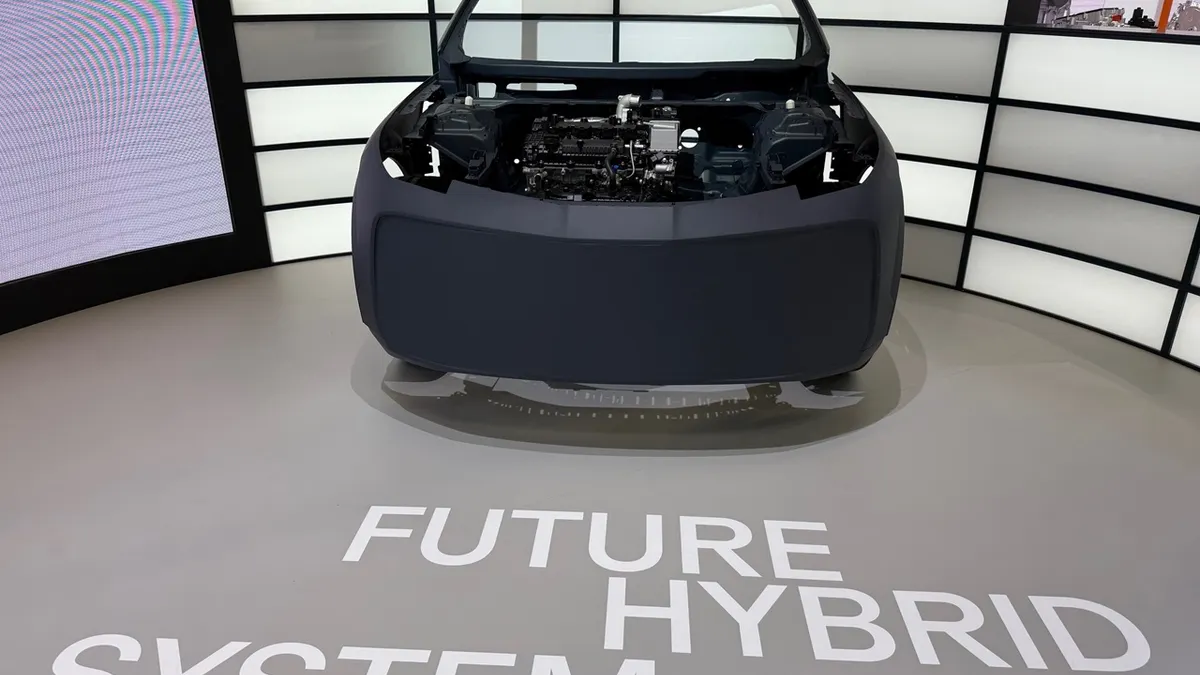
The company’s powertrain solutions cover the spectrum of currently available technologies and it used the Munich event to showcase its Future Hybrid System, first shown at Auto Shanghai 2025. It’s a hybrid powertrain that combines an engine, transmission, motor and power electronics into a single system.
The Future Hybrid System replaces the front electric drive unit of an electric vehicle, converting it into a hybrid, plug-in hybrid or range-extended vehicle with minimal modifications to the original platform.
The system has two variants. The first is a 29-inch (740 mm) wide unit with two motors, one at the engine output shaft and another at the transmission output shaft. The second is a 25.6-inch (650 mm) wide version, which uses a single motor between the engine and transmission.
Both versions use a 1.5-liter, four-cylinder engine and dedicated hybrid transmission and include the power electronics required for hybrid powertrains. The Future Hybrid System also integrates with other vehicle systems, including a DC/DC converter, on-board charger and an 800-volt charging booster.
Horse Powertrain also presented the Horse C15, a plug-and-play hybrid or range extender powertrain it says can apply to EV platforms. Boasting the dimensions of a large briefcase, the Horse C15 all-in-one powertrain includes a 1.5-liter, four-cylinder engine with a generator, exhaust and cooling package.
For B-and C-segment vehicles, the Horse C15 is naturally aspirated with a maximum power output of 94 hp (70 kW). For larger D-segment vehicles and small light commercial vehicles, the addition of a turbocharger boosts output up to 161 hp (120 kW).
According to the company, one of the key advantages of the unit’s size and shape is that automakers can install it horizontally or vertically to convert their electric platforms into range-extended electric vehicles. The Horse C15 can also run on various fuels, including gasoline, ethanol and methanol flex fuels and synthetic fuels.
Giannini said that the Future Hybrid System concept took its engineers less than a year to perfect, employing the long tradition of powertrain design from Renault with the lightning speed of production from Geely’s China manufacturing processes.
The system displayed at Auto Shanghai earlier this year has been improved, and the “2.0 version” unveiled in Munich is very near series production, he said.
We don’t call it a hybrid concept anymore,” Giannini said. “We call it a hybrid system because we moved already from concept to development. We are developing this, it’s not just an idea on a piece of paper,” he added.
He said this speed of production is what will help automakers cut vehicle development time and get products into markets to meet local consumer demand faster than ever.
Giannini pointed to Mercedes-Benz using Qualcomm technology in its latest models as an indication of how outside suppliers can adopt both software and hardware.
“OEMs have developed and launched powertrains their whole life,” he said, adding: “Is that the most efficient way for them to do it?”
He responded to his own question, suggesting it is not. While niche sports car consumers will still want their V8 and V12 ICE vehicles, the majority of the market will be using electrified powertrains.
“For the majority of the other vehicles, we're going into a direction where the powertrain is becoming a commodity,” he explained.
In this scenario, the automaker can save money, said Giannini, because an EV with a battery size that’s half of what it currently needs would save much more on production costs than the price of adding a range extender unit.
“Then they can offer that vehicle at a more competitive cost to the consumer and, powered by a biofuel like in Brazil with ethanol, that vehicle, that solution is cleaner than it was an EV,” he said.
Giannini said he is a firm believer in a multi-path approach to powertrain technology, at least for the medium-term.
He highlighted an assessment of EV adoption published in September by EY. Its Mobility Lens Forecaster findings analysis suggests a slower Europe and U.S. path to mass EV adoption, affected by policy volatility, tariffs and affordability.
In its key findings, EY estimates that the U.S. won’t reach 50% EV adoption until 2039, five years later than its original forecast. Giannini also warned that EU mandates to effectively ban ICE powertrains for new car sales by 2035 would be disastrous for the industry.
“The mistake, in my opinion, was when legislators went from: ‘How is your industry going to solve this problem?’ and ‘Let's establish some targets to get there’, to: ‘I am going to dictate which one of the many avenues that you have to go!’”
The result is a scenario that will see owners of older, more polluting, vehicles hold on to them after the ICE ban and, so, would not be helping to clean up the Continent’s [EU] fleet, said Giannini.
Until the infrastructure challenges are resolved, both for the consumer and for the energy industry supplying green electricity, hybrid and carbon-neutral fuels are essential tools to decarbonize Europe’s transport industry, said Giannini.
“It’s creating a gap in the powertrain market, and that’s what Horse Powertrain is all about, helping the OEMs to fill that gap,” he concluded.