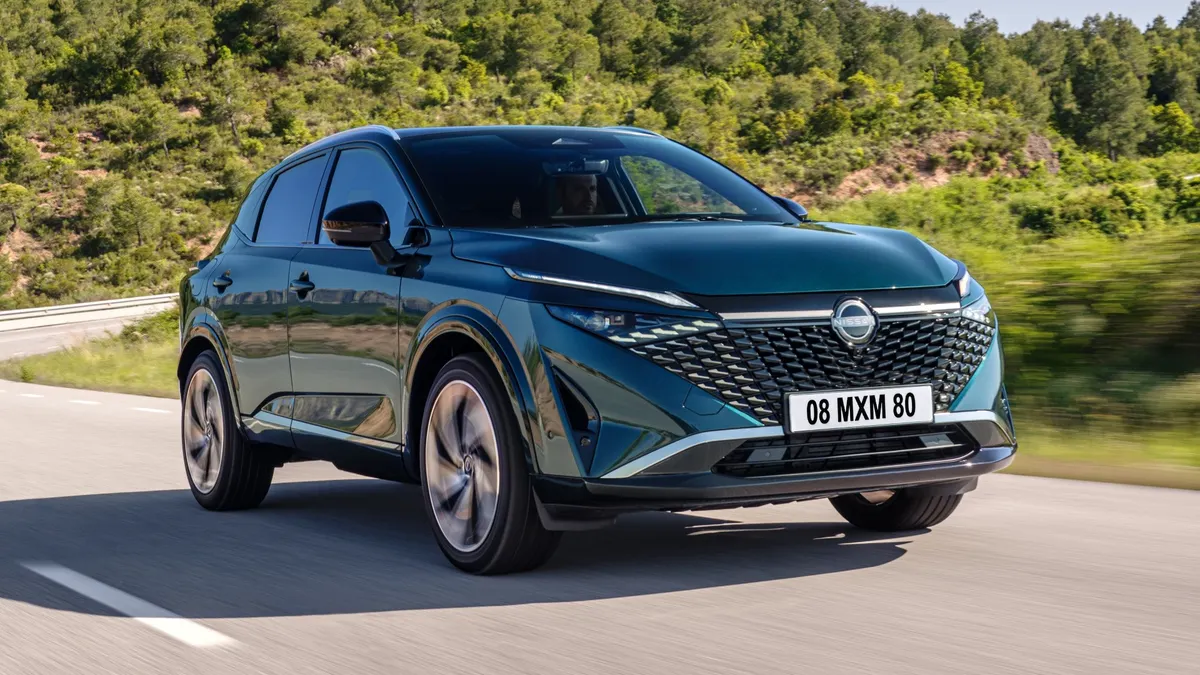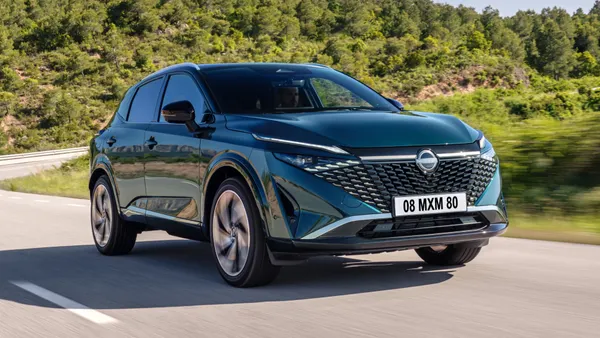


After spending its first 15 years as a compact hatchback, the world’s first mass-produced battery-electric vehicle goes crossover.
However, that’s not the only big news for the 2026 third-generation Nissan Leaf. It also will have a longer range and faster charging times than its predecessors.
Nissan's U.S. unit is touting the new Leaf will travel up to 303 miles (488 km) on its 75-kWh Li-ion battery pack, up from the second-gen, long-range Leaf’s 212 miles (341 km) with its 62-kWh pack and a sharp increase from the 2011 Leaf’s 73 miles (118 km) from a 24-kWh pack.
Unlike the first- and second-gen models, which use air cooling for their packs – that resulted in some instances of premature pack degradation in hot climates – the automaker says the new Leaf’s pack is liquid-cooled.
The 75-kWh pack is paired with a 214-hp electric motor, although a shorter-range, 52-kWh pack mated to a 174-hp motor is due in spring 2026.
Enhancements to the car’s battery thermal management system to combat winter conditions include a resin cover sealing the pack to keep cold air, slush and snow from the underside of it and the recapturing of wasted drive-motor and on-board charger heat to help warm the pack and maintain efficiency-enhancing ideal battery temperature.
Tesla Supercharger Compatible
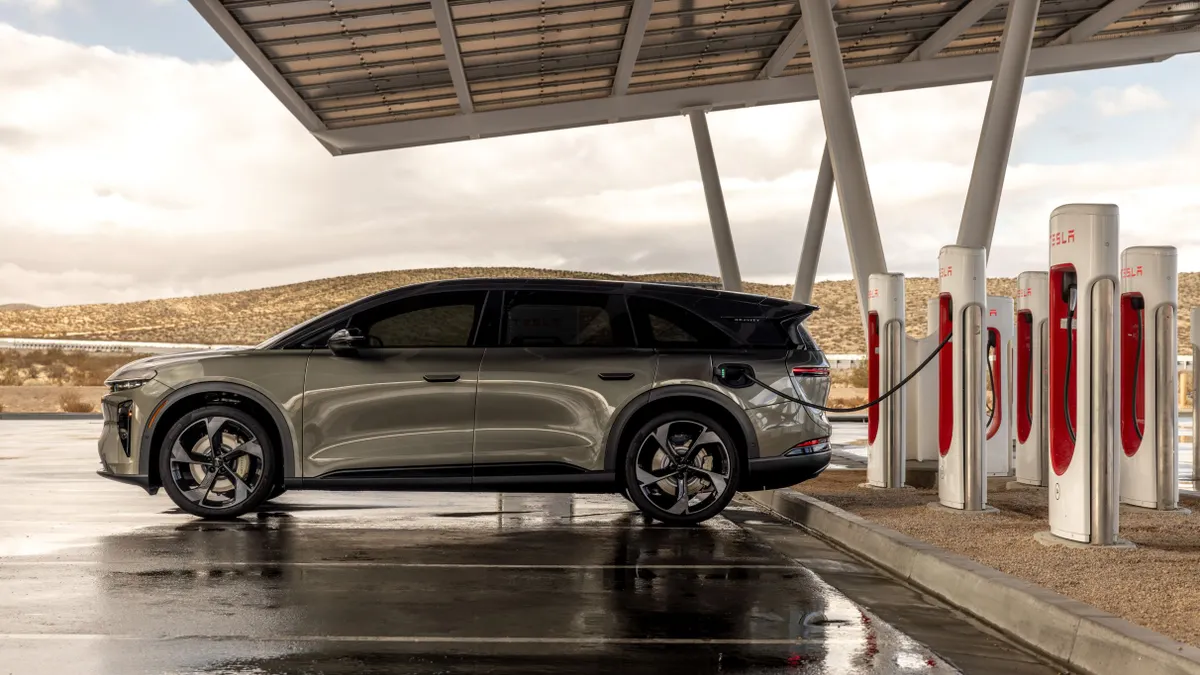
Like other newly arriving BEVs, the 2026 Leaf comes equipped with a Tesla North American Charging Standard (NACS) port so drivers can utilize Tesla’s ubiquitous Supercharger DC fast-charging network. First- and second-gen Leafs used the CHAdeMO DC fast-charging standard, but CHAdeMO chargers are being phased out in the U.S.
Charging at a speed up to 150 kW is possible, as is going from a 10% full pack to 80% full pack in as little as 35 minutes, Nissan says. Some second-generation and all first-generation Leafs were limited to charging speeds up to 50 kW.
Nissan says part of the car’s extensive R&D – which included talking to owners who’ve collectively put 12 billion electric miles globally on their Leafs, as well as engineers’ 1,500 days on the road across various U.S. states – was connecting the third-gen model to “employees’ own charging stations in their garages, ensuring (it) would effortlessly connect to chargers of almost any make or model.”
Slipperier Despite Added Height
Not wanting to compromise aerodynamics in the switch from car to crossover, the automaker says it paid heavy attention to the slippery-ness of the exterior. Drag coefficient of the new CUV version of the Leaf is 0.26, below that of prior-gen Leaf hatchbacks’ 0.27-0.29 Cd. The new 2026 Leaf in Europe is expected to move even more fluidly through the air, with a 0.25 Cd due to sleeker mirror and wheel designs.
Elements that allowed Nissan to get to 0.26 Cd include motorized flush front door handles (used for the first time on a Nissan production car); concealed rear door handles in the C-pillars; integrated window glass; and a tailgate spoiler mounted at a 45-degree angle.
Interior Stays Minimalistic
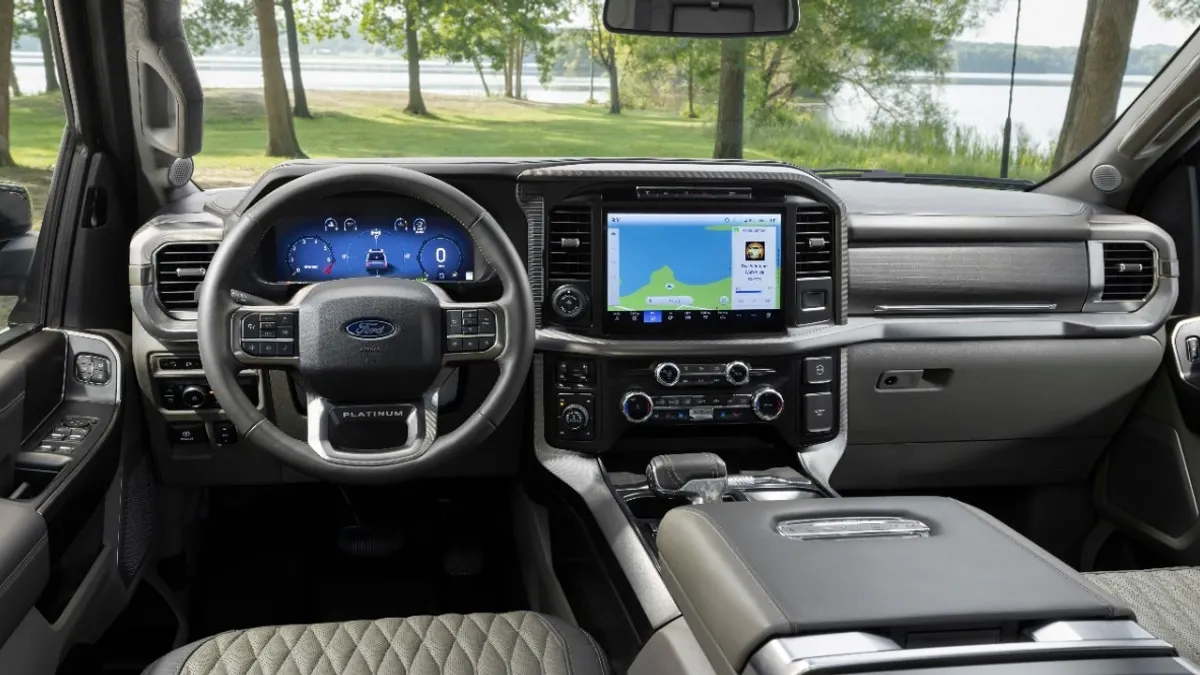
The first- and second-generation Leaf interiors are well known for embracing minimalism and that holds true with the third-gen model. Photos released to media reveal a relatively uncluttered instrument panel design, with few traditional buttons.
As in the Nissan Ariya BEV CUV, the new Leaf has haptic controls hidden below decorative trim and a large display screen, with separate cluster and infotainment displays adjoined to give the impression of one long, large screen.
Also as in Ariya, riding on the same CMF-EV platform as the new Leaf, the center console isn’t connected to the IP, with open space at its front to place a bag on the car’s flat floor.
Nissan says the new center console isn’t as bulky as the one in the outgoing Leaf due to moving shift controls to the IP; meanwhile, redesigned seats “enhance second-row knee room.”
Google Built-In and CarPlay
The upper grades of the 2026 Leaf have Google Built-In technology, offering Google Assistant, Google Maps and the Play Store, but lower grades feature as standard wireless Apple CarPlay and Android Auto, allowing for the mirroring of driver smartphone features to the infotainment display.
The Leaf’s top grade, Platinum+, has a 10-speaker Bose audio system, featuring front headrest speakers similar to those in other Nissans, such as the Kicks small CUV, a 2025 Wards 10 Best Interiors & UX winner.
Nissan’s Safety Shield 360 suite of advanced driver assist systems (ADAS) is standard on all Leafs. It includes Nissan’s ProPilot Assist semi-autonomous driving technology and, new to the Leaf, tech dubbed front wide view, helping drivers “see” around corners in tight garages by showing a wide-angle view to the front and sides of the Leaf.
Prospects and Pricing
With the top-selling BEVs globally being crossovers, including Tesla’s Model Y – the No.1-selling BEV worldwide in 2024 with more than 1 million sold – the body style shift, as well as improved performance specs, stands a chance of raising Leaf volume, which for 2024 tallied 28,281 between Europe, Japan and U.S. deliveries, per Nissan data.
The Japanese automaker’s decision to give the new 2026 Leaf a crossover body style not only appeases customers, who bought four times as many light trucks than cars last year in the U.S. but also pencils more than ever financially for an OEM as lithium-ion batteries have become more energy-dense and fallen in price over 15 years.
Nissan is not releasing pricing for the new Leaf yet, but it is expected to begin below the Ariya, which starts around $40,000. Industry watchers expect the 2026 Leaf to begin around $35,000, only a bit higher than the original 2011 model’s $32,780 starting cost, but given Nissan is switching production for the U.S. from its Smyrna, TN, plant to its Tochigi, Japan, plant – home of the Ariya – base MSRP may rise above $35,000 given U.S. tariffs on imported vehicles and their parts.