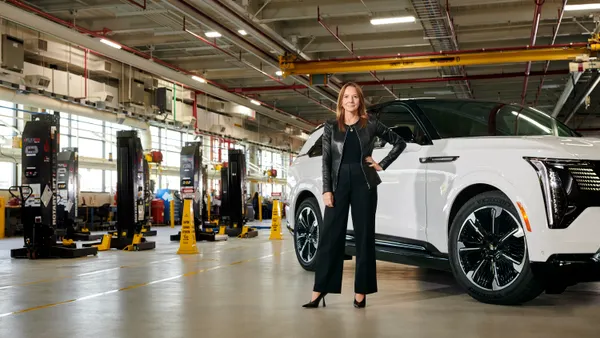
PONTIAC, MI — Where some fear a chilling effect on business from the slowdown toward electrification and strategy shifts surrounding software-defined-vehicle development, Stuart Ryan sees opportunity.
Ryan, who leads the Americas region for Amsterdam-based HERE Technologies, remains confident the location-technology supplier can still meet its goal of a 50% hike in annual revenue over the next three years, believing the recent upheaval in market dynamics ultimately allows his company to play a bigger role as automakers continue to develop next-generation advanced-driver-assist-system (ADAS) technology and draw up revised SDV roadmaps.
“I think for the narrative to hold, you have to fundamentally believe the assumption that everything is moving to an SDV world,” Ryan says of HERE’s chances for meeting its ambitious 2028 growth target. “And it will, because it’s the only way (automakers are) going to be able to keep up with competition, bring their products to market more quickly, innovate and potentially create new monetization opportunities.
“There is no alternative right now.”
HERE, which offers a wide array of software and services ranging from mapping and location applications to product-development tools and beyond, recently was at the M1 Concourse racetrack here just north of Detroit to showcase its technology to customers, collaborators and new prospects, including its latest-generation core navigation software packaged onboard the new Lotus Eletre battery-electric vehicle.
As demonstrated in a short drive along public roads surrounding the M1 track, the HERE navigation software monitors the Eletre’s state of charge and features intelligent route planning that can locate public charging stations and advise precisely how much energy is needed to make it to the next station in order to minimize travel time.
HERE, majority owned by German automakers Audi, BMW and Mercedes and semiconductor supplier Intel, has been around for 40 years. It has mapped some 200 countries and territories, taking in 35 billion vehicle and sensor points daily and each month making nearly 900 billion map updates and processing more than 170 billion application programming interface (API) requests.
Because HERE is privately held, financial results are not disclosed, but the company reports it has seen eight consecutive quarters of revenue growth and currently has an order backlog of €4.4 billion ($5 billion). About 60% of its business is in automotive, with the remainder in industries such as transportation and logistics. Customers include fleet operators and government agencies as well as more than 30 global automakers covering over 70 brands worldwide. It claims market leadership with roughly 53 million vehicles relying on its maps to guide ADAS functionality. More than 220 million vehicles are said to have used its location data and software services.
HERE had envisioned its intelligent-navigation services to be a key growth initiative, so the recent slowdown in BEV sales and policy shift away from electrification in the U.S. under the Trump Admin. threatens to be a setback. Further headwinds are being stirred up via Trump’s tariff policies that are expected to increase vehicle prices, curb new-vehicle demand overall and force automakers to pull back on new-model investments, potentially slowing the march toward SDVs.
But Ryan sees a silver lining.
“Tariffs are never a long-term commercial or competitive strategy,” he tells WardsAuto. “Quite frankly, it buys the North American OEMs a little bit of time. It’s caused people to take a pause right now and say they don’t necessarily need to continue investing on the path that they were on already. It gives them a brief moment to step back, reevaluate and determine what they want to do in this area.”
That time, Ryan says, will be needed as automakers rejigger their SDV efforts away from BEV platform development and toward an evolutionary approach that more gradually takes their legacy-vehicle platforms to the next software-driven stage.
“I do believe it’s more of a reprieve than a stop in this area,” he says of where the industry now stands on SDVs. “And what you’re going to start to see is…they’re now trying to accelerate alternative paths to be able to realize their SDV ambitions.
“It’s a reevaluation point, a bit of an inflection point, but the market dynamics and the competition is going at such a pace that they’re going to have to make some very specific decisions soon.”
Recent months have seen several automakers making dramatic moves regarding their SDV programs. Ford reportedly scrapped a four-year effort to produce a new SDV architecture, choosing to integrate elements of the technology developed into existing vehicle platforms. After years of trying to cultivate a go-it-alone strategy with its CARIAD software operations, Volkswagen is leaning on BEV start-up Rivian for help with its SDV development. In August, General Motors trimmed more than 1,000 software engineers from its rolls, signaling a new direction in its SDV product-development strategy.
“What North American OEMs did, and German ones as well, was they were trying to use the EV platform as a transition to the SDV platform,” Ryan says. “And what they’re seeing is that…might not be the right transition or maturation path. The other thing they’re struggling with is, they haven’t necessarily built up the capabilities to (engineer), start to finish, the software-defined-vehicle experience.
“They’re finding they’re having to rejigger and reconfigure the partnerships and the supplier ecosystems that they have to work with. So, we see all of this as a very opportune time for HERE Technologies to reinforce that we intimately understand these dynamics.”
Although Ryan doesn’t believe automakers will completely abandon reliance on more plug-and-play infotainment operating systems such as Android Automotive OS, he does believe OEMs will try to wrestle back more control of their software platforms in this new phase of development.
“The last five, seven years, there’s been a bit of a backlash happening,” he says, because although adopting such an off-the-shelf operating system can alleviate a lot of in-house engineering work, it often comes “at the cost of delayed implementations.
“OEMs have lost control over the roadmap back into these hyperscalers, (and) that has severed their ability to truly innovate with the immersive experiences in the vehicle,” Ryan adds. “They’ve lost control over the direct access to the customer experience. And that’s going to be a forcing factor that (will lead to) more powerful and differentiated embedded experiences coming from the OEM and other partners.”
The biggest challenge for HERE – and anyone else looking to grow in the current environment – will be to keep up with the pace of change.
“'What’s the next disruption going to be?' is the big thing when it comes to the kind of potential momentum around this industry,” Ryan says of potential hurdles ahead. “That’s what keeps us vigilant and paranoid – but excited as well for the potential. Really, it’s just about keeping the antenna sharp and then being agile. You need to be able to adapt.”