Mercedes-Benz has recalibrated its autonomous driving ambitions, stepping back from an initial plan to offer an updated SAE Level 3 Drive Pilot system in the latest version of its flagship sedan.
For the facelifted 2026 model year S-Class, the German automaker will instead deploy a so-called Level 2++ driver-assistance system in the U.S. market, Mercedes-Benz representatives told WardsAuto over the course of several conversations in the past months. At the same time, it will redirect its engineering resources toward the development of a future Level 3 system capable of operation at speeds up to 81 mph as well as an even more advanced, driverless Level 4 system, which has already begun public road trials in an S-Class-based prototype robotaxi in Abu Dhabi.
The shift comes after a reassessment of both the U.S. regulatory environment and the value proposition for customers, Mercedes-Benz said. Certifying a Level 3 autonomous driving system, where the vehicle assumes legal responsibility for driving under specific conditions, remains a complex, state-by-state challenge in the U.S.
Why Mercedes-Benz is pivoting to its Level 2++ system
Mercedes-Benz’s earlier Level 3 Drive Pilot system, the first of its type to be offered in the U.S., was offered on the S-Class and electric-powered EQS. It was restricted to 40 mph and was geofenced within the states of California and Nevada.
However, Mercedes-Benz has confirmed that its Level 2++ system, known as MB.Drive Assist Pro, will launch across the U.S. later this year in both the facelifted fourth-generation S-Class and the all-new third-generation CLA sedan.
This newer system, which will first be launched in China before being rolled out in the U.S. and, later, Europe, is designed to manage complex urban traffic scenarios, including automated lane changes and navigation in heavy traffic. But it lacks the full fail-operational architecture that defines higher levels of driving autonomy under the SAE’s Level 3 and Level 4 autonomous driving guidelines.
Defending the move, Mercedes-Benz says it will use the new MB.Drive Assist Pro system to advance to Level 3 and Level 4.
“The technical foundation has been laid for the next step,” said Mercedes-Benz spokesman Tobias Mueller.
The sensor suite of Mercedes-Benz’s Level 2++ system, including its lidar sensor and the centralized computing of the latest Mercedes-Benz Operating System (MB.OS) is engineered to be scalable. The transition to a Level 3 system, targeted for inclusion on future Mercedes-Benz models, will primarily require the addition of fully redundant systems for steering, braking and power.
The implications of the decision to roll back on its initial plans for Level 3 autonomous driving extend beyond Mercedes-Benz. It signals a growing caution within the global automotive industry regarding the commercial and regulatory feasibility of incremental, geofenced Level 3 autonomous driving systems in key markets such as North America. The strategy now appears to favor perfecting and widely deploying high-level driver assistance systems while preparing for a more substantial leap to autonomous systems that can achieve highway speeds without human oversight.
In a bid to accelerate development, Mercedes-Benz has entered into technical partnerships in the U.S., including a collaboration with NVIDIA on the core computing architecture and AI software stack necessary for Level 3 and Level 4 autonomous driving. It is also working closely with Uber to explore deployment models for a robotaxi service based on the S-Class.
How the new S-Class compares to previous models
These driver assistance and autonomy plans are grounded in a comprehensive update to the S-Class, some six years after its launch in 2019. The key revisions for the 2026 model are both engineered and stylistic, focusing on drivetrain refinement and chassis intelligence but also subtly updating its looks and cabin.
The most significant powertrain revision centers on the V-8 engine, known internally as the M177, which powers the S 580 4MATIC. The twin-turbocharged 4.0-liter unit has undergone a fundamental change with the adoption of a flat-plane crankshaft and a new firing order. This departure from the traditional cross-plane design is aimed at reducing rotating mass and internal vibrations. Output has risen to 530 hp and 553 lb.-ft. of torque, gains of 96 hp and 37 lb.-ft. over the outgoing model.
The inline-6-cylinder engine, codenamed M256, in the updated S 500 4MATIC has also received attention. Revisions to its electric compressor and camshafts prioritize torque, which now peaks at 443 lb.-ft. While its horsepower rating remains at 443 hp, the focus has been on improving noise, vibration and harshness characteristics. Both the revised, newly engineered V-8 and inline-6 are now paired with a 48V mild-hybrid system featuring a 23-hp integrated starter-generator housed within the 9-speed automatic transmission as standard.
The chassis software has been updated to leverage cloud connectivity. The optional E-Active Body Control suspension can now use anonymized data from other vehicles to preemptively adjust damping for known road surface irregularities.
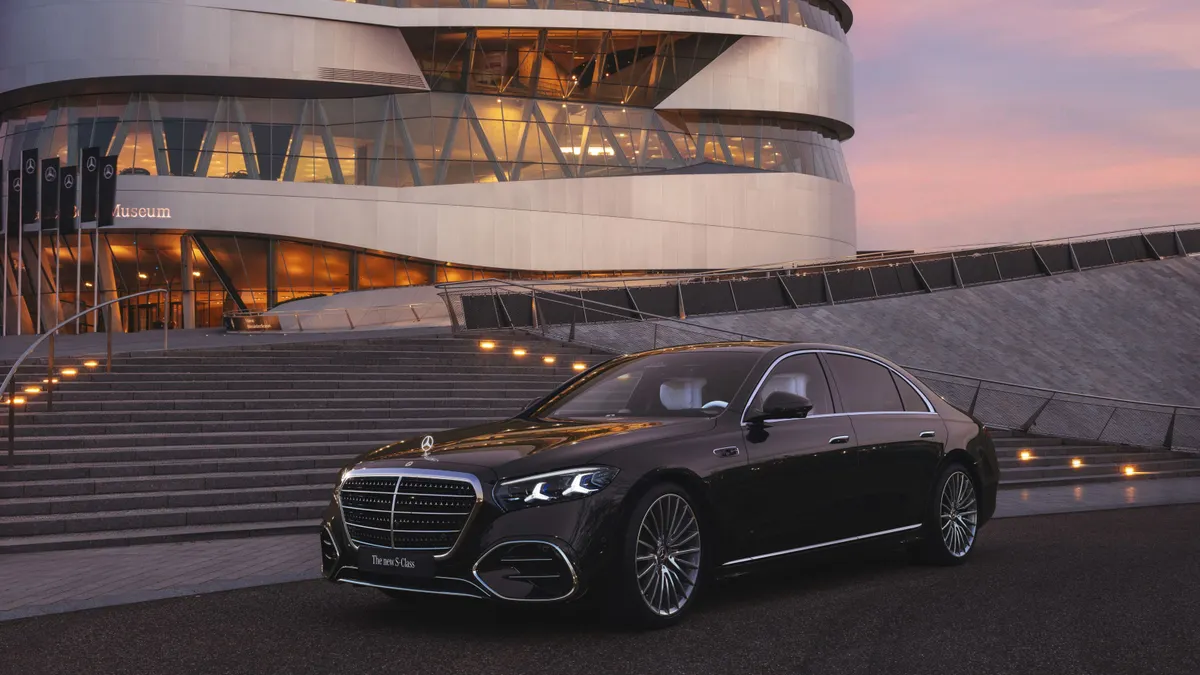
Exterior design changes are typically restrained, limited to a larger grille and new three-pointed star hood emblem – both with illumination, as well as updated lighting with star-shaped graphics front and rear.
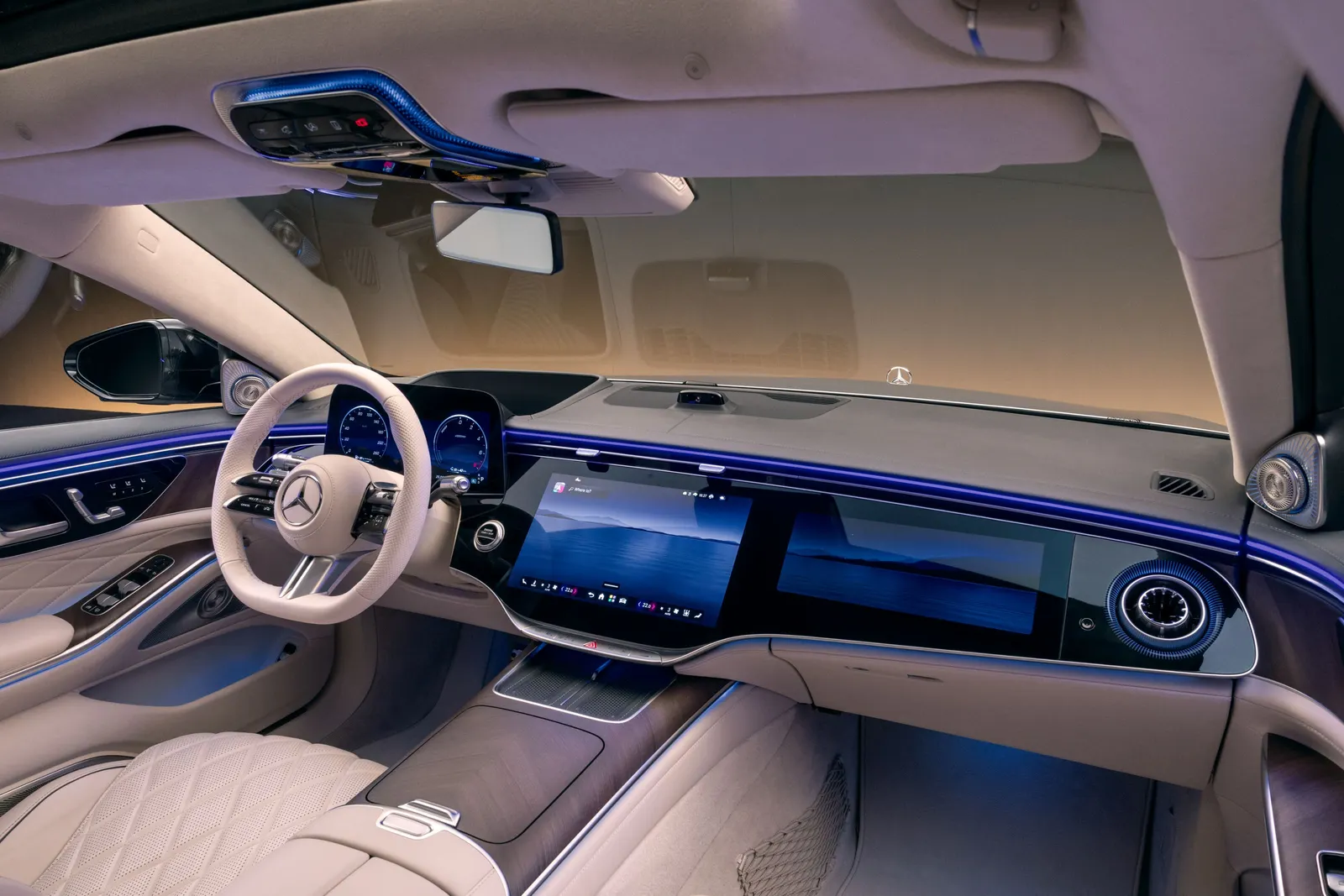
Inside, the primary evolution is digital and centered on Mercedes-Benz’s latest MBUX Superscreen – a new display featuring a standalone 12.3-in. digital instrument display, as well as a 14.4-in. central infotainment touchscreen and a 12.3-in. passenger-side display. The new dashboard-mounted interface is powered by the new MB.OS operating system, which integrates the vehicle's functions in a central computer and introduces a generative AI-powered voice assistant based on large-language models. Other new technology available on the facelifted S-Class includes heated seat belts.
The U.S. remains a critical market for the S-Class, a high-margin sedan flagship in a segment challenged by the dominance of luxury SUVs. Mercedes-Benz’s strategy has been to defend its position not through radical change but through a traditionally evolutionary midlife update, while mapping a more customer-relevant, if delayed, path to more advanced autonomous driving technology, which has proven more complex and taken longer to develop than once thought.