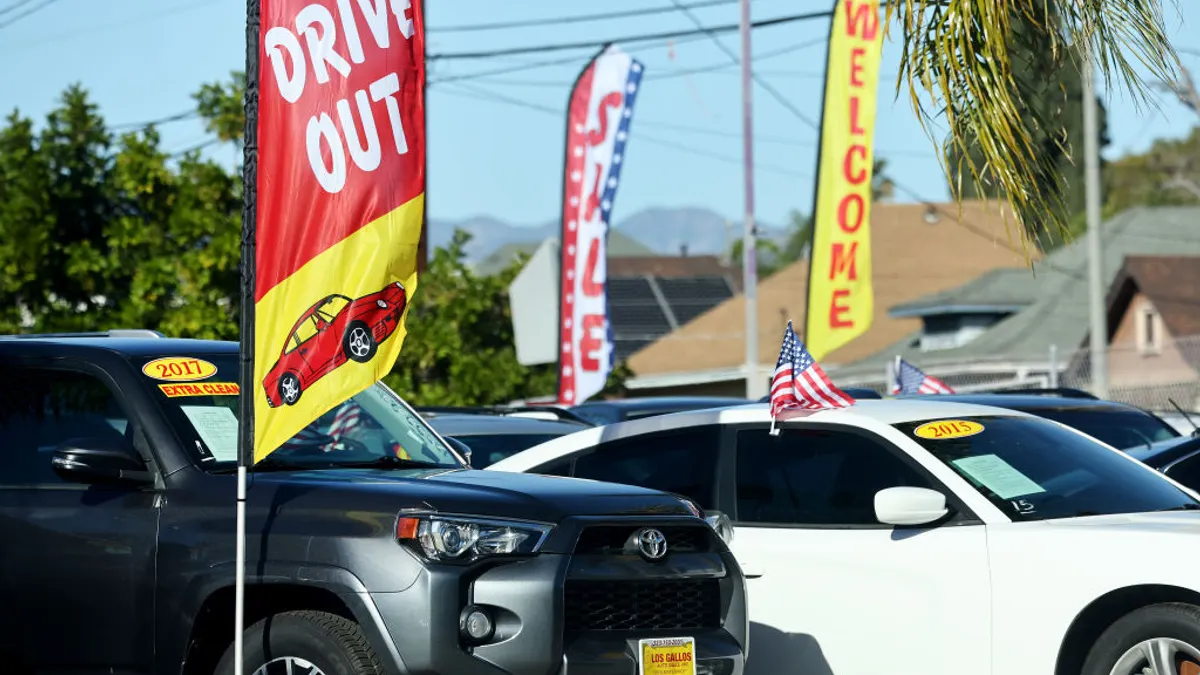
Lithia Motors is leaning into older used cars, encouraging its dealerships to acquire and sell more cars 9 years old or older – and to charge more for them, even if they sit on the lot a little longer, rather than drop the price to move the metal.
“This is the fun part of the business for me,” Bryan DeBoer, Lithia Motors president and CEO, said during a discussion about used-car strategizing in a Feb. 11 earnings call. “I think we have got the right formula, now that our stores are keeping the older cars.”
In contrast, a couple of Lithia’s publicly traded, megadealer competitors said in their own, separate earnings calls recently that they plan to avoid older used cars to avoid high reconditioning costs, weighed against possible reliability problems and customer-satisfaction issues.
The used-car strategy discussion came as Lithia Motors reported record revenue of $37.6 billion in 2025, up 4% year-over-year. Its fourth quarter results, however, revealed some shifts in its used car mix, with its “Value Autos” channel — defined as used vehicles 9-plus years old — accounting for 18% of its used-vehicle sales in the fourth quarter of 2025, down from 21% in the same quarter in 2024.
The average Value Autos selling price was $14,849 in the fourth quarter of 2025, flat versus $14,797 a year ago, the company said.
Shifting mindsets
Lithia’s DeBoer has promoted the appeal of older used cars and called out some financial results for the “Value Autos” channel for years, dating back to at least 2020, in past quarterly results presentations. It’s not a new concept to management.
But Lithia has grown enormously to become the biggest U.S. new-car chain: 459 dealerships in 2025, from 137 in 2015, according to a slide at the recent Haig Partners Maximizing Value Conference in Las Vegas.
Whether new acquisitions or not, DeBoer said not everybody is fully on-board with Value Autos. He said in the Feb. 11 call that a sample of Lithia dealerships is underpricing Value Autos vehicles by 12% to 13%, or about $2,000, versus the market for comparable cars.
To catch up, the group plans to “re-educate” store leaders, DeBoer said. The idea is “to inflate the pricing on those cars, and understand that it is not necessary that the velocity of that car turns within four days. It is okay if it turns in 24 days, because that scarce car will bring in additional traffic,” he said.
“We are still having tendencies to give them away, or think that there is a more sensitive pricing on those scarce older cars – and there is not,” DeBoer said.
Opposing viewpoints
Some of the other publicly traded megadealer groups don’t see older used cars as a good fit for them.
“We’re not in the old-car business. I know some people feel that it’s a great opportunity,” said Roger Penske, board chair and CEO for Penske Automotive Group, in a separate earnings call Feb. 11.
“But I can tell you, when we were selling these older cars in the U.K., the amount of cars that came back for policy or buyback … we couldn’t control it. So that was another reason we decided to pull back and go down a gear, because the older a car gets, you can’t do the full reconditioning” because it’s too expensive, Penske said.
On the other hand, without full reconditioning, reliability can be an issue. “Remember, when you buy a car, you’re expecting to be able to drive it, not have to take it back to the dealership three days later,” Penske said. He described the Penske Automotive used-car “sweet spot” as up to five years old.
One big difference between the two groups is that Penske Automotive has a higher mix of premium-luxury brands — at 71% of Penske Automotive Group of dealership revenue in 2025, compared with 35% premium luxury for Lithia Motors.
In AutoNation Inc.’s Feb. 6 earnings call, CEO Michael Manley said he’s interested in pursuing more-affordable used vehicles for resale this year, but in a price range around $30,000. That would be below the $40,000-and-above range where Manley said AutoNation had a lot of success in 2025.
Manley said in effect that he was concerned whether vehicles in a range of $20,000 or below would live up to the group’s brand image. AutoNation’s premium-luxury brand mix was 40.1% of new-vehicle sales for its franchised dealership segment in the fourth quarter, the company said.