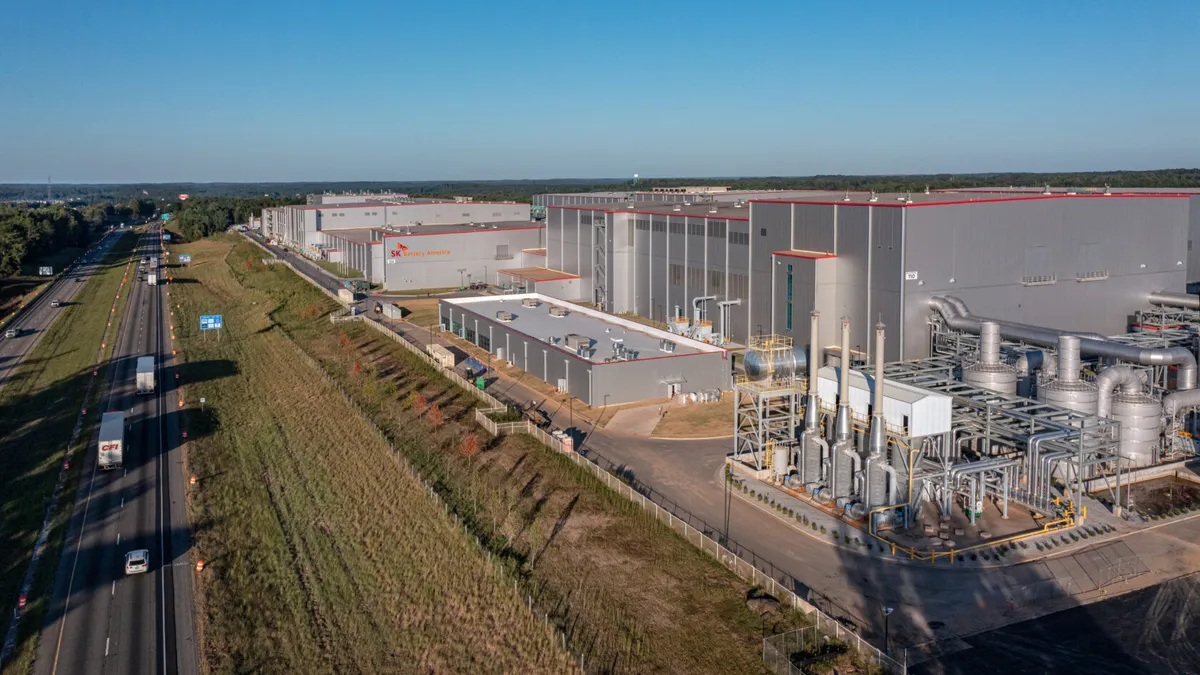
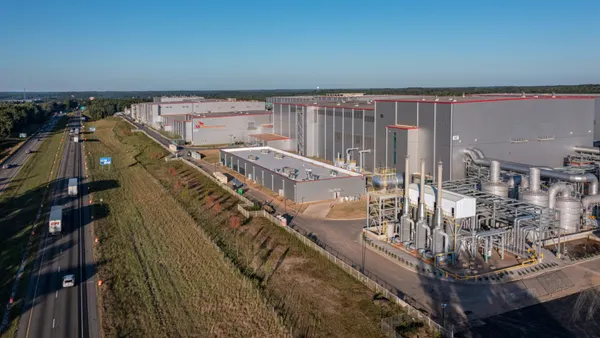
HOLLAND, MI – LG Energy Solution (LGES) has opened a 1.7-million-sq.-ft. (157,935 sq.-m) manufacturing plant here to produce lithium-ion phosphate (LFP) batteries. The facility represents a $1.4 billion investment made by the South Korean company.
The factory, adjacent to an existing facility LGES opened in 2012 to produce nickel, manganese, cobalt (NMC) batteries, has capacity to produce 16.5 GWh of LFP batteries. With the NMC capacity (5 GWh), the site has a total capacity of 21.5 GWh. Total employment at the complex in western Michigan is expected to reach some 1,700 people when at full production.
Bob Lee, corporate executive vice president and president, North America LGES, says the new facility at the site represents the company’s “resilience.”
Lee is referring to the slower-than-forecasted growth of battery-electric vehicles (BEVs) were not growing as anticipated, moving the company to pivot to applying its technical and manufacturing expertise to develop and produce LFP batteries for energy storage systems (ESS) applications.
According to Dimension Market Research (https://dimensionmarketresearch.com), the U.S. energy storage market was $21.9 billion in 2024 and is expected to have a compound annual growth rate of 13.9%, reaching $70.7 billion by 2033. The research firm says lithium-ion batteries are the leading storage source.
The reason ESS is becoming increasingly important: the growth of power-hungry data centers for cloud computing and Artificial Intelligence, as well as the growth of renewable energy sources including wind and solar (the energy generated is stored in batteries so there is available power when the wind isn’t blowing, or the sun isn’t shining).
Jaehong Park, president of LG Energy Solution Vertech, which specializes in ESS system integration, says the LFP plant was built in Holland rather than at a site in Arizona, which had been the original plan. The Michigan site was selected because available infrastructure was in place and, Park emphasizes, because there were trained engineers, technicians and operators in and near Holland.
It is interesting to note that Ford is building an LFP plant in Marshall, MI, which is some 90 miles (145 km) southeast of Holland. BlueOval Battery Park Michigan, a $2.5 billion, 2-million sq.-ft. (186,000 sq.-m) purpose-built facility, is expected to open in 2026 with 1,700 employees
At the LGES LFP plant there are three lines, two of which are presently in operation, with the third planned to launch in late 2025 or early 2026.
How are the LG batteries produced? Starting with the electrode, there are materials such as lithium iron phosphate and graphite mixed with a solvent to create a slurry that’s about the consistency of molasses. The foils (cathode: aluminum; anode: copper) are coated. They are dried, then run through a series of rollers to achieve the required dimensions. The layers are stacked, with a polymer separator that keeps the cathode and anode from touching, but which allows the lithium ions to pass. Ultrasonic welding and laser welding are performed for assembly. The resultant block is placed in an aluminum pouch. Electrolyte is added and the pouch is sealed. There is a series of inspections during the processing. Then, after the pouches are complete, they go through a series of charge-discharge operations to not only activate the cells but also measure the performance of the batteries.
LFP cells are of interest to automakers because materials like iron and phosphate are not rare earths and consequently less costly. But compared with NMC batteries for automotive applications, LFP batteries have less energy density, which means reduced range. Although LFP batteries can better manage more charging cycles, they can’t charge as well as NMC batteries on increasingly popular high-voltage chargers.
However, at the LGES LFP plant, all production is used for producing batteries for ESS applications, not BEVs.
Tristan Doherty, LG Energy Solution Vertech’s chief product officer, explains that ESS applications require “less functionality” of the batteries than BEVs do; for example, the batteries are stationary and in many applications in climate-controlled environments. The LFP batteries for ESS applications are not only dimensionally different, but the chemistries are formulated to handle the unique demands of ESS,
The processes performed in the LGES Holland LFP factory apply to producing BEV batteries, but as Lee points out, there is significant growth in the ESS space, which will soak up demand for the company’s batteries if BEV demand falters. The production capacity, including that third line, is likely to remain ESS. It is worth noting that LGES has extensive auto battery production capacity. The General Motors-LGES joint-venture Ultium battery plant in Lansing, MI, has been wholly acquired by LGES. There are two continuing JV plants with GM, one in Warren, OH, and the other in Spring Hill, TN. LGES is working on a JV plant with Honda in Jeffersonville, OH, and a JV plant with Hyundai in Savannah, GA. LGES is building a plant that will start producing cylindrical cells in Greater Phoenix (Queen Creek, AZ) next year. LGES is also opening a retrofitted plant in Madison, IL, that will pack cells together to be used in modules for energy storage.