The automotive lightweight materials market has achieved steady annual growth over the past few years, and it’s easy to understand why. Lightweighting is a benefit that applies to every type of vehicle in today’s market, as the practice extends the battery range of battery-electric vehicles, improves the fuel economy of gas-powered vehicles and achieves both objectives for hybrids.
As OEMs explore their lightweighting strategies, they are also looking for opportunities to streamline their end-to-end manufacturing processes. In addition to innovative materials that will help make their vehicles lighter, stronger and safer, they seek solutions that will simplify their operations, reduce costs and mitigate environmental impact.
In my role as structural product development manager at L&L Products, I’ve been on the front lines of these initiatives for many of our clients in the automotive sector. In this article, I’ll share my expert insights and advice on how automotive OEMs can develop high-performance lightweighting solutions while achieving other benefits throughout their manufacturing workflow.
Lightweighting Strategies That Can Optimize Your Processes
First, companies should break out of the “customer-supplier” mindset. Working in the traditional “customer-supplier” mode, where vendors are limited to supplying materials, can greatly reduce your potential for affordable lightweighting solutions. Lightweighting innovations rarely happen with stock, out-of-the-box materials. Look for a true development partner that can design, test and iterate solutions tailored to your specific needs and production processes.
Partnerships should promote expert discussions and deep collaboration. In my experience, the best results always come from deep collaboration between product and process specialists on both the customer and supplier side. The best recipe is to include your partner as early as possible in the development process and freely exchange information and ideas while respecting confidentiality agreements. Your partners will do their best work by gaining a comprehensive understanding of your needs, options and limitations.
Automakers and suppliers should accelerate development with digital twinning. If you can’t simulate the behavior, you can’t implement a solution in the vehicle. That said, traditional prototyping and testing is incredibly costly for OEMs. Now, much of that important work can be done by creating a digital twin of the vehicle: a sophisticated virtual model that can be tested, optimized and refined long before a physical prototype is needed. Along with dramatically reducing costs at the prototype stage, digital twins also enable rapid iteration and testing of optimal material placement and geometry. The result is an accelerated development cycle without sacrificing safety or structural integrity.
Collaborations should take a holistic approach to lightweighting. For me, the most common mistake automotive OEMs make is to think about lightweighting as a part-by-part weight comparison. Even when focusing on a specific part in the vehicle, it’s crucial to consider the full system and the way it functions. Performance, cost and implementation are equally important. When we work with OEMs to evaluate lightweighting in a holistic way, we are frequently able to identify solutions at neutral cost.
Partnerships should examine direct and induced lightweighting opportunities. First, we consider what can be changed in the full structure to achieve direct lightweighting (i.e., replacing one part with a lighter-weight part). Next, we consider the additional benefits direct lightweighting solutions can introduce via induced lightweighting (i.e., additional lightweighting opportunities due to reduced load on other vehicle systems).
Automakers Need to Consider Their Processes, Not Just Their Parts
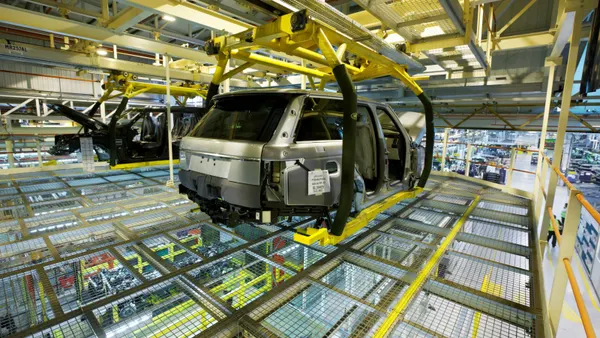
Different manufacturing techniques linked to different materials can significantly simplify your manufacturing processes. Any new materials and processes you consider should be highly compatible with your existing manufacturing workflow – or ideally represent an opportunity to streamline your workflow even further. For example, by introducing an injection-molded part in the Body in White, we’ve helped our customers avoid complex welding guns and reduced the space needed for processes in their facilities. Simplified operations are crucial for automotive applications, where production volumes require reliable, repeatable and cost-effective processes.
Automakers must think beyond “metal behaviors.” Many of our customers would like to replicate “metal behaviors” when developing a lighter-weight composite solution. Sometimes, this is simply impossible. Other times, it significantly reduces the inherent weight-saving potential. Don’t think of lightweighting as “replacing metals;” think of it as helping metals work in the most efficient way – and the best way to do that is to put the right materials in the right locations in the right quantities. Again, holistic system performance should be the focus, not a “part-by-part” approach. It sounds complicated, but partnering with an experienced, proven and motivated team of experts can guide you toward the ideal solutions.
OEMs should explore multiple paths to sustainability. In the realm of lightweighting, sustainability has become an increasingly important area of focus for many automotive OEMs. It’s important to understand that there are several paths to sustainability, and many of them are complementary. Lightweighting in itself helps reduce the environmental impact of a vehicle by improving fuel efficiency and battery range, but there are also sustainable solutions that reduce the environmental impact of your manufacturing operations. Certain material choices and processes can reduce your carbon footprint and waste, such as low-bake solutions that require less energy consumption at your manufacturing facilities.
Above All, Embrace an Innovative Approach
Ultimately, it takes more than innovative materials to optimize your approach to lightweighting. It also requires an innovative mindset. The secret to your success lies in doing things differently, exploring new approaches and collaborating with your expert partners.
When introducing new materials, concepts and processes, you need experts alongside you who understand your needs, your processes and your definition of success. The right partner will ensure you don’t need to develop or execute a successful strategy entirely on your own. Their contributions will go well beyond material expertise. They’ll help test, optimize and refine your path to lightweighting perfection. They’ll unlock opportunities to streamline your end-to-end manufacturing workflow. They’ll provide key insights about how existing systems can work better together, and they’ll understand how to make the most of your existing processes while implementing innovative improvements to your workflow.
About the Author
Nuria Ignés is structural product engineering manager at L&L Products Europe, where she oversees all CAE (computer-aided engineering) activities for customers in the region.