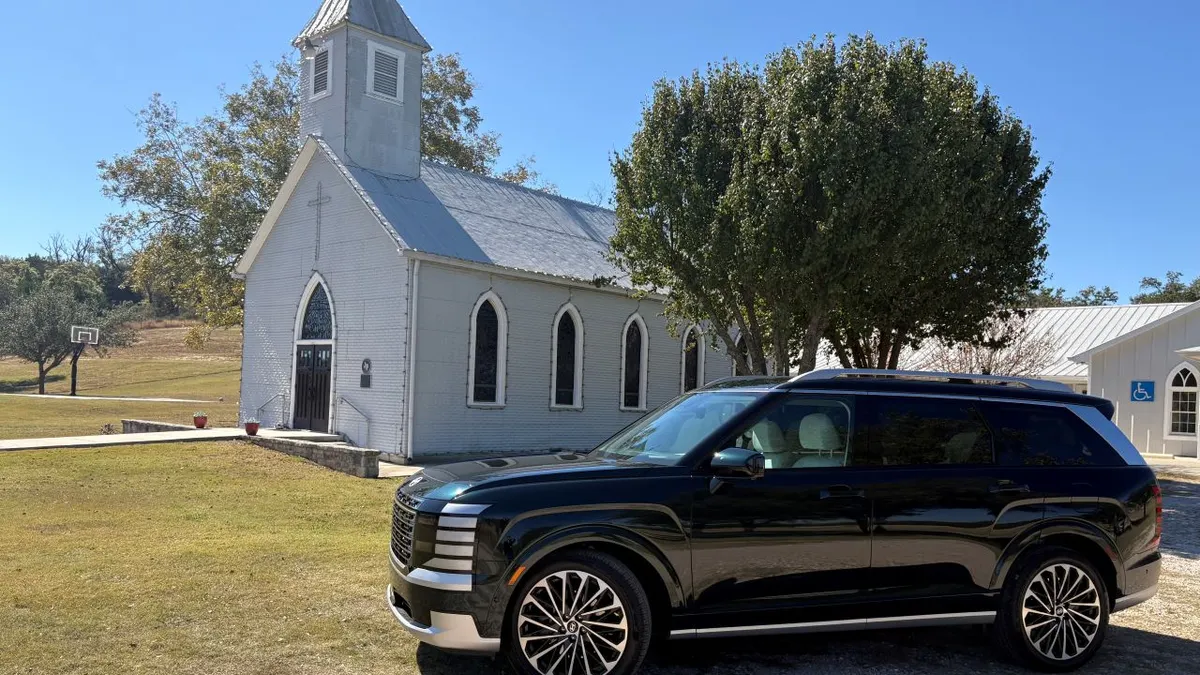
AUSTIN, Texas — Hyundai isn’t trying to reinvent the wheel with the hybrid version of its popular large SUV, the three-row Palisade.
On the contrary, executives on hand at a recent media drive were quick to point out that on the surface, the HEV and sibling gas-powered vehicle (which WardsAuto reviewed in August) are very similar, at least at first glance.
“Depending on what trim level, the SEL the Limited, or the Calligraphy, between the ICE and the hybrid, the content is basically identical,” Melvyn Bautista, manager, product planning, Hyundai Motor North America, told the journalists gathered for the drive.
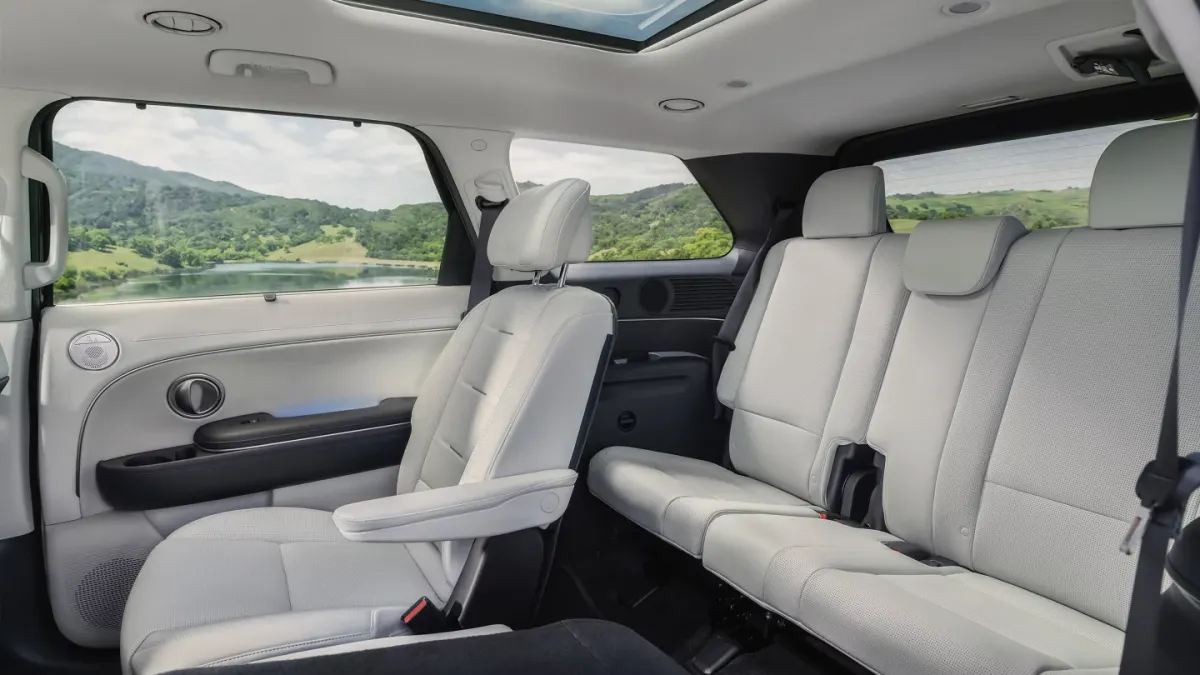
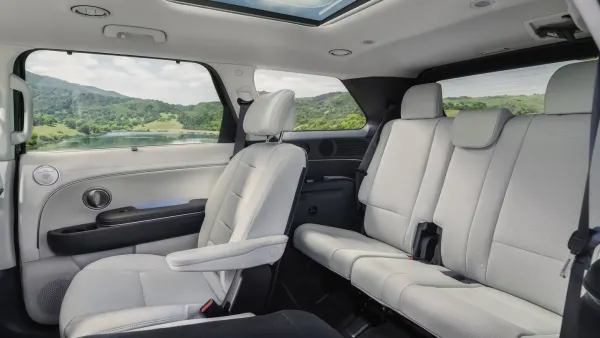
Second-row passengers will probably not notice the slightly less leg room (1.6 inches) because of the Hybrid’s battery position under the front passenger’s seat. The  passenger volume is 159.6 cubic feet compared to 161.9 cubic feet for the ICE version. Total interior volume is 178.7 cubic feet, down slightly from the ICE version’s 181.0 cubic feet.
But what they, and the driver, will notice is the reduction in ride noise, vibration and harshness as a result of better aerodynamics and lower coefficient of drag.
“It's the first three-row SUV in the market that has over 300 horsepower, over 30 miles per gallon on the highway, and over 600 miles total driving range,” Bautista said.
A fun-to-drive three-row
Hyundai chose the gently curving roads of Texas Hill Country to show off the finesse of the three-row Palisade. You have to look in the rear-view mirror to remember you are driving a large vehicle, because it handles quite nimbly.
All three trim levels include the same 2.5L turbocharged 4-cylinder, two electric motors and a six-speed automatic transmission. It generates 258 hp and 260 lb.-ft. of torque by itself but, when paired with the hybrid battery, the total system horsepower output shoots up to 329 hp and total system torque output is 339 lb.-ft.
My Palisade HEV test vehicle was not in the most fuel-efficient trim level but in the high-end Calligraphy model with AWD (a $2,000 addition). It only sucks slightly more gas, recording a 29 mpg combined city/highway fuel economy. With FWD, that number improves to 31 mpg combined. The mid-range Limited trim level gets the same fuel economy.
Another slight difference in the HEV vs. ICE is towing capacity, which drops to 4,000 pounds vs. 5,000 pounds. But most Palisade owners are not towing boats or RVs, Bautista says.
“The top accessories that they're purchasing, number two, is a hitch,” he said. “And it's not necessarily that they're towing their vehicles or they're towing things. They're using it for bike racks, extenders and other things to put stuff back there so that they can fill the cabin with passengers.”
Hybrid Stay Mode is more than just a “party trick”
A cool feature in the hybrid model is what Hyundai is calling the Hybrid Stay Mode.
“It provides an EV-like experience that allows you to operate the HVAC system, the infotainment as well as the convenience features while the gasoline engine is off, so you have the ability on the touchscreen to put it into Hybrid Stay Mode,” Bautista said. “It uses the main drive battery to power all these systems.”
Bautista gave his own user-case scenario of how this works: “My daughter is a cheerleader. We arrived early to one of the games. A couple of her friends were complaining because they needed to charge their phones. A couple of them were hot. They were bored. So it's like, ‘Hey, let's hop in the Palisade Hybrid.’
“A couple of them were using the 100 watt USB charge ports, so they were able to get out of the vehicle a half hour later and get 30 or 40% charge on their phones. It was kind of nice knowing that you're not using gas and you're using the battery that you built up energy on just by driving the vehicle.”
One caveat: in order for the Hybrid Stay Mode to be fully available, drivers must set their destination on the navigation system on approaching the vehicle so that batteries start charging using the gas engine to get up to 80%.
Hyundai’s expanding hybrid lineup
Hyundai plans to launch 18-plus hybrid models by 2030, including hybrids in its Genesis luxury line starting in 2026.
The next-generation hybrid system features a new transmission with two integrated motors that can be paired flexibly with a range of internal combustion engines, allowing for optimized performance and fuel efficiency across a range of vehicle classes.
Additionally, various electrification-focused technologies have been incorporated into the next-generation hybrid system to enhance driving performance, refinement and ride comfort.
The Palisade’s transmission includes a new P1 motor that handles engine start, generator, drive and regenerative braking assist. The transmission’s P2 driving motor is responsible for propulsion and regenerative braking integrated into the transmission.
This integrated dual-motor setup improves power, performance and fuel efficiency while achieving smooth shifting and reduced noise and vibrations for a more refined driving experience.
“From a ride comfort perspective, we call this E ride, it’s where we use the driving motor to improve the pitch motion when you're going over bumps or over hard acceleration,” Bautista said.
If the Palisade HEV is so great, why didn’t Hyundai offer it sooner?
While hybrids have been offered on Hyundai’s smaller vehicles, those systems wouldn’t work with the larger and heavier Palisade.
“Their first generation hybrid system was really targeted towards smaller to midsize vehicles. It didn't scale up to vehicles this large, because as you get into larger vehicles, you need more electrical power, more battery power, and you need the torque capacity, because you also have to mate it with a larger combustion engine,” said Telemetry analyst and vice president for market research, Sam Abuelsamid, who I shared a vehicle with during the first drive. “Since they had to re-engineer it anyway, they took the opportunity to make a number of other changes … and do more with it, and get more benefits in terms of fuel economy for a larger vehicle.”
Look at the higher price tag like a short-term investment
The electrified powertrain is a $2,200 upgrade across all three trims versus the ICE Palisade. But buyers who choose the hybrid will recoup that money in gas savings after 1 or 2 years, depending on how many miles they are driving, Bautista claimed.
Calligraphy has a starting MSRP of $56,780 compared to $47,520 for the base level SEL Premium, which includes a surround view monitor and heated and ventilated front and 2nd row seats and a heated steering wheel.
The mid-range Limited starts at $51,990 which adds upgrades like 20-inch alloy wheels, leather trimmed seats and 3rd row heated, power folding/unfolding seats.
Like its gas-powered sibling, the Hyundai Palisade HEV is assembled at Hyundai’s Ulsan, South Korea, plant, so tariffs will be a factor and will affect the automaker’s profits on this vehicle.