

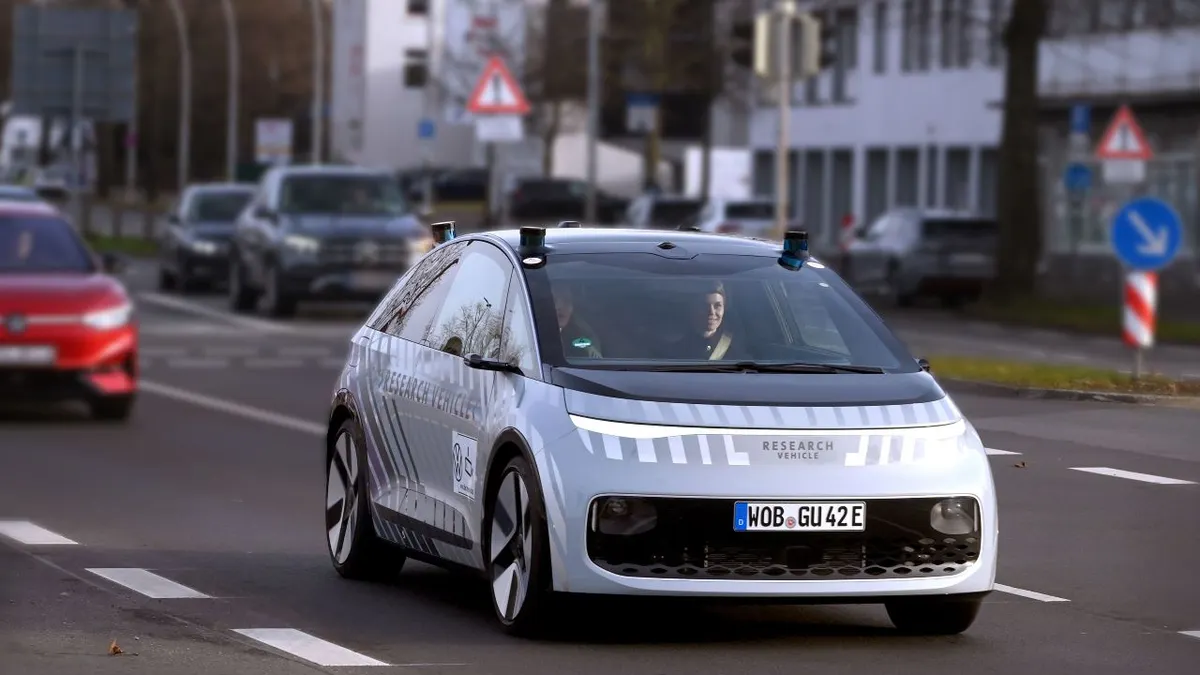
Volkswagen Group has begun its latest phase of on-road driverless technology testing in the city of Wolfsburg using its automated driving mule, the Gen.Urban.
Its research project, in the northern state of Lower Saxony, hopes to explore how passengers experience riding in a self-driving vehicle without a traditional steering wheel or pedals and the design consequences for future vehicle concepts, the company said in a Dec. 12 press release.
German automakers are seen as being at the forefront of autonomous driving technology in Europe with brands like Mercedes-Benz promising high-speed hands-free autobahn adaptive cruise control capabilities.
Driverless tech in the country received a kickstart in 2021 when then-Chancellor Angela Merkel told IAA Mobility that lawmakers had changed transport regulations to allow for Level 4 automated driving on public highways.
Volkswagen’s latest pilot includes a wide range of engineers and behavioral specialists to assess the vehicle’s impact on consumers. Its findings should contribute to the development of future interior and user experience concepts across the Group’s brands, the company said.
Questions asked of users of the Gen.Urban vehicle include: How do people spend their time in a self-driving vehicle? Which digital features best support work, entertainment or relaxation? How should interaction between the vehicle and passengers be designed, particularly for older people or children? And: Do people feel comfortable?
“The technology for autonomous driving is making rapid progress,” said Nikolai Ardey, head of Volkswagen Group Innovation, in the press release. “The key to a positive customer experience is to build trust through meaningful interaction, a relaxed atmosphere and intelligent assistance systems that respond precisely to the needs of passengers,” he added.
Passengers can customize their preferences, for features such as cabin temperature, seat adjustment, infotainment display or sound, and ambient lighting, before departure using a dedicated app or directly in the vehicle.
During the trials, the test participant, currently a Group employee, sits in the driver’s seat, while a trained safety driver monitors the vehicle from the passenger seat. In the event of an emergency, the safety driver can intervene using a dedicated control panel with a joystick.
The project’s test route begins from the visitor parking lot at VW’s local headquarters and follows a ten-kilometer loop through the city center and lasts about 20 minutes.
“Ultimately, technology should fit people, not the other way around,” said Ardey. “We will benefit from these insights across the entire Group in the long term.”