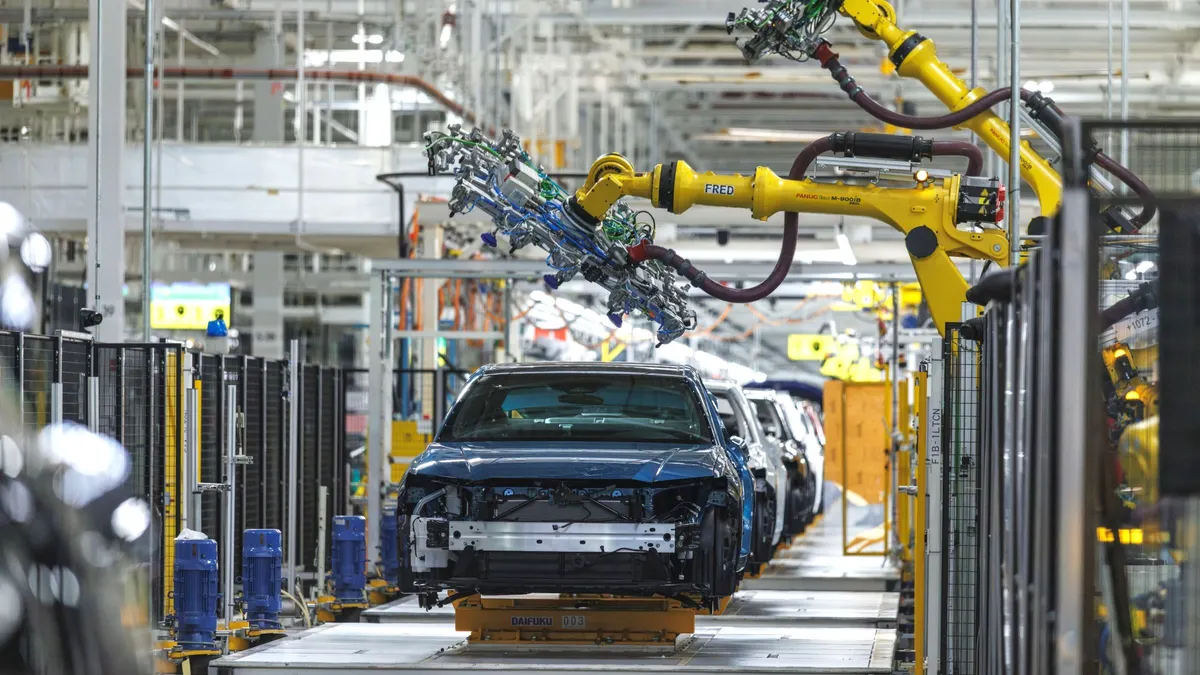
Leading Chinese automakers are considering accelerating their expansion in the European Union by stepping up development of new plants, as well as by raising production closer to capacity at existing facilities.
Despite strengthening their positions in the EU market in recent years, Chinese car companies’ actual share in the local market remains small. Estimates by Jato Dynamics set that share at just 2.6%; by comparison, Nissan’s alone is 2.4%.
Yet, that situation could change in the short term, owing to China’s ongoing trade wars with the U.S. and the growing demand for electric vehicles in Europe. That could be achieved by the construction of large-scale factories in the EU with the goal of avoiding tariffs of up to 45% on Chinese EV imports enacted last fall.
Part of Chinese automakers’ strategy is to draw on the experience of Japanese and South Korean manufacturers, which succeeded in Europe after launching their own assembly plants on the continent.
Chinese automaker BYD is one company aiming to take a bigger slice of European new-vehicle sales. BYD last year began building a large factory in Hungary as part of its plan to overtake Elon Musk’s Tesla in Europe. According to Reuters, the €4 billion ($4.5 billion) plant will have a maximum capacity of about 200,000 vehicles per year. Hungarian officials say production will begin in the second half of 2025.
“We will start the ramp-up at the end of 2025,” BYD’s European CEO, Stella Li, told German automotive paper Automobilwoche. “The first two cars we will produce will be the Dolphin and the Atto 3. These models belong to the compact segment, meaning they are electric cars of the Golf class.”
Since becoming dominant in China’s highly competitive EV market, BYD – which retails battery-electric, hybrid and plug-in-hybrid vehicles, is now looking to expand abroad. According to its own data, the company exported a record number of BEVs and hybrids in the first quarter of 2025.
BYD’s presence in the U.S. market is minuscule due to high tariffs, while in Europe it faces a 17% import tariff, prompting the company to invest in local factories like the one in Hungary.
According to Reuters, the automaker also is developing a 300,000-unit-capacity factory in Turkey scheduled to open in mid-2026. (China’s CATL, the world’s largest maker of batteries for EVs, also is building a €6.7 billion [$7.6 billion] factory in the country.)
BYD is planning a third assembly plant in an undisclosed location, Li told Automobilwoche.
BYD’s aggressive expansion in Europe poses a major threat to Tesla, which assembles BEVs at its gigafactory in Germany and considers Europe its third-largest market. According to Tesla, it sold 327,000 vehicles in Europe last year, but deliveries plunged 37% in the first quarter of this year as consumers reacted to CEO Musk’s support of a far-right German political party.
BYD, meanwhile, says its Q1 2025 sales rose nearly 300%.
Meanwhile, Chinese automakers’ ever-growing presence in the EU has caused tensions with the trading bloc.
The Financial Times reported in May that the EU was investigating whether BYD’s Hungarian factory received unfair subsidies from the Chinese government.
EU regulators have also expressed concerns about the share of non-EU components in Chinese cars, as they consist of so-called “knocked-down kits” – prefabricated components manufactured in China and then assembled in Europe. This strategy is intended to help protect intellectual property related to Chinese technology.
BYD is not the only Chinese automaker with ambitious expansion plans for Europe. According to the Catalan government, Chery plans to acquire a Nissan factory in Barcelona, Spain, which closed in December 2021. Chery also is considering producing vehicles at a Volkswagen Group plant in Germany, but the automaker reportedly wants more information regarding costs, supply chains, labor unions and regulatory requirements, according to Electrive magazine.
As far as other EU developments by other Chinese automotive companies, Leapmotor has formed a joint venture with the Stellantis Group to expand outside of China. The Leapmotor T03 subcompact has been produced since June 24 at the Stellantis plant in Tychy, Poland. The B10 compact SUV is also planned for Europe. According to Highmotor magazine, the favored location is the Opel plant in Eisenach, Germany, which already has experience in producing all-electric SUVs through the Opel Grandland.
Germany is considered a preferred choice for Chinese automakers looking to establish European production, despite high labor and energy costs, low productivity and limited flexibility, due to its status as the largest economy in Europe and its citizens having high purchasing power. And with the BEV segment in the country relatively vacant, Chinese automakers are in a hurry to fill it with offerings.
Meanwhile, Chinese authorities have warned the country’s automakers to slow their expansion in Europe due to the escalating trade conflicts and imposition of tariffs by the EU, according to Bloomberg. Beijing reportedly is also concerned about potential overcapacity caused by the unsteady transition to BEVs in Europe and weak demand for Chinese cars in the EU.
Still, so far, only state-owned Dongfeng Motor Group has halted plans to potentially produce cars in Italy in response to these warnings, which has been confirmed by Italian media including Corriere della Sera.