SAN FRANCISCO – After two days of tearing around the Bay Area in Cadillac’s latest battery-electric utility vehicles, it’s safe to say they share little more than electrified propulsion and the brand’s illuminated trademark crest.
At the top end of the portfolio sits the 2025 Escalade IQ, built on the same double-stack, 24-module battery pack platform underpinning the Hummer EV and General Motors’ large electric pickups. Short of the stratospheric, boutique-built $300,000-plus Celestiq EV, the Escalade IQ and the coming IQL models sticker in the $130,000 range and represent the pinnacle of the brand, offering electric alternatives to Cadillac’s wildly popular internal-combustion version of the big, 3-row luxury SUV favored by everyone from well-heeled families to rappers and professional athletes.
More interesting to the general populace, however, is the 2025 Optiq midsize luxury CUV, with less than half the starting price of its megastar sibling but packing a cargo-load of features and fun-to-drive factors the Escalade IQ can’t match.
The Optiq shares propulsion architecture with the Chevrolet Equinox EV, but the Cadillac comes strictly in dual-motor, all-wheel drive dress (vs. front or AWD in the bowtie model), developing 300 hp and 354 lb.-ft. (480 Nm) of torque from its combination of a permanent-magnet front motor and freer-spinning induction motor at the rear.
The 85-kWh (usable energy) 10-module lithium-ion battery pack provides up to 302 miles (486 km) of range while gaining up to 79 miles (127 km) of range in 10 minutes of DC fast charging, Cadillac says.
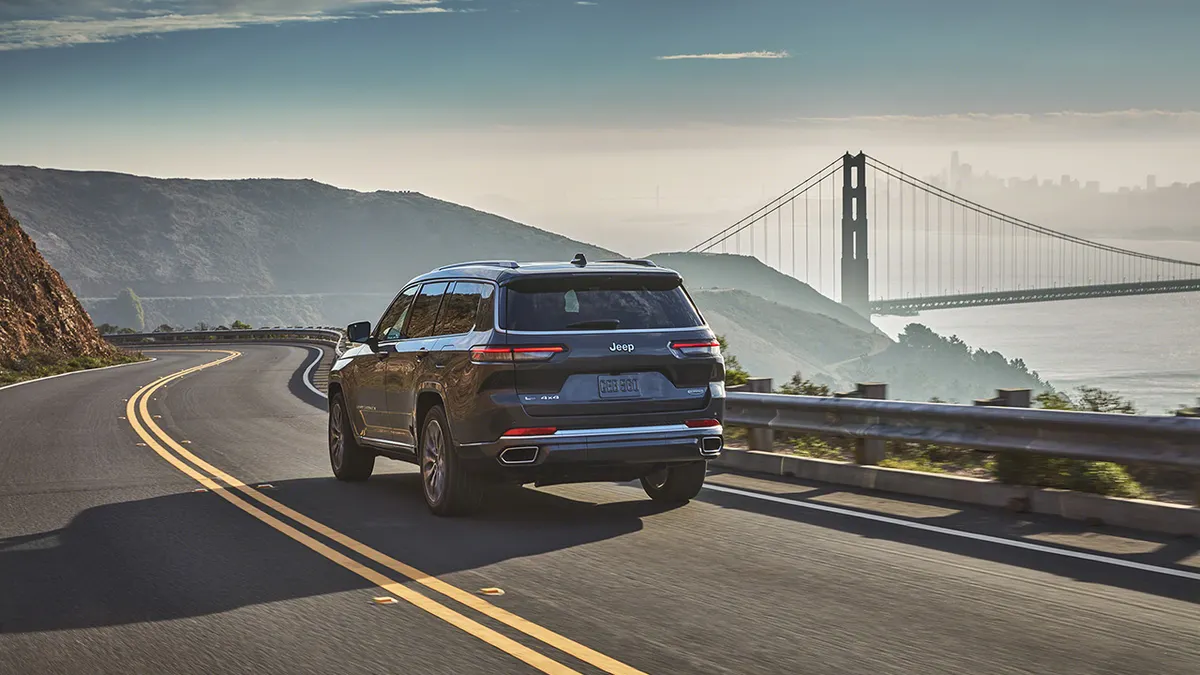
Ripping through the curves along the Pacific coast north of the Golden Gate Bridge, the Optiq shows off its handling chops along with the propulsion system’s ability to accelerate in a flash and decelerate just as quickly thanks to strong motors and powerful regenerative braking settings built into the system.
Rear side glass strakes echoed in taillights.
We spend much of the drive in Sport mode (other modes are Tour, Snow/Ice and personalized My Mode), while relying on a middling level of motor-regen braking that adds 0.2g braking on throttle lift and applying up to 0.4g extra motor braking via a steering-wheel-mounted regen-on-demand paddle. Sport mode amps up steering, braking and throttle response, dials back yaw control and adds a touch of artificial sound to help “hear” the propulsion system’s reactions. This gives the Optiq an aggressive and sporty response that makes the vehicle a hoot to drive hard but for passengers can induce a touch of motion sickness (though the fake sound is intended to help minimize that).
Chief Engineer John Cockburn tells us the Optiq operates with a front-motor, front-wheel-drive bias in normal driving, similar to the setup in the Chevrolet Equinox EV with which it shares propulsion architecture. But the Optiq quickly shifts to a rear bias in response to more-active driving as it senses quicker steering inputs and yaw, keeping the rear motor “awake” and ready to react with zero lash when called upon for power.
While power shifts front to rear in response to more complex systems, torque vectoring is a bit simpler, explains Tom Schinderle, lead development engineer whose previous work includes the likes of performance-tuned Cadillac Blackwing models.
“The rear is an open differential. We use a form of brake-torque vectoring, but we only transfer torque side to side when there is wheel slip,” Schinderle says. “We use software controls to monitor and will activate brakes on the wheel that is slipping to transfer torque to the non-slipping wheel.”
On the rain-dampened routes we’re driving, the Optiq exhibits exactly the behavior engineered into it, powering through corners without a trace of understeer that one might detect if front drive were dominant.
Meanwhile, the Optiq’s unique interior is deliberate in its design elements, including tweed-like trim made from recycled materials in the dashboard and door panels surrounding color-coordinated inserts of a pleather material dubbed “Interluxe.” Other recycled materials include actual re-used newspaper underlaying the center console, with even some letters visible if one looks closely enough.
Newsprint underlays center console trim.
Relatively understated, simple controls for the HVAC system sit below the 33-in. (1,006-cm) combined instrument cluster and center display screens that handle nearly all other functions.
A highlight is the standard AKG audio system featuring Dolby Atmos immersive sound – the car’s 18-speakers faithfully replicate the audio experience of a much larger space as we noted playing a song through the system that we’d heard two days before in the fullsize theater at the Dolby Laboratories headquarters here. Optiq gets Dolby Atmos first, but the system will be offered across all other models in 2026.
Understated interior features tweed-like weave on dash.
Going Large With Escalade IQ
As mentioned earlier, the Escalade IQ brings battery-electric propulsion to the big SUV segment for GM, featuring a segment-leading 460 miles (740 km) of range from its 200-kWh battery and the ability to recoup about 100 miles (161 km) of range in 10 minutes on a 350-kW fast charger. Propulsion isn’t as over the top as the Hummer EV that preceded it, but is still formidable at 750 hp, 785 lb.-ft. (1,064 Nm) of torque from its two-motor (front/rear) system in Velocity Max mode (680 hp and 615 lb.-ft [834 Nm] in Normal mode).
We’ve written quite a bit about the features in the IQ and IQL, so we won’t revisit all of that here. Suffice to say the Escalade IQ lives up to the pre-drive hype with elements such as the 55-in. (140-cm) nearly pillar-to-pillar curved infotainment and instrument cluster display screen. It’s huge and presents all information in a reconfigurable manner and with LED clarity – 8K for the driver functions, 4K for the rest.
Escalade’s wide 55-in. screen impresses.
Perhaps one of the best features shared with the Hummer EV is four-wheel steering, albeit to a lesser 7.2-degree maximum of rear-wheel-steering angle (vs. 10 degrees for the Hummer), but still able to give the vehicle a tight 39.8-foot (12.1-m) turning circle, just 1.5 feet (0.5 m) wider than a Chevy Bolt EV. It’s enough to make the more than 9,000-lb. (4,082-kg) behemoth feel positively agile in low-speed maneuvers.
What we find less than satisfying, at least on the choppy freeway surfaces heading out of the city here, is the relatively harsh response from the Magnetic Ride Control and Adaptive Air Ride suspension. Elsewhere on the drive, the ride is smooth as silk.
Al Oppenheiser, chief engineer, says the electric Escalade functions primarily with a rear-drive bias for efficiency, but dials in enough front-drive motor propulsion to balance the chassis for aerodynamics, specifically to limit the amount of front body lift typical from rear-driven power. The front motor also kicks in as needed to provide all-wheel drive in slick conditions.
Regardless of efficiency and aero efforts, no big, heavy SUV is going to be an efficiency leader. We note 2.1 mi./kWh during our drive, in keeping with numbers we’ve seen testing the Hummer EV, but Oppenheiser says engineers have observed up to 2.9 mi./kWh.
Cadillac For Every Buyer
From the modestly priced Optiq to the opulent Celestiq, with the Lyriq, coming Vistiq and Escalade IQ and IQL in between, Cadillac is positioned to have the best-selling luxury BEV brand by the end of this year, says Patrick Nally, Cadillac marketing director. Whether the brand can execute, and whether buyers come to Cadillac’s BEVs remains to be seen. But with players with huge followings such as the Escalade and less-expensive options with superior capabilities like the Optiq, GM’s wreath-and-crest brand is well-positioned to reinvent itself for a strong showing in the electrified future of luxury transportation.
Rear roofline of IQ slopes downward, aiding aero.