The automotive industry is witnessing a fundamental shift in its approach to software-defined vehicles (SDVs), with artificial intelligence and advanced software capabilities now recognized as core enabling technologies rather than supplementary features.
According to Omdia’s 2025 Software-Defined Vehicle survey, sponsored by Sonatus, AI-based vehicle applications outside of ADAS/AV emerged as the top enabling technology for SDVs, with approximately 35% of respondents identifying it as critical. This represents a significant evolution from previous years when data management and systems integration dominated priorities.
The AI Implementation Timeline
The survey reveals a strategic progression for AI deployment in vehicles that follows a clear three-phase approach:
Phase 1 (2026-2027): Implementation begins with AI-based vehicle applications for Advanced Driver Assistance Systems (ADAS) and Autonomous Vehicles (AV). This initial focus on safety and driving assistance aligns with regulatory priorities and consumer expectations for improved vehicle intelligence.
Phase 2 (2028-2029): The second wave focuses on AI-based vehicle applications, excluding ADAS/AV, expanding into areas like personalized comfort settings, predictive maintenance and enhanced user interfaces. This phase represents the broader integration of AI into everyday vehicle functions.
Phase 3 (2030+): The final phase involves AI-based organizational processes, where artificial intelligence transforms how automotive companies operate internally – from supply chain optimization to design processes and manufacturing.
Regional Variations in AI Adoption
The survey highlights significant regional differences in AI implementation approaches:
- China demonstrates the most aggressive AI adoption timeline, with many respondents reporting customer-centric development methodologies already implemented. Chinese manufacturers appear particularly focused on voice assistant services and in-cabin AI applications.
- North America shows strong interest in AI applications but demonstrates a more cautious implementation timeline, particularly regarding zonal architecture adoption.
- European manufacturers, especially in Germany and France, are prioritizing AI for vehicle personalization and ride customization over other applications, reflecting regional preferences for active driving experiences.
The Organizational Challenge
Despite the technological focus, the survey reveals a concerning disconnect: Organizational structure ranks surprisingly low among perceived SDV enablers (approximately 18%), even though it represents a critical implementation barrier. As automakers progress through a digital transformation, legacy processes and organizational frameworks have emerged as major obstacles to innovation.
Collaborative organizational structures featuring cross-functional teams and distributed decision-making are expected to be widely implemented only by 2028-2029, significantly later than many technological components. This suggests that while companies recognize the importance of technology, they may be underestimating the organizational changes required to leverage these innovations fully.
Software Capabilities Supporting AI Integration
The survey indicates that software capabilities are evolving to support AI integration:
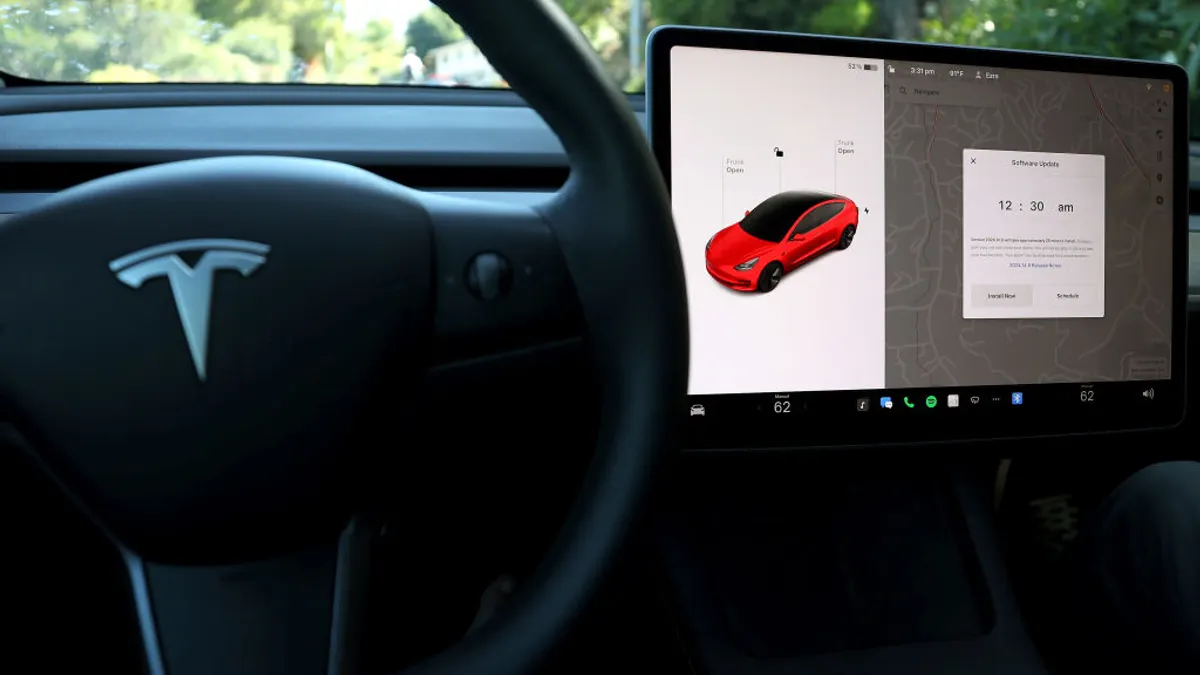
- OTA software updates are already widely implemented, providing the foundation for continuous improvement.
- Software upgrades and introduction of new features via OTA are expected to be fully implemented by 2027.
- Continuous integration/continuous deployment (CI/CD) practices will follow closely behind.
- Virtual development environments and cloud parity are projected for widespread adoption by 2029.
- Automation of software re-certification will be the final piece, with implementation extending beyond 2030.
Industry experts suggest that achieving true transformation requires more than technological adoption; it demands dismantling entrenched organizational structures and rebuilding frameworks specifically designed for tomorrow's automotive landscape.
Hardware Evolution Supporting AI Implementation
The hardware roadmap revealed in the survey shows a clear progression that will enable increasingly sophisticated AI applications:
- High-speed in-vehicle network backbones by 2027, establishing the essential infrastructure for complex, interconnected systems.
- Vehicle platform standardization by 2028-2029, creating consistent architectural frameworks.
- Hardware consolidation with systems running multiple workloads through abstraction layers by 2029.
- Transition to zonal architecture from 2030 onwards, optimizing the Electrical/Electronic architecture for SDV systems.
This hardware evolution timeline aligns with the AI implementation phases, ensuring that the physical infrastructure will be ready to support the computational demands of advanced AI applications. As the automotive industry continues its transformation toward software-defined vehicles, AI stands at the forefront of this evolution. The survey results suggest that manufacturers who successfully integrate AI across vehicle systems while simultaneously transforming their organizational structures will be best positioned to lead in the next generation of mobility solutions.