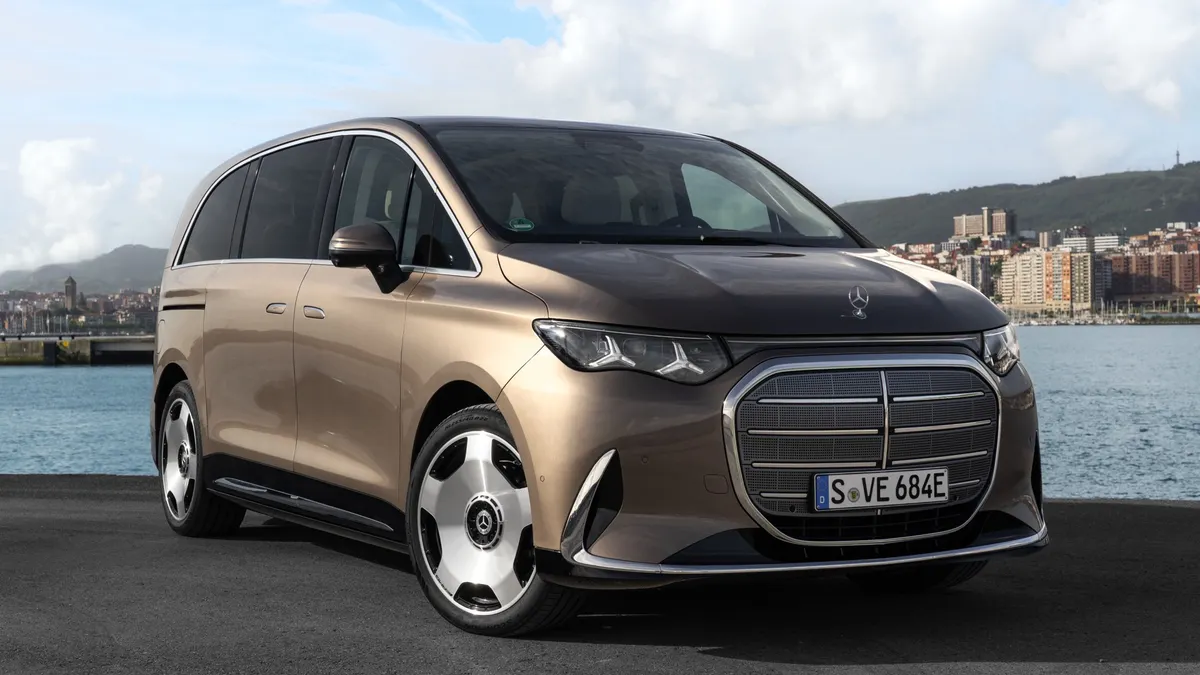
For decades, passenger vans have occupied an unusual position in the U.S. market.
Some of them start with a car and build upward — the “minivan,” to generations — while others start with a commercial van and work in the comfort and luxury, without sacrificing too much of the inherent practicality and flexibility.
While the latter is true of the upcoming 2028 Mercedes-Benz VLE, the automaker believes it can help change some of the misconceptions.
Due in North America during the second half of 2027, the VLE is the first passenger-focused model based on Mercedes-Benz's new VAN.EA architecture. The platform will underpin an entire generation of vans, ranging from the next-generation Vito commercial vehicles to the forthcoming Mercedes-Maybach VLS, offering a choice of electric, gasoline and diesel power.
More importantly, it provides Mercedes-Benz with an opportunity to move beyond the compromises that defined its predecessor, the EQV, a model not officially sold in the U.S.
The outgoing EQV introduced battery-electric propulsion to the company's van range but remained closely tied to the V-Class on which it was based. The VLE takes a different approach. While retaining the practicality expected of a large multi-purpose vehicle, it has been engineered with a much stronger emphasis on comfort, refinement and passenger-car driving characteristics.
The effect is immediately apparent from behind the wheel. Mercedes-Benz has lowered the seating position and reduced steering wheel angle to match that of its GLE and GLS SUVs. The result is a noticeably more natural driving environment than before. Rather than sitting upright, the driver occupies a position much closer to that of a conventional passenger vehicle.
Yet the improvements go well beyond the seating position.
At up to 216 inches long, the VLE a very long vehicle even by American standards; but it is unexpectedly easy to place on the road. Rear-wheel steering, capable of turning the rear wheels by up to seven degrees, provides excellent maneuverability. Mercedes-Benz claims a turning circle of 35.8 feet — comparable to that of the compact CLA sedan, and the benefit is immediately apparent in urban driving conditions.
Visibility remains strong, aided by a large glass area and extensive camera and sensor coverage, although more substantial A-pillars than the EQV, required for U.S. crash standards, occasionally restrict sightlines.
More impressive still is the level of refinement. A drag coefficient of 0.25, extensive sound insulation, a stiffer body structure than the EQV and a decoupled electric drivetrain combine to deliver levels of quietness that feel closer to Mercedes-Benz's passenger-car lineup than any previous van-derived model. Wind noise is subdued, road noise remains distant and the overall sense of isolation is impressive.
Vehicles equipped with the optional Airmatic suspension build on these strengths. Ride quality is supple in Comfort, one of four driving modes, and body motions are tightly controlled with little trace of the float often associated with large people-movers.
Drivetrain choices begin with the front-wheel-drive VLE 300, where a front-mounted synchronous electric motor develops 272 hp, drawing energy from a 115-kWh battery. Mercedes-Benz estimates more than 414 miles of WLTP range — more generous than U.S. EPA ratings — while acceleration from 0-62 mph takes 9.5 seconds. Above it, VLE 400 4Matic adopts a dual-motor four-wheel-drive layout producing 416 hp. It cuts the 0-62 mph time to 6.5 seconds, with a projected WLTP range at 391 miles.
Both VLE models use an 800-volt electrical architecture and support DC fast charging at up to 300 kW. Under ideal conditions, Mercedes-Benz says enough electric energy for 221 miles of driving can be added in approximately 15 minutes.
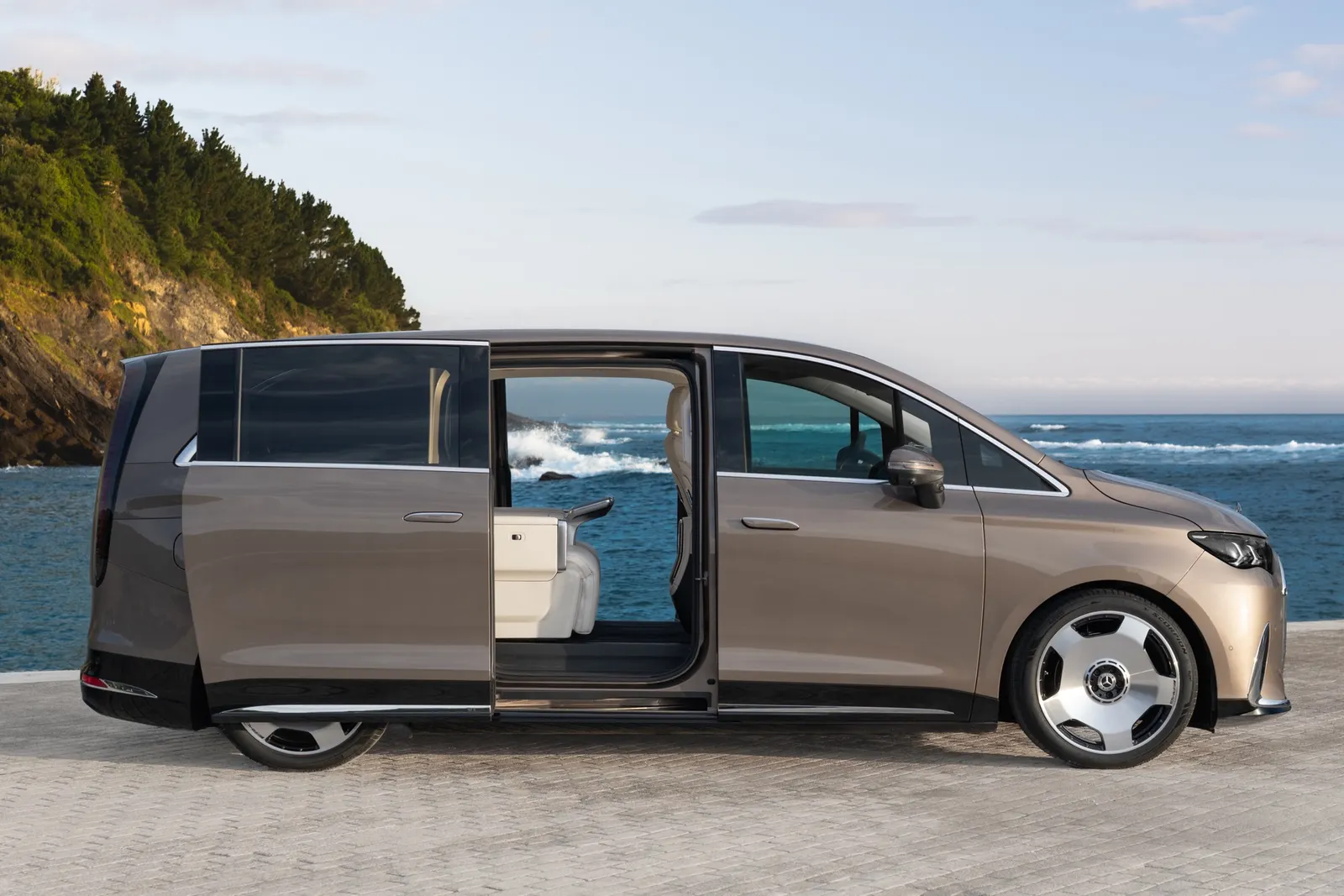
Inside, Mercedes-Benz has moved the VLE further upmarket from the EQV.
Configurations ranging from five to eight seats will be offered, while a new "Roll and Go" seating system allows chairs to slide, fold or be removed entirely. Electrically adjustable seats can also be repositioned remotely through the infotainment system or smartphone app.
Material quality is substantially improved over the EQV. The optional MBUX Superscreen spans the dashboard, while a long list of optional equipment includes a glass panoramic roof, ambient lighting and a retractable 31.3-inch rear entertainment display.
Not every element is perfect. Brake pedal feel lacks the precision expected from a Mercedes-Benz, although the regenerative braking system itself works well and offers multiple levels of adjustment, including one-pedal driving capability.
After a day behind the wheel, the lingering impression is the ease with which the VLE goes about its business. It feels smaller than its dimensions suggest, remains composed over long distances, and combines impressive practicality with a level of refinement that would have been difficult to imagine in a Mercedes-Benz passenger van only a few years ago.
Pricing remained unconfirmed for the U.S. in June when we drove the VLE, which is built in Spain. By the time it reaches North America, the new trade framework between the European Union and the United States should help provide a predictable price tag.
That aside, the VLE remains Mercedes-Benz's most convincing attempt yet to transform a traditional commercial vehicle into a luxury passenger car.