NAPA COUNTY, CA – In a segment where each new 3-row CUV seems more refined and tech-forward than the last, the 2026 Hyundai Palisade manages to stand apart. So refined, in fact, that even buyers who don’t typically shop large crossovers may want to give it a closer look. It delivers premium comfort and technology at a mainstream price – an increasingly rare combination.
Dealers are already receiving orders for the redesigned Palisade, which arrives in September at Hyundai’s U.S. stores. The update brings seven trims – SE, SEL, XRT, Limited and Calligraphy, along with new Calligraphy Night and Black Ink editions – each building on the nameplate’s loyal following since its 2020 debut.
U.S. sales of the Palisade rose 6.8% in the first half of 2025 compared to the same period in 2024, Omdia Automotive data shows. While that trails the 14.5% year-over-year gain of its corporate sibling, the Kia Telluride, it’s still a healthy uptick that’s expected to grow with the arrival of this refined second-generation model.
WardsAuto spent one day driving the top-end Calligraphy grade through the rolling hills and tight switchbacks of Napa and Sonoma counties, and its mission quickly became clear: This is a luxury-first SUV but with plenty of practical features buyers will want built in.
Smooth in the Curves, Whisper-Quiet in the Cabin
Whether coasting along Route 29 or winding through vineyard-lined two-lanes in Sonoma, the Palisade proved impressively composed. Steering is precise, body control is tight for its size and the vehicle hugs curves with confidence that belies its 3-row proportions. Even at higher speeds, the cabin remains exceptionally quiet – thanks to acoustic glass in the top trims and refined insulation throughout. On broken pavement or gravel, the ride remains mostly plush.
Braking felt consistent and well-modulated on descents, and the CUV remained settled even through quick transitions. The suspension absorbed rough patches with grace – though there were some significant bumps on unpaved roads –while the cabin’s tranquil design adds to the stress-free drive. Whether cruising at highway speeds or navigating stop-and-go traffic through town, the Palisade consistently felt more premium than its price tag suggests.
Bigger Outside, Roomier Inside
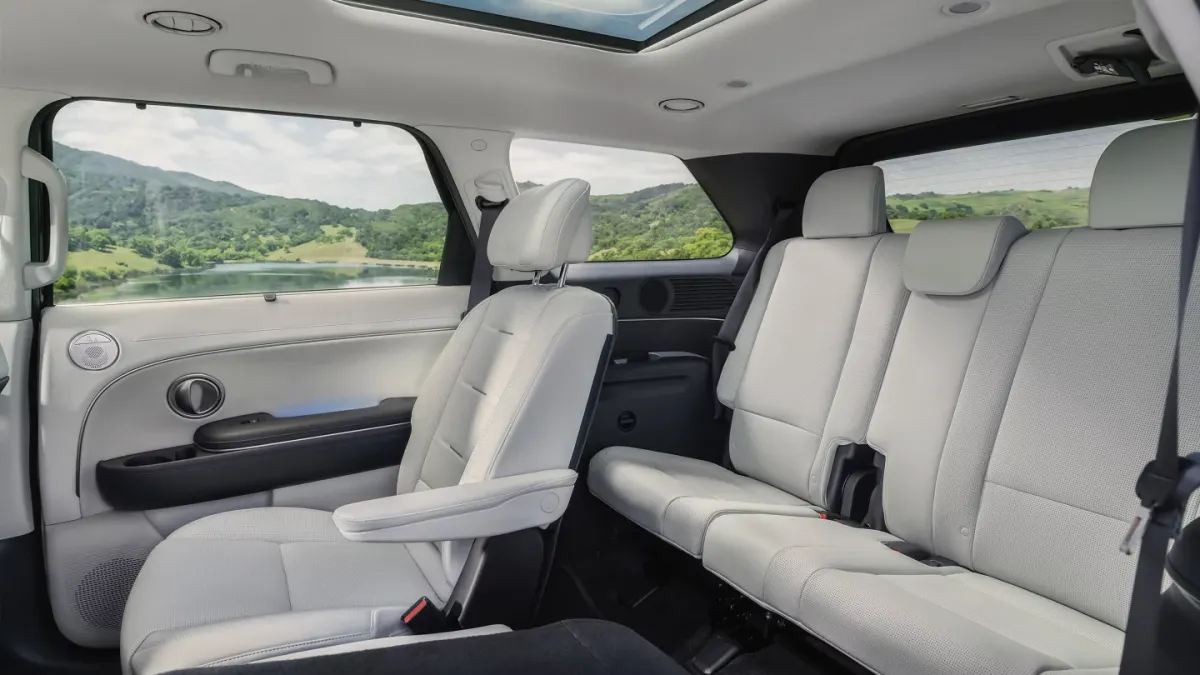
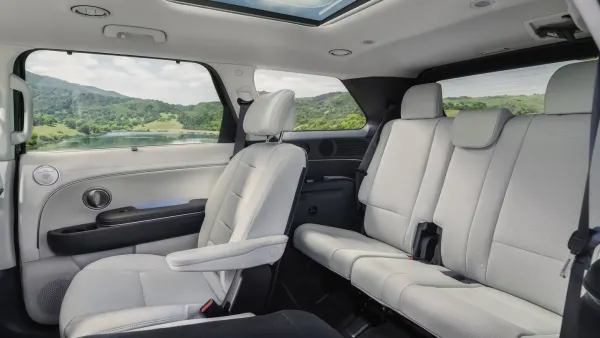
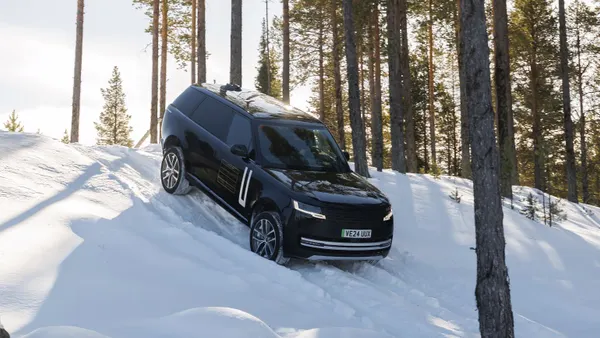
The 2026 redesign gives the Palisade a more sweeping, Range Rover-esque silhouette. It’s 2.5 ins. (64 mm) longer overall than the outgoing generation, with a 2.7-in. (69-mm) stretch in wheelbase and slight gains in width and height. The result? More room in all three rows. But beware: Adults will still find the third row tight on longer rides, although access and comfort are improved with power reclining and easier entry.
Inside, the transformation is even more dramatic. A new curved panoramic display – shared with the Ioniq 6 electric sedan and 2025 Santa Fe midsize CUV – integrates dual 12.3-in. (31-cm) screens under a single sheet of glass. Touch-capacitive controls now accompany physical toggles for audio and climate, balancing aesthetics with usability.
Design cues draw from midcentury modern styling and are reminiscent of cues in the Hyundai Ioniq 9 electric 3-row CUV, winner of a 2025 Wards 10 Best Interiors & UX award. The MCM influence is seen particularly in the Calligraphy trims, where upscale materials like Nappa leather, ambient lighting and satin-finished trim elevate the space. Acoustic glass extends to the second row for an even quieter ride.
A redesigned center console adds more usable storage, and the wireless phone charger accommodates larger phones than these features in the 2025 Palisade. A great Hyundai feature continues as plentiful USB-C ports are easily accessible in all three rows. Hyundai’s latest tech – including Digital Key 2, remote smart parking assist and over-the-air software updates – comes standard on most trims.
New V-6 Engine, Same Mission
Replacing the outgoing 3.8L V-6 is a new 3.5L V-6, generating 287 hp and paired with an 8-speed automatic transmission. Power goes to the front or all four wheels, depending on configuration.
While output remains similar, the driving character has changed. Acceleration is slightly less urgent – Hyundai estimates 0–60 mph (0-97 km/h) in 6.6 seconds, compared to 6.4 seconds previously – but the powertrain now feels smoother and quieter, in line with the Palisade’s comfort-first mission. Braking and steering have also been softened to reduce fatigue on longer trips.
Of course, all of that power and luxury comes at a bit of a cost. Hyundai’s estimated 21 mpg (11.2 L/100 km) combined rating was just a tad over the fuel economy we experienced – ours clocked in at 19 mpg (12.4 L/100 km) combined.
Fuel-conscious buyers should note a 329-hp hybrid variant is slated for production in late 2025, roughly a few months after a 3.5L variant launches. When it arrives, it will bolster the Palisade’s standing among electrified competitors like the Toyota Grand Highlander and Honda Pilot Hybrid.
Pricing and Trims
Pricing starts at $41,200 for the base SE front-wheel-drive model and climbs to just under $55,000 for a fully equipped Calligraphy grade with all-wheel drive. AWD adds $2,000 to FWD prices, where not standard, and destination charges are $1,395.
Like the first-generation model, the second-generation Palisade is assembled at Hyundai’s Ulsan, South Korea, plant.