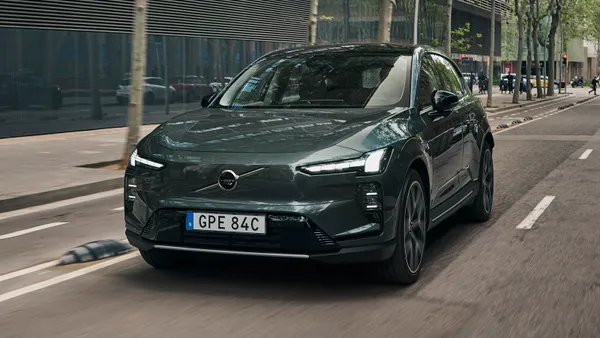

Imagine this scenario: an automobile prototype finishes its laps at the test track and a fault has been captured in the logs. The data says that something failed, but doesn't explain the circumstances. Because the team has no context around the failure, all they can do is book another drive and hope that the fault will repeat for some root-cause analysis.
That cycle of driving, analyzing and driving again is what makes validation slow. Slow validation is a problem for auto companies because they're racing to meet production dates. But speed has its limit. Every problem that validation misses gets more expensive once it's in the field. According to McKinsey, industry warranty costs nearly doubled to $58 billion between 2012 and 2024.
So the race is on to compress the validation loop. That’s hard, however, because prototype vehicles are scarce and expensive. One industry estimate puts each one at $250,000 to $1 million. And let's not forget the talent bottleneck. Engineers with intimate knowledge of different subsystems are hard to find and they can't swap hats easily: The expert in a particular subsystem might be busy working on a different issue.
The new hope is AI. It can make validation faster and smarter on the test vehicles teams already have by pinpointing the moment in the data that matters. Sonatus describes the approach in five steps: detect, collect, reason, act and learn. The first two capture only the data that matters. The last three analyze it, decide what to capture next and carry what’s learned from that analysis into the next investigation. The result is shorter investigations, fewer re-drives and more productivity from every test vehicle.
Shrink the haystack: detect and collect
AI thrives on data and software-defined vehicle subsystems produce plenty of it: a vehicle can generate terabytes a day. The problem is getting that data off the vehicle and then finding the parts of it you need.
Sonatus's answer isn't just to sort through the data haystack faster, but to shrink the haystack in the first place. Fastlane™ Collector, which runs on the vehicle, replaces broad, static logging with targeted, event-driven collection. Unlike a conventional data logger, which records everything and sorts it out later, it preserves only the data a team needs.
Testing teams write data collection policies that describe the data they need. Each one also defines the trigger conditions, meaning the events the engineers want data around and how much to look back before the fault to to capture data before the trigger. That's important because, while a fault may be easy to detect after an event, the cause often sits just before it.
Test vehicles generate thousands of signals, which is far too many for an engineer to choose from when writing data collection policies manually. With Fastlane Collector, an engineer can describe what’s needed in natural language, for example, capturing 15 seconds of steering and braking data during heavy braking. The AI picks the relevant signals and drafts the policy, which gets the engineer 90% of the way toward a finished policy, leaving the engineer to review and refine it.
Because only data from the relevant trigger window is stored, there’s less to store and upload. The narrow window also lets engineers sample at higher frequencies, which would produce an unmanageable mountain of data in a blanket logging system.
Digest the data: Reason, act and learn
Collection is only part of the process. Fastlane™ Insight, a cloud service, provides the context that traditional validation loops have often missed. It keeps proprietary data in the OEM’s own environment and correlates telemetry with diagnostics, software logs, engineering documentation and prior investigations to help engineers track down the likely root cause of an issue and decide what to do next. Because Fastlane Insight can comb through thousands of pages of manuals and specifications, it can reach conclusions that human engineers might not have spotted.
For an engineer, the starting point can be as simple as asking Fastlane Insight to find the active problems in a vehicle. It works through the data, names the subsystem of most concern and explains why. Then, Fastlane Insight recommends specific correction actions based on cited sources. In one demonstration, the answer wasn’t a failed part; the sensor was reporting correctly without demonstrating any electrical faults; it simply needed to be cleaned.
Each pass through this analytics loop makes the next one faster. The insights from one round of analysis feeds into the knowledge base that informs testing in subsequent programs. A fault that pops up in one program might emerge in a similar component a year or two later. Similarly, when a part changes between model years, the knowledge base can help show whether the new part is the culprit or a red herring for a broader systemic issue. As the knowledge base builds more data, it can make more correlations and provide engineers with more focused options.
Putting AI in test vehicles now
Those gains don’t have to wait for the next program. They can land during the current testing program. Validation technology is often designed into a vehicle from the start, but the Sonatus system doesn't need to be. Fastlane™ Copilot is a box that plugs into a completed prototype vehicle. It is preloaded with Fastlane Collector, which captures the vehicle data and Fastlane™ Edge, which processes the data with AI models directly on the vehicle. Together with Fastlane Insight in the cloud, the solution spots anomalies and diagnoses problems. OEMs can be up and running with Fastlane Copilot within days, Sonatus says.
Conclusion
What teams learn in validation should not stay in a report. It should become detection logic deployed in production vehicles. That’s the thinking behind the five-step loop described above: detect, collect, reason, act and learn. It doesn’t have to wait for production. It can start now, on the test vehicles already on the track.
Learn how Sonatus brings AI to test and validation.
About Sonatus
Sonatus® delivers cloud-to-edge AI for smart vehicles. Its Fastlane™ Platform enables OEMs and suppliers to achieve faster time-to-production, lower lifecycle costs and continuously improve their vehicles — from engineering and development through production and service. Founded in 2018, Sonatus is backed by investors in the automotive, semiconductor and venture capital sectors and its technology is deployed in more than 9 million vehicles globally. Sonatus is headquartered in the heart of Silicon Valley (Sunnyvale, Calif.), with regional headquarters in Dublin and offices in Bangalore, Detroit, Frankfurt, Kraków, Paris, Pune, Seoul, Shanghai, Taipei and Tokyo. For more information, visit www.sonatus.com.
Sonatus, Fastlane and the Sonatus logo are trademarks of Sonatus, Inc. that are registered or pending in the United States and in other countries. © 2026 Sonatus, Inc.