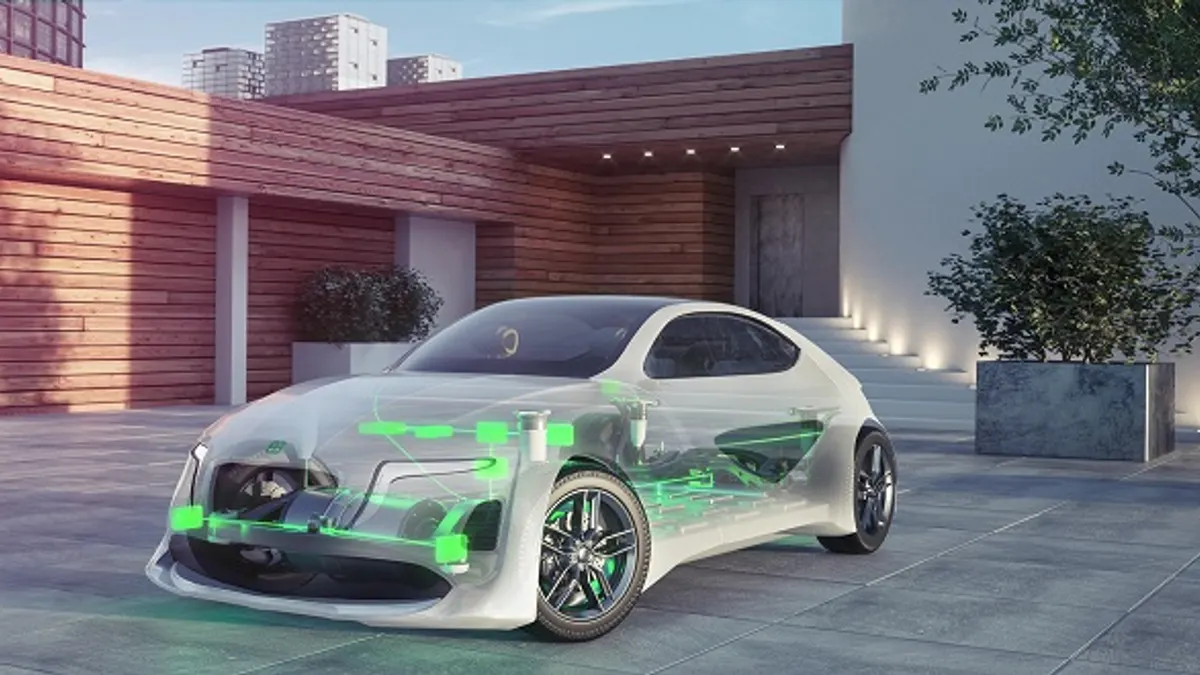
There’s a growing cohort of fast-charging BEVs from Lucid, Hyundai, Kia, Genesis, Audi, Porsche and Tesla built around a battery pack and architecture at 800V or higher.
From a physics standpoint, it’s a win-win. Up the voltage and you can get more electrons to the battery pack during charging, in less time, with less heat and weight along the way, which can translate to higher efficiency.
At the same time, most automakers are planning or already have Tesla Supercharger access for their BEVs, mostly using a combination of adapters and phasing in the Tesla-based NACS port.
But with most of the Supercharger network consisting of older hardware running below 500V (according to Chargeway, only 134 Supercharger stations [2,020 ports] are next-generation V4s, while 2,005 stations [25,053 ports] are V3) it can sometimes result in disappointingly slow charging for owners of 800V-plus BEVs.
For these BEVs, the tech mismatch demands charging solutions for boosting the lower voltage to what those models need – without bulking up too much.
Going purely by numbers and charge rates, luxury BEV maker Lucid has the most effective solution so far in its new Gravity electric CUV.
Faster Than Tesla on Its Own Hardware
The Lucid Gravity runs at 926V and is one of the auto industry’s fastest-charging BEVs. According to Lucid Senior Vice President-Powertrain Emad Dlala, it can add 200 real-world (70-mph [113 km/h]) highway miles (322 km) in as little as 10.5 minutes. That’s on 1000V hardware capable of delivering charging speed up to 400 kW; charging time on DC fast chargers with maximum speed up to 350 kW is nearly as quick.
On Tesla V3 Supercharger connectors, delivering up to 250 kW, the Gravity will charge at 200 to 225 kw for 10 minutes or more – which, says Dlala, amounts to 200 real-world miles in as little as 16.5 minutes.
That’s quicker than any Tesla CUV can charge on those Superchargers. In 15 minutes, the Model X and Model Y can add up to 175 miles and 162 miles (282 and 261 km), respectively, according to Tesla.
Amid the industrywide shift to the Tesla-based NACS port and eyeing Superchargers as a good road-trip backup, Lucid moved the Gravity’s NACS port at the rear left, where it is on Teslas – and packaged its boost converter solution with the rear drive unit.
“I think the biggest lift was developing a world-class charging system into our existing, modified, next-generation drive unit,” says Eric Bach, Lucid’s chief engineer and senior VP for product, underscoring that the charger cross-compatibility was no simple task.
“Inside a lot has changed, but the housing technically is about the same size,” he notes.
Beneath It, a Novel Solution for Stepping Up the Volts
There are various ways to solve the tech mismatch between modern BEVs and older-generation DC fast chargers, some with caveats. Transformers on the vehicle can up the voltage but add weight. Using a charge converter or connecting halves of the pack in parallel are other options.
But Lucid turned to a boost converter – a switched-mode power supply using an inductor, switch and capacitor. The rear motor’s stator is used as the inductor, while the propulsion unit’s silicon carbide MOSFETs (specialized transistors) and capacitors do the switching. What especially distinguishes the method is that with the three-phase inverter it manages three boost converters for each of the phases in an interleaved fashion, the company confirms to WardsAuto.
When a charger can deliver the 1000V needed for the quickest charging, it bypasses this hardware, connecting directly to the battery pack.
There are no extra cooling needs for Lucid’s tech solution. And at about 174 lbs. (79 kg), it’s just 11 lbs. (5 kg) more than the drive unit without the changes. Dlala notes the automaker set a ceiling at 225 kW not because of heat but to avoid damaging the motor magnets.
Lucid’s is a lighter and much more effective solution than what’s used in the Porsche Taycan, or in the Lucid Air sedan, which instead has a charge booster limited to 50 kW.
“If you went with a Porsche 150-kW charger, it’s a whole box…it’s definitely more than 5 kg,” emphasizes Bach.
Porsche Does It Differently
To step up 400V, the Taycan instead uses a device called a charge pump, in which transistors allow the charging of capacitors, releasing pulses of current that are then doubled in voltage. That’s done along two rails, with the oscillating current streams reconciled near a steady 800V.
In its update applying to the 2025 Taycan, Porsche has saved 11 lbs. by shifting to a more modular approach. But by design, this particular charge pump is limited to 150 kW.
Porsche tells WardsAuto that keeping charging separate from the rest of the drive system was intentional in the Taycan, as it helps manage heat to maximize performance driving. The charge pump sits atop the front inverter but doesn’t use the same cooling loop as the motor or battery pack.
Hyundai Boosts the Boost for 2025
The approach taken by Hyundai’s 800V BEVs on its E-GMP platform is probably closest to Lucid’s strategy. In those models, the motor and inverter are also used as part of a boost converter.
Up until now, all versions of Hyundai's BEVs have been limited to about 85 kW from this solution. But in the 2025 Ioniq 5, which has a native Tesla NACS port, Hyundai raised that to 135 kW with a revised power module harnessing a silicon carbide inverter and new capacitors.
Others Split the Pack
In the Porsche Macan Electric and Audi Q6 e-tron, which share parent Volkswagen’s 800V PPE platform, a switch connects the two halves in series, allowing fast charging at up to 270 kW. But for 400V charging, the switch connects those two halves in parallel instead, allowing exactly half the input power (135 kW).
It’s essentially the opposite for double-layer packs in General Motors’ GMC Hummer, Chevy Silverado/GMC Sierra pickups and Cadillac Escalade IQ BEV models. Usually in parallel at 400V, they switch to a series configuration to utilize 800V charging.
With either of these pack-splitting approaches, there’s additional weight and complexity, if not efficiency losses, to have it all work reliably. That’s certainly part of the reason Lucid has gone with a solution outside of the battery pack – while broadening the experience of its owners.
For what amounts to a backup plan, it’s a smart one.